
Suji @ Kasi v. The State, 2026
The judgment reinforces the principle that consent must be free, voluntary, informed, and unequivocal, aligning criminal jurisprudence with constitutional values protecting dignity and personal autonomy.
Judgement Details
Court
Madras High Court
Date of Decision
14 July 2026
Judges
Justice Anand Venkatesh and Justice K.K. Ramakrishnan
Citation
Acts / Provisions
Facts of the Case
-
The appellant, Suji @ Kasi, was initially arrested in connection with another criminal case.
-
During the investigation, the police recovered his laptop, which contained obscene photographs and videos of several women, including the complainant in the present case.
-
Following the recovery of the electronic evidence, the investigation relating to the complainant's case was transferred to the CB-CID.
-
The complainant lodged a separate complaint alleging that the appellant had deceived her into believing that he intended to marry her and would also help her secure employment.
-
According to the prosecution, after gaining her trust, the appellant developed a relationship with the complainant and secretly recorded her intimate photographs and videos.
-
The appellant thereafter threatened to circulate the intimate images among her family members, friends, colleagues, and on social media if she refused to continue the relationship.
-
Out of fear of public humiliation and blackmail, the complainant was repeatedly compelled to submit to sexual intercourse with the appellant.
-
After trial, the Fast Track Mahila Court, Nagercoil, convicted the appellant under Sections 376(2)(n), 417, 354A, 354C, 294(b) IPC and Section 66E of the Information Technology Act, sentencing him to imprisonment for life till his natural death.
-
In appeal, the appellant contended that the relationship was consensual and that the complainant had voluntarily permitted the recording of the photographs and videos.
-
The State opposed the appeal, asserting that the complainant's consent had been obtained through deception, intimidation, and continuous threats of circulating her intimate images.
Issues
-
Whether the repeated sexual relationship between the appellant and the complainant constituted a consensual relationship in law?
-
Whether mere non-resistance or passive submission by the complainant amounted to free and voluntary consent?
-
Whether consent obtained through deception, intimidation, blackmail, and threats to circulate intimate photographs constitutes valid consent under criminal law?
-
Whether the conviction and sentence imposed by the Trial Court warranted interference in appeal?
Judgement
-
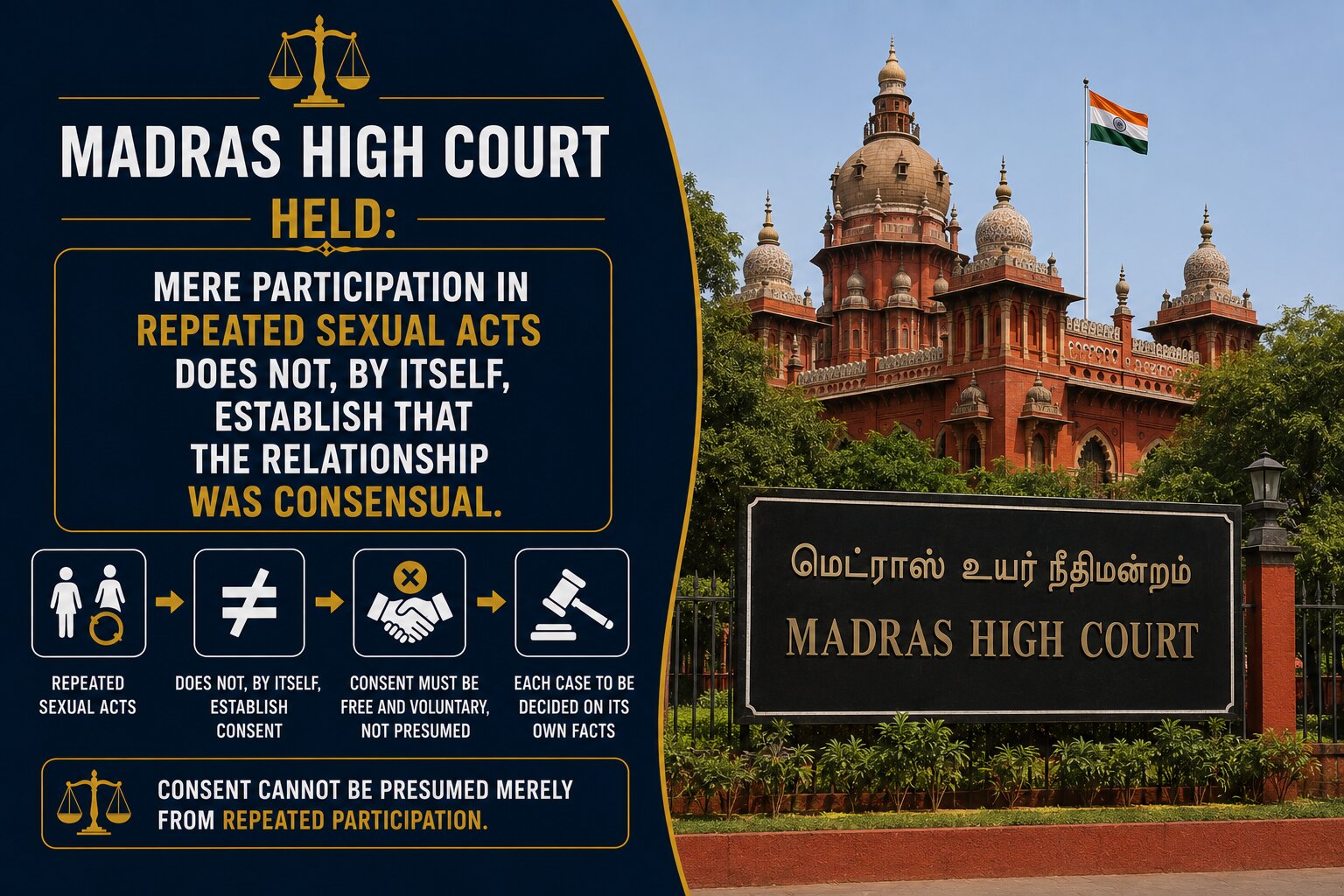
The High Court held that mere participation in repeated sexual acts does not, by itself, establish that the relationship was consensual.
-
The Court observed that where a victim continues in a relationship because of coercion, intimidation, threats, or inability to escape the accused's control, such conduct amounts only to passive submission and not voluntary consent.
-
The Court reiterated that mere non-resistance cannot be equated with legally valid consent.
-
The Court held that while determining consent, courts must examine the surrounding circumstances, including deception, coercion, intimidation, abuse of trust, and fraudulent inducement.
-
The Court found that the appellant had gained the complainant's confidence by falsely promising marriage and employment before exploiting her.
-
The Court further found that after obtaining intimate photographs and videos, the appellant continuously threatened to circulate them publicly, thereby compelling the complainant to submit to repeated sexual intercourse.
-
The Court held that the complainant's consent was neither free, voluntary, nor informed, but had been secured through deception and intimidation.
-
The Court emphasized that the constitutional guarantee of bodily autonomy and sexual autonomy requires every physical relationship to be founded upon free, voluntary, informed, and unequivocal consent.
-
The Court rejected the appellant's contention that the relationship was consensual and held that the evidence fully established the offences proved by the prosecution.
-
Finding no mitigating circumstances or legal infirmity in the Trial Court's judgment, the High Court dismissed the appeal and affirmed both the conviction and the sentence of imprisonment for life till the appellant's natural death.
Held
-
Mere non-resistance or repeated sexual intimacy does not establish consent.
-
Consent obtained through deception, blackmail, intimidation, or threats is not valid consent in law.
-
Passive submission under fear cannot be treated as voluntary consent.
-
The complainant's bodily autonomy and sexual autonomy had been violated.
-
The conviction under Sections 376(2)(n), 417, 354A, 354C, 294(b) IPC and Section 66E of the Information Technology Act was upheld.
-
The sentence of life imprisonment till the appellant's natural death was affirmed.
Analysis
- The Court clearly distinguished voluntary consent from mere submission, emphasizing that silence or lack of resistance under coercive circumstances cannot legitimise sexual acts.
-
The decision highlights that courts must evaluate the entire factual context, including deception, intimidation, abuse of trust, and psychological domination, rather than merely the existence of a prior relationship.
-
By recognizing blackmail through intimate images as a powerful form of coercion, the judgment addresses modern forms of technology-facilitated sexual exploitation.
-
The Court reaffirmed that fraudulent promises and threats which deprive a person of genuine freedom of choice vitiate consent and attract criminal liability.
-
The ruling strengthens protection of sexual autonomy, making it clear that every individual retains the right to make informed and voluntary decisions regarding physical intimacy.
-
The judgment also underscores that digital exploitation through creation and misuse of intimate images aggravates the gravity of sexual offences and cannot be dismissed as part of a consensual relationship.
-
Overall, the decision contributes significantly to evolving jurisprudence on affirmative consent, coercive control, and privacy in the digital age.