
Suhail v. State of U.P. & Anr. along with Connected Appeal, 2026
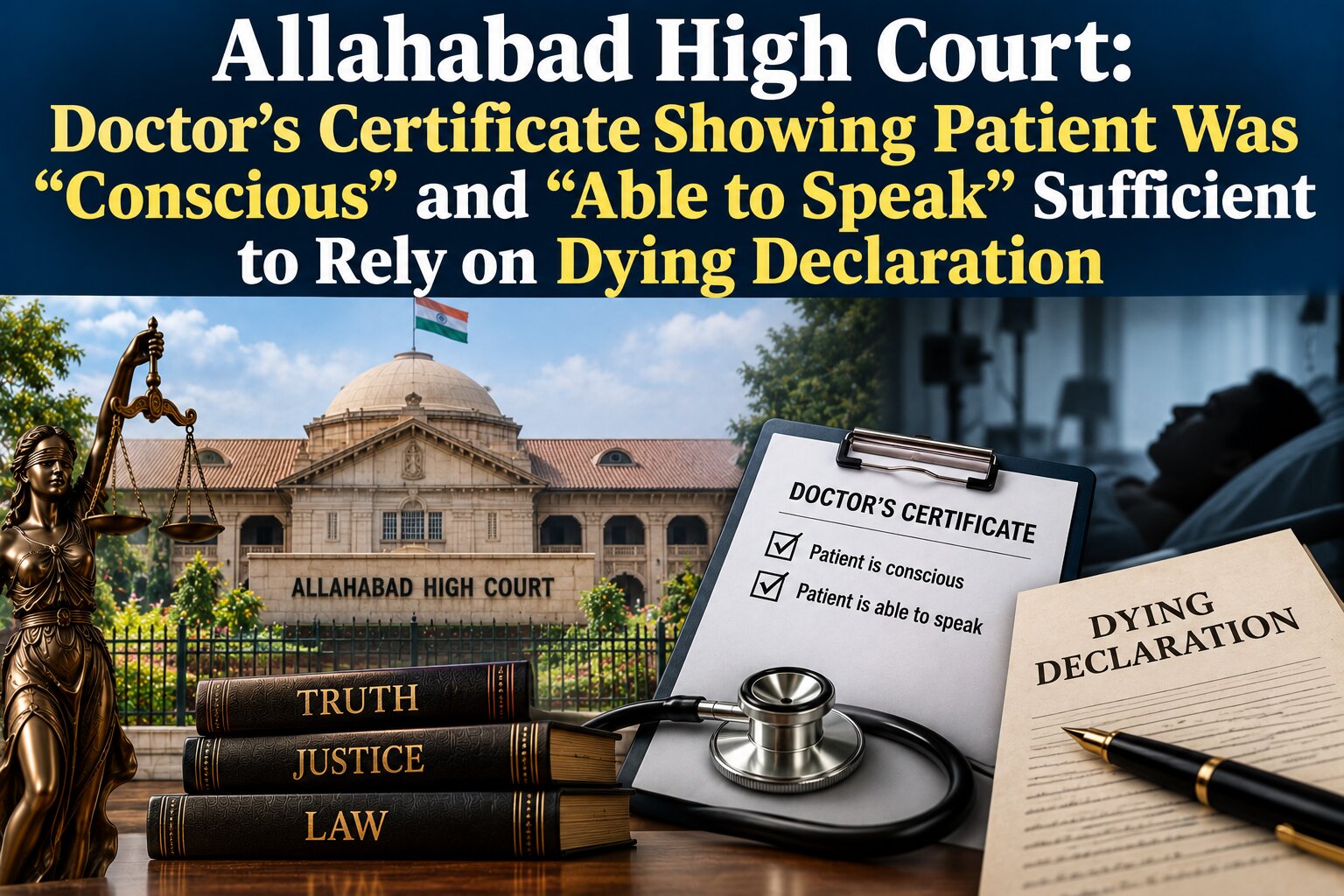
A separate doctor's endorsement specifically stating that a deceased was in a "fit state of mind" is not a rule of law governing every dying declaration.
Judgement Details
Court
Allahabad High Court
Date of Decision
12 August 2026
Judges
Justice J.J. Munir and Justice Vinai Kumar Dwivedi
Citation
Acts / Provisions
Facts of the Case
- Sanno sustained approximately 95% superficial to deep thermal burns on 16 November 2017 and subsequently died of septicemia on 30 November 2017.
-
Her mother lodged a written report alleging that Suhail, the husband, and his family members had set Sanno on fire over demands for a four-wheeler and taunts concerning her childlessness.
-
During trial, the principal prosecution witnesses, including the deceased's mother, turned hostile.
-
The prosecution primarily relied upon the dying declaration recorded by a Naib Tehsildar at the hospital.
-
Before recording the declaration, the doctor certified that Sanno was conscious and able to speak. The doctor subsequently certified that she remained conscious, well-oriented and mentally sound during the statement.
-
The Trial Court convicted Suhail under Sections 302 and 498A IPC and sentenced him to life imprisonment. His father, Tufail, was convicted under Section 498A IPC.
-
The accused challenged their convictions before the High Court, principally questioning the reliability of the dying declaration because of the extent of the victim's burns and the absence of a separate endorsement specifically stating that she was in a "fit state of mind."
-
The prosecution contended that the declaration was recorded by a Magistrate/Naib Tehsildar in circumstances excluding tutoring or prompting and was corroborated by medical evidence.
Issues
-
Whether a dying declaration can be relied upon when the doctor has certified that the victim was conscious and able to speak but there is no separate mandatory endorsement regarding mental fitness?
-
Whether the absence of a specific doctor's fitness endorsement automatically renders a dying declaration inadmissible or unreliable?
-
Whether the dying declaration was truthful, voluntary and free from tutoring or prompting in the circumstances of the case?
-
Whether the conduct of the husband after the incident corroborated the prosecution case that the burning was homicidal rather than accidental?
-
Whether the father-in-law could be convicted under Section 498A IPC when the evidence showed that he lived separately and his involvement was doubtful?
Judgement
-
The High Court dismissed Suhail's appeal and affirmed his conviction under Sections 302 and 498A IPC along with the life sentence.
-
The Court held that a doctor's specific endorsement declaring the victim to be in a "fit state of mind" is not a mandatory requirement of law for accepting a dying declaration.
-
The relevant test is whether the declaration is shown to be truthful, voluntary and free from tutoring, prompting or other suspicious circumstances.
-
The Court found that the doctor had certified that Sanno was conscious and able to speak, while the officer who recorded the declaration independently satisfied himself about her ability to answer questions.
-
The dying declaration was recorded without undue delay and no member of the deceased's paternal family was present in the ward, substantially eliminating the possibility of tutoring or prompting.
-
The Court also relied upon Suhail's conduct after the incident. Instead of promptly taking his severely burned wife to hospital and informing the police, he fled from the place of occurrence.
-
This conduct supported the prosecution's case that the death was homicidal and not accidental.
-
However, the Court allowed the connected appeal of father-in-law Tufail and set aside his Section 498A conviction because the evidence and site plan showed that he lived separately and his involvement was doubtful.
Held
-
Such certification is a rule of prudence, not an inflexible statutory requirement.
-
The Court must ultimately determine whether the dying declaration is truthful, voluntary, reliable and free from tutoring or prompting.
-
A dying declaration may independently sustain a conviction when it inspires confidence and is found to be wholly reliable.
-
The fact that the victim suffered extensive burns does not, by itself, establish that she was incapable of making a coherent statement.
-
The absence of independent eyewitness support is not fatal where the dying declaration is otherwise trustworthy.
-
The husband's conduct in fleeing rather than arranging immediate medical assistance was a relevant circumstance supporting the finding of homicidal death.
-
The father-in-law's conviction could not stand where his separate residence and lack of specific involvement created reasonable doubt.
Analysis
-
The judgment reinforces the principle that the evidentiary value of a dying declaration depends primarily upon its reliability, rather than compliance with a rigid procedural formula.
-
The Court followed the principle in Laxman v. State of Maharashtra that a doctor's certification is a matter of prudence and that the real question is whether the deceased was mentally capable of making a voluntary and truthful statement.
-
In the present case, the medical evidence went beyond a mere absence of objection: the doctor specifically stated that Sanno was conscious and able to speak, and subsequently certified that she was well-oriented and mentally sound during the declaration.
-
The Court also attached importance to the manner in which the declaration was recorded. The recording officer questioned Sanno himself and found that she gave appropriate answers, providing an independent basis for concluding that she was capable of making the statement.
-
The fact that the prosecution's eyewitnesses turned hostile did not destroy the case against Suhail because the dying declaration was found to be clear, consistent and trustworthy.
-
The Court's treatment of Suhail's conduct illustrates the relevance of post-occurrence conduct. His failure to immediately arrange emergency treatment and his disappearance from the scene were inconsistent with the conduct expected from a husband faced with an accidental burning.
-
At the same time, the Court carefully distinguished the case against the father-in-law. His separate residence and absence of evidence connecting him with the cruelty or burning meant that the prosecution could not establish his involvement beyond reasonable doubt.
-
The judgment therefore demonstrates two complementary principles: a reliable dying declaration can sustain a murder conviction even without independent eyewitnesses, while criminal liability of a relative cannot be imposed merely because of the familial relationship when specific evidence of involvement is lacking.