
Subhas Chandra Sarkar v. The State of West Bengal & Ors., 2026
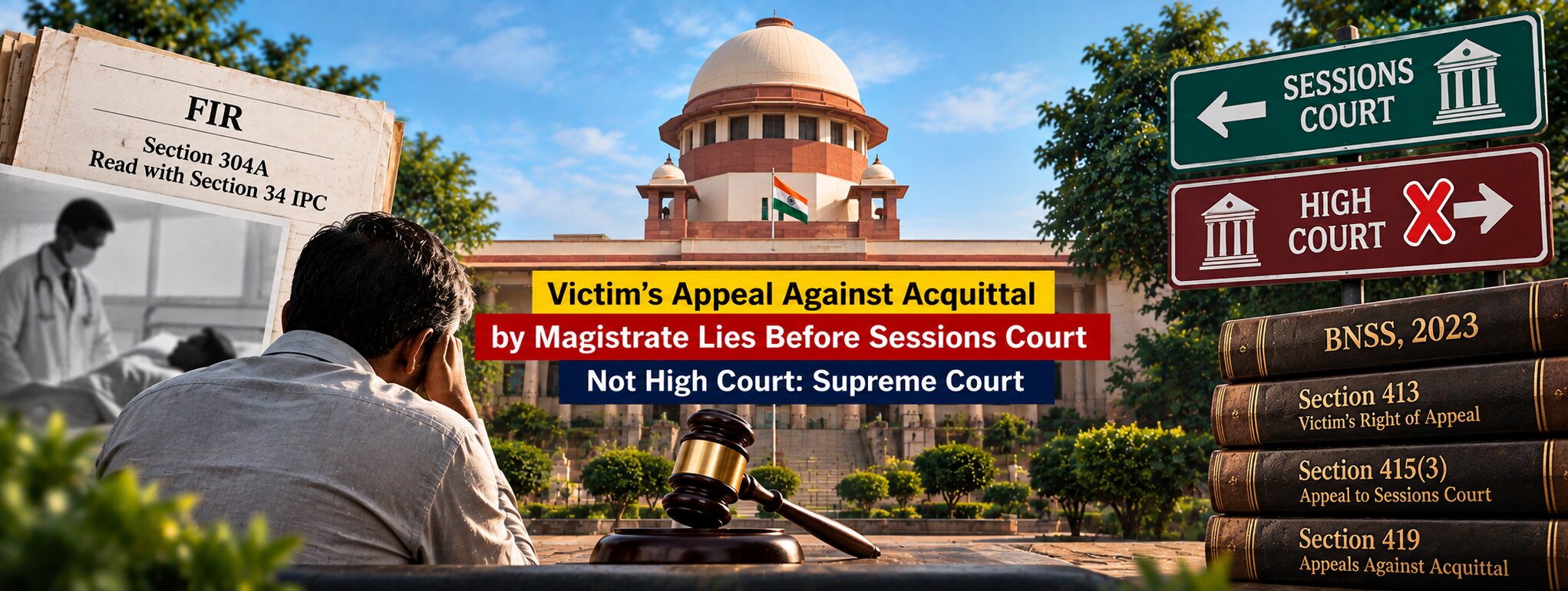
A victim's appeal against an acquittal passed by a Magistrate lies before the Court of Session and not the High Court under the statutory scheme of the BNSS.
Judgement Details
Court
Supreme Court of India
Date of Decision
25 September 2026
Judges
Justice J.B. Pardiwala and Justice K. Vinod Chandran
Citation
Acts / Provisions
Facts of the Case
-
The petitioner, Subhas Chandra Sarkar, was the father of a person who had been admitted to a hospital and subsequently died by suicide.
-
According to the petitioner, his son was suffering from depressive disorders and his death was allegedly connected with the negligence of a doctor and a nurse at the hospital.
-
An FIR was registered alleging commission of an offence under Section 304A read with Section 34 IPC.
-
The case was tried before the Judicial Magistrate, 9th Court, Alipore.
-
The Judicial Magistrate ultimately acquitted the accused persons.
-
The petitioner, claiming the status of a victim, sought to challenge the acquittal by filing an appeal before the Calcutta High Court.
-
Although the matter had initially been admitted by a Single Judge, at the stage of final hearing another Single Judge examined the statutory scheme and held that the appeal was not maintainable before the High Court.
-
The Calcutta High Court granted liberty to the petitioner to approach the jurisdictional Sessions Court.
-
The petitioner thereafter approached the Supreme Court through a Special Leave Petition, challenging the High Court's decision.
-
Before the Supreme Court, arguments were advanced concerning the interaction between Sections 413, 415(3) and 419 of the BNSS and the appropriate forum for a victim's appeal against an acquittal by a Magistrate.
-
The petitioner also relied upon Rajan Chadha v. Sanjay Arora, 2025 SCC OnLine SC 899, contending that once a matter had been admitted by one Single Judge, another Coordinate Bench could not subsequently take a contrary view.
Issues
-
Whether an appeal preferred by a victim against an order of acquittal passed by a Magistrate under the BNSS lies before the High Court or the Court of Session?
-
Whether the proviso to Section 413 of the BNSS governs a victim's appeal against an order of acquittal?
-
Whether Section 419 of the BNSS, which deals generally with appeals against acquittal, determines the forum for an appeal filed by a victim?
-
Whether an appeal against an acquittal passed by a Magistrate has to be filed before the same court to which an appeal against a conviction by that Magistrate would ordinarily lie?
-
Whether the subsequent examination of maintainability by another Single Judge was impermissible merely because the appeal had earlier been admitted by a different Single Judge?
Judgement
-
The Supreme Court upheld the order of the Calcutta High Court holding that the victim's appeal against the Magistrate's acquittal was not maintainable before the High Court.
-
The Court specifically examined the proviso to Section 413 BNSS, which gives a victim a right to appeal against an order acquitting the accused, convicting the accused for a lesser offence, or imposing inadequate compensation.
-
The crucial statutory language provides that such a victim's appeal shall lie before “the Court to which an appeal ordinarily lies against the order of conviction of such Court.”
-
The Court then examined Section 415(3) BNSS, which provides that a person convicted in a trial conducted by a Magistrate of the First or Second Class may appeal to the Court of Session.
-
Consequently, the Supreme Court held that when a Magistrate passes an order of acquittal, a victim's appeal under the proviso to Section 413 must also be presented before the Sessions Court.
-
The Court distinguished this remedy from the general mechanism under Section 419 BNSS dealing with appeals against acquittal.
-
The Supreme Court explained that Section 419 does not govern the victim's statutory appeal under the proviso to Section 413, because the latter provision specifically creates a separate right of appeal for the victim and identifies the appropriate appellate forum.
-
The Court also considered the argument based on Rajan Chadha v. Sanjay Arora and found that the precedent did not prevent the later Single Judge from examining the maintainability of the appeal on the basis of the statutory provisions.
-
The Supreme Court therefore found the Calcutta High Court's order to be legally correct and rejected the Special Leave Petition.
-
However, the Supreme Court granted liberty to the petitioner to approach the jurisdictional Sessions Court.
-
The Court directed that if the appeal was filed within one month from 22 September 2026, it should be admitted and heard on merits without treating the intervening delay as a bar, since the delay had resulted from the petitioner's bona fide proceedings before the wrong forum.
-
The Supreme Court expressly clarified that it had not expressed any opinion on the merits of the acquittal.
Held
-
The governing provision for such a victim's appeal is the proviso to Section 413 BNSS.
-
The forum is determined by identifying the court to which an appeal against the corresponding conviction by that court ordinarily lies.
-
Since an appeal against conviction by a Magistrate of the First or Second Class lies to the Sessions Court under Section 415(3) BNSS, a victim's appeal against that Magistrate's acquittal also lies before the Sessions Court.
-
Section 419 BNSS does not override or displace the specific victim's right of appeal under the proviso to Section 413.
-
The fact that an appeal was previously admitted by one Single Judge does not prevent another Single Judge from examining its statutory maintainability at the final hearing.
-
The petitioner was permitted to file the appeal before the jurisdictional Sessions Court within one month, with the delay caused by the bona fide proceedings in the wrong forum being disregarded.
-
The Supreme Court made no finding regarding the correctness of the acquittal on merits.
Analysis
-
Statutory interpretation: The central feature of the judgment is the Court's emphasis on the precise language of the proviso to Section 413 BNSS. Instead of treating the general provision relating to appeals against acquittal as controlling every type of acquittal appeal, the Court gave effect to the specific provision dealing with a victim's appeal.
-
Relationship between Sections 413 and 415: Section 413 establishes the victim's right of appeal and determines its forum by reference to the ordinary appellate forum against conviction. Section 415(3) then identifies the Sessions Court as the appellate forum for convictions by a Magistrate of the First or Second Class.
-
Section 419 distinguished: Section 419 may govern an appeal against acquittal in the circumstances contemplated by that provision, particularly an appeal by the State. The present case, however, concerned an appeal independently instituted by the victim, making the proviso to Section 413 the relevant provision.
-
Nature of the victim's right: The judgment recognizes that the BNSS expressly confers upon a victim a statutory right to challenge an acquittal. The important question is therefore not whether the victim has a right to appeal, but which court has jurisdiction to hear that appeal.
-
Forum determined by conviction appeal: The Court adopted the statutory mechanism contained in Section 413 itself: the victim's appeal follows the forum ordinarily available against conviction by the same court. Thus, a Magistrate's acquittal leads to a victim's appeal before the Sessions Court.
-
Bona fide proceedings: The Court adopted a practical approach towards the procedural error. Rather than allowing the petitioner to lose the opportunity to challenge the acquittal because the appeal had initially been filed before the wrong forum, the Court granted one month to approach the proper Sessions Court and directed that the intervening delay not be treated adversely.
-
Rajan Chadha distinguished: The Supreme Court clarified that the earlier decision relied upon by the petitioner did not establish a blanket rule preventing a Coordinate Bench from examining maintainability. The present matter involved determination of jurisdiction based upon the statutory scheme governing criminal appeals.
-
Impact on criminal procedure: The judgment provides clarity under the BNSS regarding the appellate forum available to victims. For an acquittal recorded by a Magistrate, a victim should approach the jurisdictional Sessions Court, rather than the High Court, when invoking the victim's right under the proviso to Section 413.
-
Importance for practitioners: The decision highlights the need to distinguish between a victim's appeal under Section 413 and an acquittal appeal governed by Section 419. The identity of the appellant and the statutory source of the right of appeal are therefore important in determining the correct forum.
-
No decision on merits: Importantly, the Supreme Court did not examine whether the Magistrate was correct in acquitting the accused. The judgment is confined primarily to the maintainability and proper appellate forum.