
State of Uttar Pradesh v. A.K. Gaba & Ors., 2026
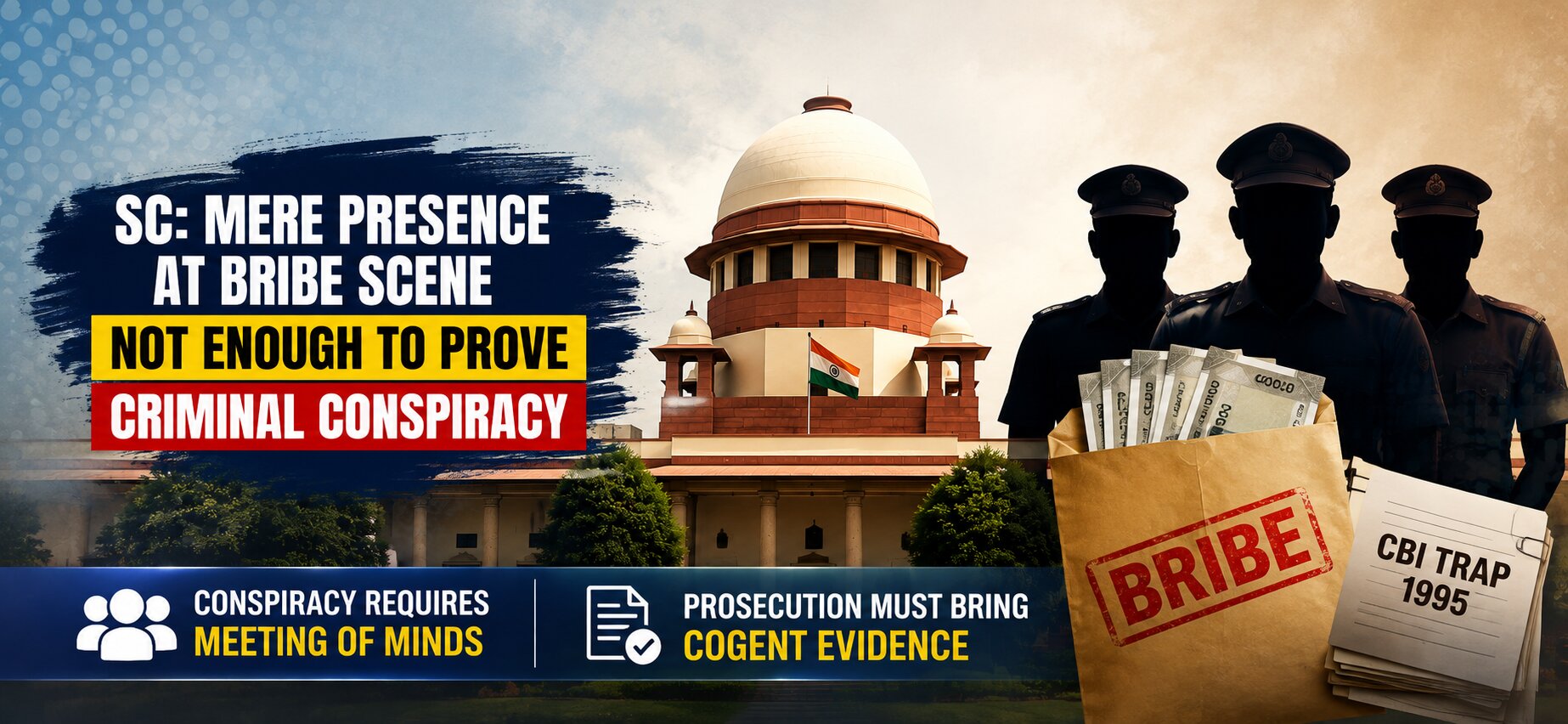
Mere presence of a public servant at the place where a bribe is allegedly accepted is insufficient to establish criminal conspiracy.
Judgement Details
Court
Supreme Court of India
Date of Decision
4 August 2026
Judges
Justice Pankaj Mithal and Justice Prasanna B. Varale
Citation
Acts / Provisions
Facts of the Case
-
The case arose from a 1995 CBI trap operation involving Central Excise officers.
-
Superintendent of Central Excise R.K. Srivastava was alleged to have demanded ₹80,000 as illegal gratification.
-
The alleged bribe was demanded in connection with the return of documents seized from a factory.
-
Inspectors A.K. Gaba, Alok Gupta and Dushyant Kumar were alleged to have participated in the conspiracy.
-
The prosecution relied substantially upon the alleged presence of the Inspectors at places where the demand or acceptance of the bribe allegedly occurred.
-
The Trial Court convicted the accused for criminal conspiracy and offences under the Prevention of Corruption Act.
-
The accused challenged their convictions before the Allahabad High Court.
-
The High Court found that the prosecution had failed to establish the necessary elements of demand, acceptance and criminal conspiracy.
-
The High Court consequently acquitted the accused.
-
The State of Uttar Pradesh challenged the acquittal before the Supreme Court.
-
The Supreme Court examined whether the alleged presence of the respondents during the bribe transaction was sufficient to establish a prior meeting of minds.
-
The Court also considered the prosecution's failure to produce a tape recording allegedly containing evidence of the bribe demand.
-
The Supreme Court ultimately upheld the acquittal.
Issues
-
Whether the mere presence of a public servant at the place where a bribe is allegedly demanded or accepted is sufficient to establish criminal conspiracy under Section 120-B IPC?
-
Whether the prosecution must establish a prior meeting of minds or agreement between accused persons to prove the offence of criminal conspiracy?
-
Whether the prosecution established that the respondents had participated in the alleged demand or acceptance of illegal gratification?
-
Whether the failure to produce a tape recording allegedly containing evidence of the bribe demand justified drawing an adverse inference against the prosecution?
-
Whether the acquittal of the respondents by the Allahabad High Court warranted interference by the Supreme Court?
Judgement
-
The Supreme Court dismissed the State's appeals.
-
The Court upheld the acquittal of the three Central Excise officers.
-
It held that mere presence at the scene of an alleged bribe transaction cannot establish criminal conspiracy.
-
Criminal conspiracy requires evidence demonstrating a meeting of minds or prior agreement between the accused.
-
The prosecution failed to produce substantive evidence showing that the respondents had entered into a prior agreement with the principal accused, R.K. Srivastava.
-
The Court also noted that the principal allegation of demanding the bribe was directed against R.K. Srivastava alone.
-
There was no independent material establishing that the respondents actively participated in the alleged demand.
-
The prosecution also failed to establish the necessary criminal intent required for conspiracy.
-
The Court found the failure to produce the alleged tape recording significant.
-
Since the recording was allegedly relevant to proving the demand, its withholding supported an adverse inference against the prosecution.
-
The Court therefore found no reason to interfere with the High Court's acquittal.
Held
-
Mere presence or association is insufficient to prove criminal conspiracy.
-
A conspiracy requires evidence of a meeting of minds between the accused.
-
Suspicion, association or presence at the scene cannot substitute for proof of a prior agreement or concert.
-
The prosecution must establish the accused's knowledge and participation in the unlawful agreement.
-
The prosecution failed to prove that the respondents participated in the alleged demand or shared the criminal intent of the principal accused.
-
Failure to produce crucial electronic evidence allegedly recording the demand justified an adverse inference against the prosecution.
-
The acquittal was therefore upheld.
-
The State's appeals were dismissed.
Analysis
-
Core principle: Criminal conspiracy is fundamentally an offence involving an agreement or meeting of minds. The prosecution must establish more than the accused person's association with the principal offender.
-
Presence is not participation: Being present where an offence occurs does not automatically demonstrate participation in that offence. Additional evidence must connect the accused to the unlawful plan.
-
Meeting of minds: The Court reaffirmed that the essence of conspiracy is the agreement between persons to pursue an unlawful object or a lawful object through unlawful means.
-
Suspicion versus proof: The prosecution cannot rely on suspicion, proximity or association as substitutes for cogent evidence establishing the conspiracy.
-
Demand of bribe: The Court also considered the failure to prove the alleged demand against the respondents. This weakened both the corruption charge and the conspiracy allegation.
-
Principal accused: According to the prosecution itself, the primary allegation of demanding the ₹80,000 bribe was against R.K. Srivastava. The absence of independent evidence connecting the respondents to that demand was significant.
-
Electronic evidence: The alleged tape recording could have been important evidence concerning the demand. Its non-production was therefore relevant to the Court's assessment of the prosecution case.
-
Adverse inference: Where a party withholds material evidence that is relevant to an issue in dispute, the court may draw an adverse inference depending upon the circumstances.
-
Standard of proof: Criminal conspiracy must be established through legally admissible and convincing evidence. The prosecution cannot fill evidentiary gaps through assumptions about the conduct of the accused.
-
Acquittal: The Supreme Court found that the High Court's assessment of the evidence was justified and saw no basis for disturbing the acquittal.
-
Importance for corruption cases: The judgment is significant for prosecution of bribery allegations involving multiple public servants. Establishing that one officer accepted a bribe does not automatically establish that colleagues who were present were conspirators.
-
Individual criminal liability: Criminal responsibility remains personal. Each accused person's participation and mental state must be established through evidence.
-
Overall significance: The judgment reinforces the distinction between mere association and criminal participation, particularly in conspiracy cases involving public corruption.