
State of Punjab v. Mohinder Singh and Others, 2026
The judgment reinforces the fundamental criminal law principle that the prosecution must establish guilt beyond reasonable doubt, particularly in cases involving circumstantial evidence.
Judgement Details
Court
Punjab and Haryana High Court
Date of Decision
21 July 2026
Judges
Justice Vinod S. Bhardwaj & Justice Sukhvinder Kaur
Citation
Acts / Provisions
Facts of the Case
-
The deceased, Harpreet Singh, aged about 22 years, allegedly opposed an illicit relationship between his father and Harjinder Kaur, the wife of his paternal uncle, which resulted in strained relations between the families.
-
According to the complainant, Surjit Kaur (mother of the deceased), Harpreet had gone to Harjinder Kaur's house to call his father home. Upon returning, he informed his mother that his father would not return that night.
-
Soon thereafter, Harpreet began vomiting and allegedly disclosed to his mother that Harjinder Kaur had given him a glass of milk before he left her house.
-
As his condition deteriorated, Mohinder Singh, Bhupinder Singh, and Chaman Pal Singh took him to a hospital at Jagraon without informing or accompanying his mother. Harpreet died the same night.
-
The post-mortem examination and Chemical Examiner's report established that the cause of death was Aluminium Phosphide poisoning.
-
The complainant alleged that the accused had conspired to murder her son by administering Aluminium Phosphide mixed in milk because he objected to the alleged illicit relationship.
-
An initial complaint was made before the Senior Superintendent of Police in April 1997, but the police found the allegations unsubstantiated and did not register a criminal case.
-
No further legal action was taken for nearly four years. A subsequent complaint was ultimately filed before the Illaqa Magistrate in 2002, approximately five years after the incident.
-
The Additional Sessions Judge, Ludhiana, acquitted all the accused in 2005 after finding that the prosecution had failed to establish guilt beyond reasonable doubt.
-
The State of Punjab challenged the acquittal before the Punjab and Haryana High Court.
Issues
-
Whether the prosecution proved beyond reasonable doubt that the accused administered Aluminium Phosphide mixed in milk to Harpreet Singh, thereby causing his death?
-
Whether the unexplained delay of nearly five years in filing the complaint adversely affected the credibility of the prosecution case?
-
Whether the prosecution established the alleged criminal conspiracy among the accused to commit the murder of the deceased?
-
Whether the prosecution's case could be sustained solely on the basis of the complainant's testimony in the absence of independent corroborative evidence?
-
Whether the trial court committed any perversity, illegality, or material error warranting interference with the order of acquittal?
Judgement
-
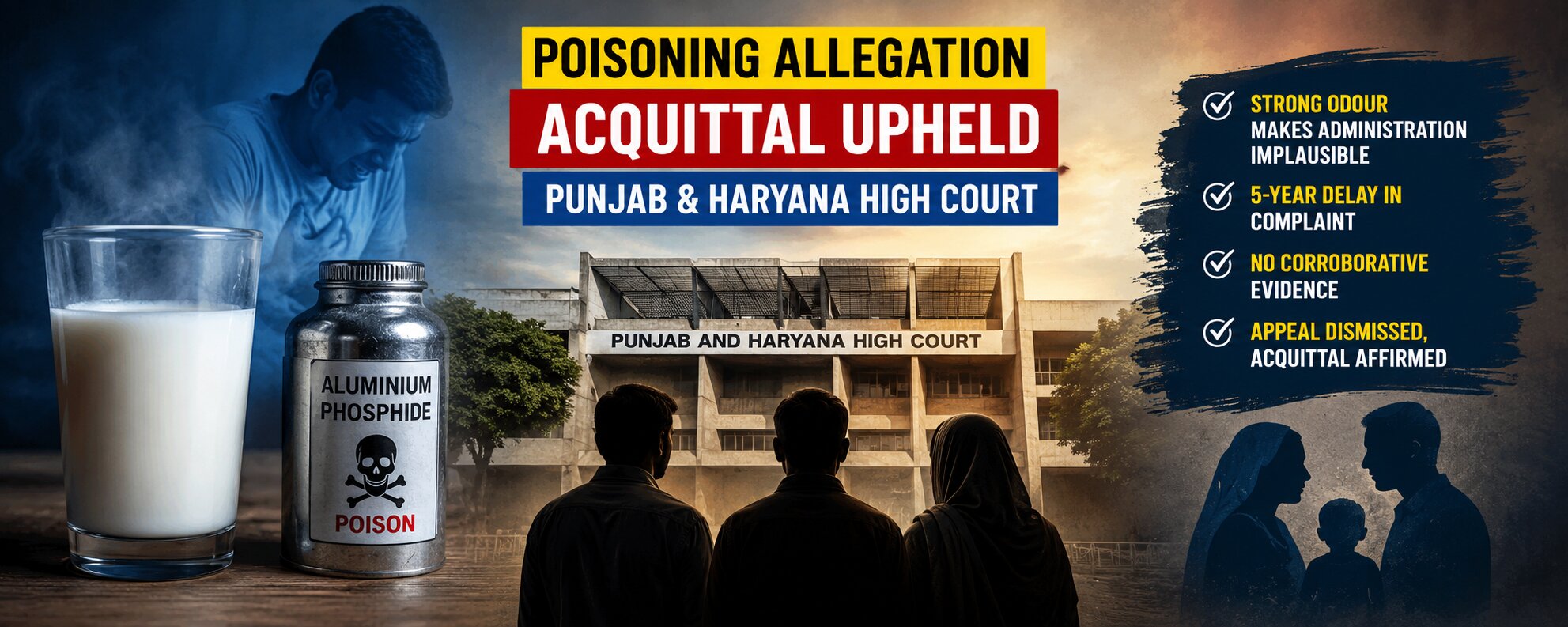
The High Court dismissed the appeal filed by the State of Punjab and affirmed the acquittal of all the accused.
-
The Court held that Aluminium Phosphide emits a strong fishy or garlic-like odour upon contact with moisture, making it highly improbable that it could have been secretly mixed in milk without the deceased detecting its smell.
-
The Court observed that the prosecution failed to produce any expert medical or toxicological evidence to contradict the scientific characteristics of Aluminium Phosphide relied upon by the trial court.
-
The Bench found that the complaint filed nearly five years after the incident remained wholly unexplained, thereby seriously weakening the prosecution case.
-
The Court noted that the prosecution relied almost exclusively upon the testimony of the complainant, without producing independent witnesses to corroborate her allegations.
-
Material witnesses referred to by the complainant were either not examined or were omitted from the list of prosecution witnesses, creating significant gaps in the prosecution evidence.
-
The Court found contradictions in the complainant's version regarding the presence of witnesses and the circumstances under which the deceased allegedly disclosed that he had consumed milk at Harjinder Kaur's house.
-
The Court considered it significant that the accused themselves transported the deceased to the hospital, which was inconsistent with the prosecution's allegation that they had conspired to murder him.
-
The Bench also found the alleged motive improbable, observing that it was unlikely for Bhupinder Singh to participate in a conspiracy to kill the person objecting to his wife's alleged illicit relationship.
-
Reiterating the settled law governing appeals against acquittal, the Court held that where the trial court's view is reasonable and supported by the evidence, an appellate court should not substitute its own opinion merely because another view is possible.
Held
-
The prosecution failed to establish the guilt of the accused beyond reasonable doubt.
-
The prosecution failed to prove that Aluminium Phosphide had been administered through milk in the manner alleged.
-
The unexplained delay of five years substantially weakened the prosecution's case.
-
The complainant's testimony lacked independent corroboration and contained material inconsistencies.
-
The findings of the trial court were reasonable and free from perversity or illegality.
-
The appeal filed by the State of Punjab was dismissed.
-
The acquittal of Mohinder Singh, Bhupinder Singh, and Harjinder Kaur was affirmed.
Analysis
-
The Court placed considerable reliance on scientific and forensic principles by considering the chemical properties of Aluminium Phosphide, thereby emphasizing the importance of objective evidence in poisoning cases.
-
The decision illustrates that expert scientific evidence cannot be ignored when assessing the plausibility of the prosecution's theory.
-
The Court emphasized that unexplained delay in initiating criminal proceedings may cast serious doubt upon the genuineness and reliability of the allegations.
-
The judgment highlights the importance of producing all material witnesses and independent corroborative evidence where available, especially when the prosecution case rests largely upon the testimony of an interested witness.
-
The Court carefully examined the conduct of the accused after the incident, treating their act of taking the deceased to the hospital as inconsistent with the allegation of a pre-planned conspiracy to murder.
-
The Bench reiterated the settled appellate principle that an acquittal strengthens the presumption of innocence, and appellate interference is justified only where the findings of the trial court are perverse, illegal, or wholly unreasonable.
-
The decision serves as an important precedent emphasizing judicial restraint in appeals against acquittal and underscores that mere suspicion or moral conviction cannot replace legally admissible proof.