
State of Maharashtra v. Monika Kiran Suryawanshi & Others, 2026
Mere production of telephone records cannot substitute substantive proof of an illicit affair constituting the motive for murder.
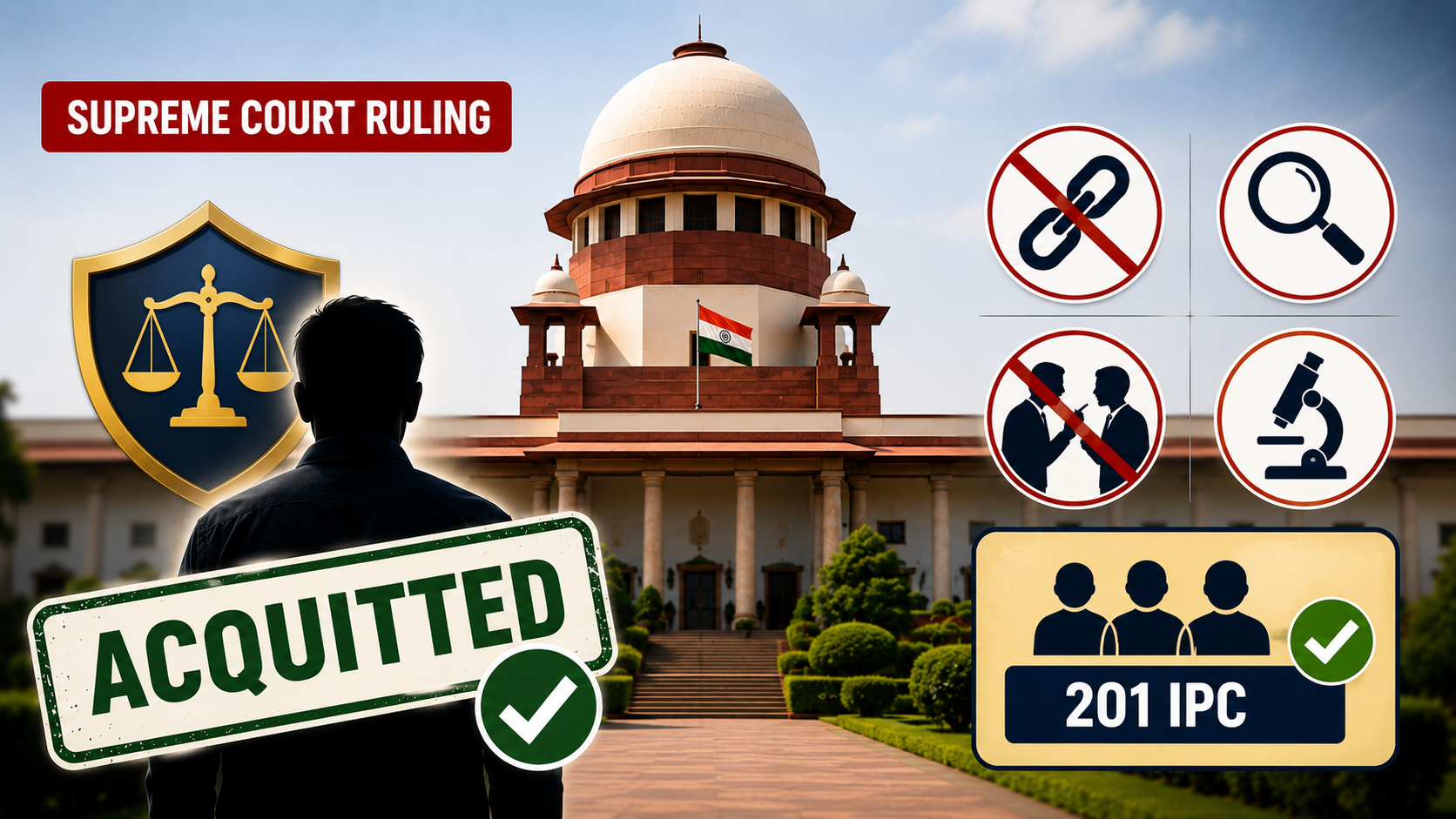
Judgement Details
Court
Supreme Court of India
Date of Decision
13 July 2026
Judges
Justice Sanjay Karol & Justice Prasanna B. Varale
Citation
Acts / Provisions
Facts of the Case
-
The case arose out of the alleged murder of Kiran Suryawanshi, an employee of ICICI Bank, in February 2007.
-
The prosecution alleged that his wife, Monika Kiran Suryawanshi (Accused No.1), had an illicit relationship with their neighbour, Prakash Patil (Accused No.2).
-
It was alleged that Monika, Prakash, and Dnyaneshwar Mahale (Accused No.3) conspired to murder Kiran.
-
According to the prosecution, Monika administered sedatives to her husband and thereafter killed him by smashing his head with a grinding stone.
-
The prosecution further alleged that Prakash and Dnyaneshwar attempted to dispose of the dead body by transporting it on a motorcycle wrapped in a plastic bag and bedsheet.
-
The Trial Court convicted all three accused under Sections 302 and 120B IPC and sentenced them to life imprisonment.
-
The Bombay High Court acquitted them of murder and conspiracy after finding serious deficiencies in the prosecution case.
-
The State challenged the acquittal before the Supreme Court.
Issues
-
Whether the prosecution proved an unbroken chain of circumstantial evidence sufficient to sustain the conviction of the accused for murder and criminal conspiracy?
-
Whether mere production of telephone call records is sufficient to establish an illicit affair as the motive for murder?
-
Whether the prosecution proved the alleged motive, last seen theory, recoveries, and forensic evidence beyond reasonable doubt?
-
Whether the conviction of Accused Nos. 2 and 3 under Section 201 IPC required interference?
Judgement
-
The Supreme Court dismissed the State's appeals and upheld the acquittal of all the accused for offences under Sections 302 and 120B IPC.
-
The Court held that the prosecution entirely relied upon circumstantial evidence but failed to establish a complete chain of circumstances leading exclusively to the guilt of the accused.
-
The Court observed that the alleged motive of an illicit relationship remained unproved.
-
It held that the call detail records merely showed communication between parties and did not constitute substantive proof of an extramarital affair.
-
The Bench observed that the prosecution's own call records contradicted its allegation that Monika had summoned Prakash on the night of the incident.
-
The Court rejected the prosecution's reliance upon the "last seen" theory because the exact time of death had not been established.
-
The Court found serious defects in the investigation, particularly the failure to properly seal seized articles before sending them for forensic examination.
-
Consequently, the Chemical Analyzer's reports lost much of their evidentiary value.
-
The Court also noted that the alleged recovery of the grinding stone and syringe was made from a public place accessible to everyone and that the search panchnama did not bear the signature of Accused No.1.
-
The Court further observed that although the prosecution alleged that the deceased had been brutally assaulted on the bed, no blood stains were found on the mattress, pillow, or bedsheet, making the prosecution story highly improbable.
-
However, the Court upheld the conviction of Accused Nos. 2 and 3 under Section 201 IPC, observing that they were apprehended while transporting the deceased's body and had clearly attempted to cause disappearance of evidence.
-
Since they had already undergone the sentence of one year's imprisonment, no further directions were required.
Held
-
In a case based entirely on circumstantial evidence, every circumstance must be proved and the chain must be complete and consistent only with the guilt of the accused.
-
Failure to seal seized articles and maintain proper forensic chain of custody seriously undermines the prosecution case.
-
The prosecution failed to establish motive, reliable last seen evidence, recoveries, and forensic evidence beyond reasonable doubt.
-
The acquittal under Sections 302 and 120B IPC was upheld.
-
The conviction of Accused Nos. 2 and 3 under Section 201 IPC was maintained.
Analysis
-
The judgment reiterates the settled principle that conviction based on circumstantial evidence requires an unbroken chain of proved circumstances, excluding every reasonable hypothesis except the guilt of the accused.
-
The Supreme Court emphasized that call detail records are corroborative evidence and cannot independently establish the existence of an illicit relationship or motive without substantive supporting evidence.
-
The decision highlights the importance of scientific investigation and proper preservation of physical evidence, stressing that failure to seal recovered articles destroys the reliability of forensic reports.
-
The Court reaffirmed that the last seen theory is a weak piece of evidence unless the prosecution conclusively proves the time of death and establishes a close proximity between the accused being last seen with the deceased and the occurrence of death.
-
The judgment also underscores the necessity of maintaining the chain of custody for forensic exhibits, observing that link evidence is indispensable before relying upon Chemical Analyzer reports.
-
At the same time, the Court distinguished the offence under Section 201 IPC, holding that independent evidence showing the accused attempting to dispose of the dead body justified sustaining their conviction for causing disappearance of evidence.
-
Overall, the decision strengthens safeguards against convictions founded on speculative inferences while reinforcing the high standard of proof required in criminal cases based solely on circumstantial evidence.