
State of Haryana v. Arun and Others, 2026
A disclosure under Section 27 of the Indian Evidence Act is admissible only when all essential requirements relating to custody, voluntariness, relevance, distinct connection and genuine discovery are satisfied.
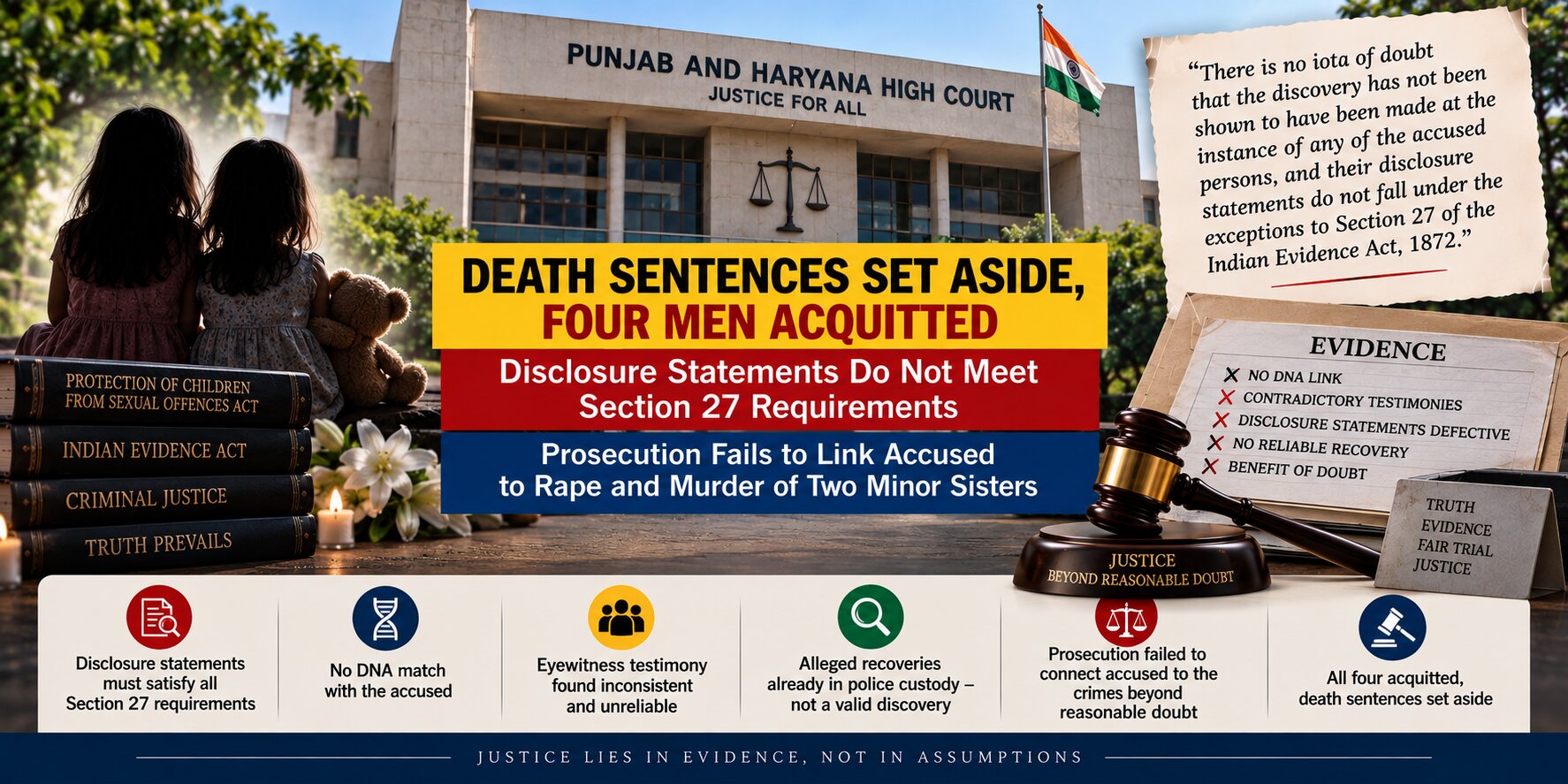
Judgement Details
Court
Punjab and Haryana High Court
Date of Decision
17 August 2026
Judges
Justice Anoop Chitkara and Justice Ramesh Chander Dimri
Citation
Acts / Provisions
Facts of the Case
-
Two minor sisters, aged 13 and 12 years, died after being brought to a Delhi hospital in the early hours of 06.08.2021.
-
Their mother initially informed the doctors and police that the girls had died after being bitten by a snake.
-
Post-mortem examinations did not find snakebite marks but revealed injuries consistent with sexual assault.
-
Toxicological examination detected Pendimethalin, a herbicide, in the stomach contents of the victims.
-
Three days later, the mother lodged a complaint alleging that four neighbours had entered the room, sexually assaulted the girls, administered poison and threatened the family.
-
The four accused were arrested and subsequently convicted by the Trial Court under provisions relating to gang rape, murder, POCSO and common intention, and were sentenced to death.
-
During the appeal and death-reference proceedings, the High Court examined the reliability of the eyewitness account, scientific evidence and alleged disclosure-based recoveries.
-
The prosecution principally relied upon the mother's statements, DNA evidence and disclosure statements leading to alleged recoveries.
Issues
-
Whether the prosecution established the identity and involvement of the four accused beyond reasonable doubt?
-
Whether the mother's contradictory statements could safely be relied upon to sustain the convictions?
-
Whether the alleged disclosure statements satisfied the requirements of Section 27 of the Indian Evidence Act?
-
Whether a fact already in police custody could subsequently be treated as a discovery pursuant to an accused's disclosure?
-
Whether the absence of DNA linkage and reliable forensic evidence created reasonable doubt regarding the involvement of the accused?
-
Whether the alleged recoveries of incriminating articles were sufficiently connected with the accused to constitute legally admissible evidence?
-
Whether the prosecution established a complete chain of circumstances sufficient to sustain convictions carrying the death penalty?
Judgement
-
The High Court acquitted all four accused and set aside their convictions and death sentences.
-
The Court found that the prosecution had established that the victims had been sexually assaulted and had died due to poisoning, but had failed to connect the four accused with those offences.
-
The mother's different accounts were found to contain material inconsistencies, beginning with her initial explanation of snakebite and followed by later allegations against the accused.
-
Her subsequent statement under Section 164 CrPC also created serious doubts regarding her identification of the accused.
-
At trial, the mother turned hostile and denied that the accused had committed any wrong against her daughters.
-
The Court found no reliable scientific evidence linking the accused to the victims.
-
The DNA profiles of the accused did not match the biological material recovered from the victims or the allegedly incriminating cloth.
-
The Court rejected the Trial Court's interpretation of old scars on the accused as evidence of injuries sustained during resistance.
-
The alleged disclosure statements were found legally defective because some articles had already been recovered before the purported disclosures were made.
-
The Court formulated a six-part test for determining whether a disclosure and resulting discovery fall within the exception under Section 27.
-
The murder reference was consequently dismissed, and the accused were directed to be released immediately on personal bonds without sureties.
Held
-
The accused must have been in custody for the relevant offence when making the disclosure.
-
The disclosure must be voluntary and free from coercion, threats, inducement or deception.
-
The information must lead to the discovery of a fact that was not already known to or in the possession of the police.
-
An object already recovered by the police cannot subsequently be described as a discovery pursuant to an accused's disclosure.
-
The prosecution cannot selectively rely upon one portion of an unreliable eyewitness's evidence while ignoring materially contradictory earlier and later statements.
-
The establishment of the commission of a crime is not sufficient; the prosecution must also legally and reliably establish the accused's connection with that crime.
-
Where the prosecution evidence leaves substantial gaps and does not establish guilt beyond reasonable doubt, the accused are entitled to acquittal, even in a grave offence.
-
In a case involving the death penalty, evidence connecting the accused with the crime must meet the highest standard of reliability.
Analysis
-
The judgment is significant for its detailed examination of Section 27 of the Indian Evidence Act, particularly the requirement that there must be a genuine discovery resulting from information supplied by an accused.
-
The Court's six-part test provides a structured framework for assessing disclosure-based recoveries: the accused must be in custody, the disclosure must be voluntary, the information must be relevant and distinctly connected with the discovery, and the fact must not have already been discovered.
-
The Court correctly distinguished between proving that a crime occurred and proving that a particular accused committed it. The medical and toxicological evidence established the occurrence of rape and poisoning, but did not establish the identity of the perpetrators.
-
The mother's evidence suffered from serious credibility problems because her initial account, subsequent complaint, Section 164 statement and trial testimony were materially inconsistent.
-
The Court refused to construct a conviction by selectively accepting the accusatory version while disregarding the other portions of the evidence that undermined it.
-
The alleged recoveries were particularly damaging to the prosecution because the chronology suggested that at least one incriminating object was already in police possession before the alleged disclosure.
-
The absence of DNA matching further weakened the prosecution's case, especially when the prosecution sought to sustain convictions for extremely serious offences.
-
The Court also corrected the Trial Court's factual interpretation of the medical examination of the accused. Old scars could not logically be treated as fresh injuries resulting from resistance during the alleged assault.
-
The decision demonstrates that even in emotionally grave cases involving sexual violence and the deaths of children, conviction cannot rest on suspicion, inconsistent testimony or legally inadmissible recovery evidence.
-
The acquittal ultimately rested on the fundamental criminal-law principle that the prosecution must prove the accused's guilt beyond reasonable doubt, and serious gaps in the evidentiary chain must operate in favour of the accused.