
Sri Ravi S. @ Jeevan S. v. Smt. Sahana Devi A. & Others, 2026
Gender alone cannot determine entitlement to maintenance.
Judgement Details
Court
High Court of Karnataka
Date of Decision
29 June 2026
Judges
Justice Dr. Chillakur Sumalatha
Citation
Acts / Provisions
Facts of the Case
-
The petitioner-husband and the respondent-wife were married in the year 2024.
-
The parties lived together only for a brief period after their marriage before disputes arose between them.
-
The wife initiated proceedings under the Protection of Women from Domestic Violence Act, 2005, alleging domestic violence.
-
Along with the main petition, she filed an application seeking interim maintenance of ₹1,13,515 per month from her husband.
-
The Trial Court partly allowed the application and directed the husband to pay ₹20,000 per month as interim maintenance.
-
The husband challenged this order before the Karnataka High Court by filing the present writ petition.
-
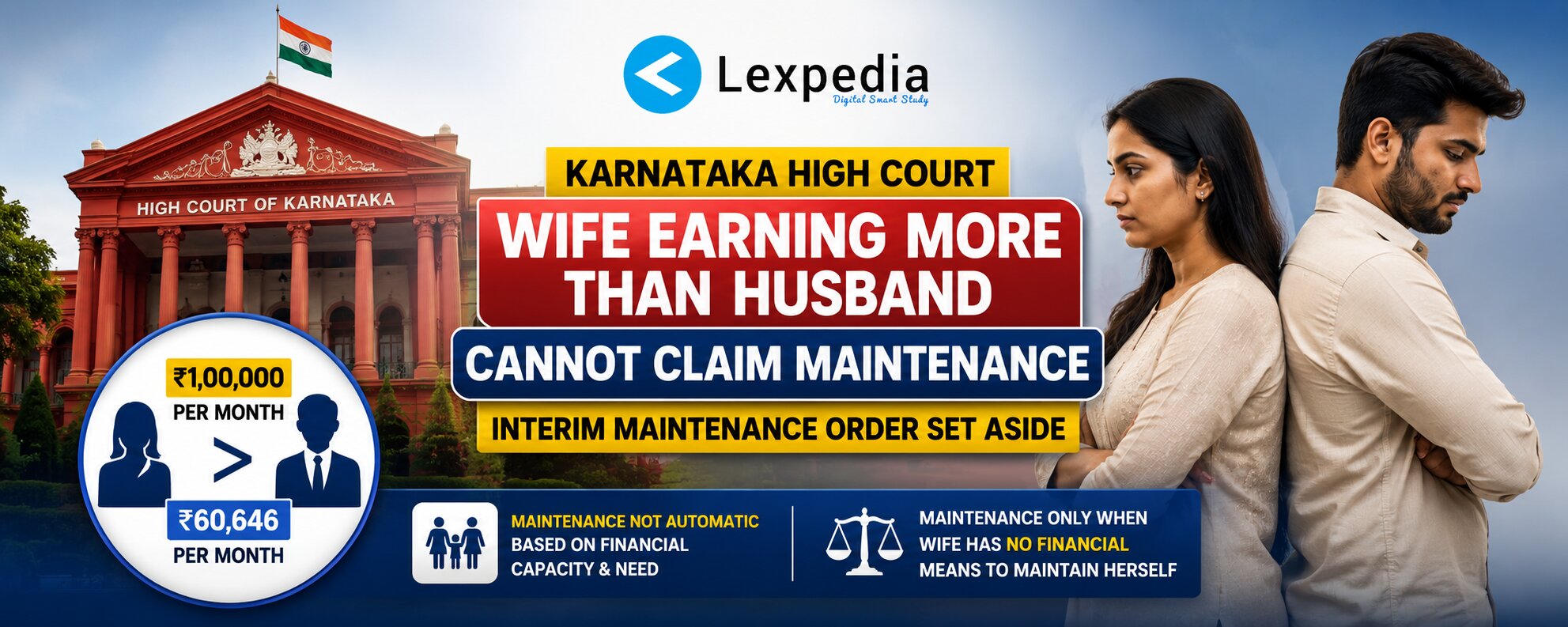
Before the High Court, the husband contended that his monthly salary was ₹60,646, whereas the wife was earning approximately ₹1,00,000 per month, making her financially stronger than him.
-
The wife argued that she was the only child of her parents and had borrowed money for her marriage, due to which she was burdened with loan repayments.
-
However, she failed to produce documentary evidence such as loan statements, EMI records, or other financial documents to substantiate these claims.
-
The affidavit filed by the wife disclosed that her income was substantially higher than that of the husband.
-
The High Court examined whether a financially independent wife earning considerably more than her husband could still claim interim maintenance.
Issues
-
Whether a wife who earns substantially more than her husband is entitled to claim interim maintenance from him?
-
Whether the Trial Court was justified in granting interim maintenance without properly considering the comparative financial status of the parties?
-
Whether the mere filing of proceedings under the Protection of Women from Domestic Violence Act automatically entitles a wife to maintenance?
-
Whether maintenance should be awarded when the wife is financially independent and capable of maintaining herself?
Judgement
-
The Karnataka High Court allowed the writ petition filed by the husband.
-
The Court held that maintenance cannot be awarded merely because the claimant is a wife.
-
It observed that the financial capacity of both spouses must be carefully examined before granting maintenance.
-
The Court noted that the wife admittedly earned ₹1,00,000 per month, substantially more than the husband's salary.
-
It found that the wife had failed to establish any additional financial liabilities through documentary evidence.
-
The Court emphasized that maintenance is intended for a spouse who is genuinely unable to maintain herself.
-
Consequently, the High Court set aside the Trial Court's order directing payment of ₹20,000 per month as interim maintenance.
-
The writ petition was allowed.
-
The Trial Court's order dated 19 December 2025 granting interim maintenance was set aside.
-
The wife was held not entitled to interim maintenance considering her higher income and financial independence.
-
The Court held that maintenance cannot be granted solely because the claimant is the wife.
-
Comparative earning capacity and financial necessity are decisive considerations while awarding maintenance.
Held
-
Maintenance is not an automatic right merely because a woman files proceedings under the Domestic Violence Act or other maintenance statutes.
-
Courts must compare the financial status and earning capacity of both spouses before awarding maintenance.
-
A financially independent wife earning substantially more than her husband ordinarily cannot claim maintenance in the absence of special circumstances.
-
Maintenance should be awarded only when the claimant demonstrates an inability to maintain herself according to the standard of living enjoyed during the marriage.
-
The Court observed that traditional assumptions that husbands must always maintain their wives should not override the actual financial realities of the parties.
-
Gender alone cannot determine entitlement to maintenance.
-
Courts should adopt a balanced and evidence-based approach while deciding maintenance claims.
Analysis
-
The judgment reinforces that maintenance laws are welfare provisions intended to prevent financial hardship rather than confer an automatic financial benefit.
-
The Court emphasized equality by considering the financial position of both spouses instead of relying on gender-based presumptions.
-
The decision underscores the importance of documentary evidence in proving financial liabilities.
-
It strengthens the principle that maintenance should be based on genuine need and comparative earning capacity.
-
The judgment discourages mechanical grant of maintenance without proper examination of income and liabilities.
-
It is likely to influence future maintenance cases by encouraging courts to undertake a realistic financial assessment before awarding interim maintenance.
-
The ruling promotes fairness while ensuring that maintenance provisions continue to protect genuinely dependent spouses.