
SRI PRINCE BANSAL v. STATE OF WEST BENGAL & ANR., 2026
Section 498A IPC is classified as a non-compoundable offence. Therefore, the parties cannot ordinarily terminate the prosecution merely by entering into a private settlement under Section 320 CrPC.
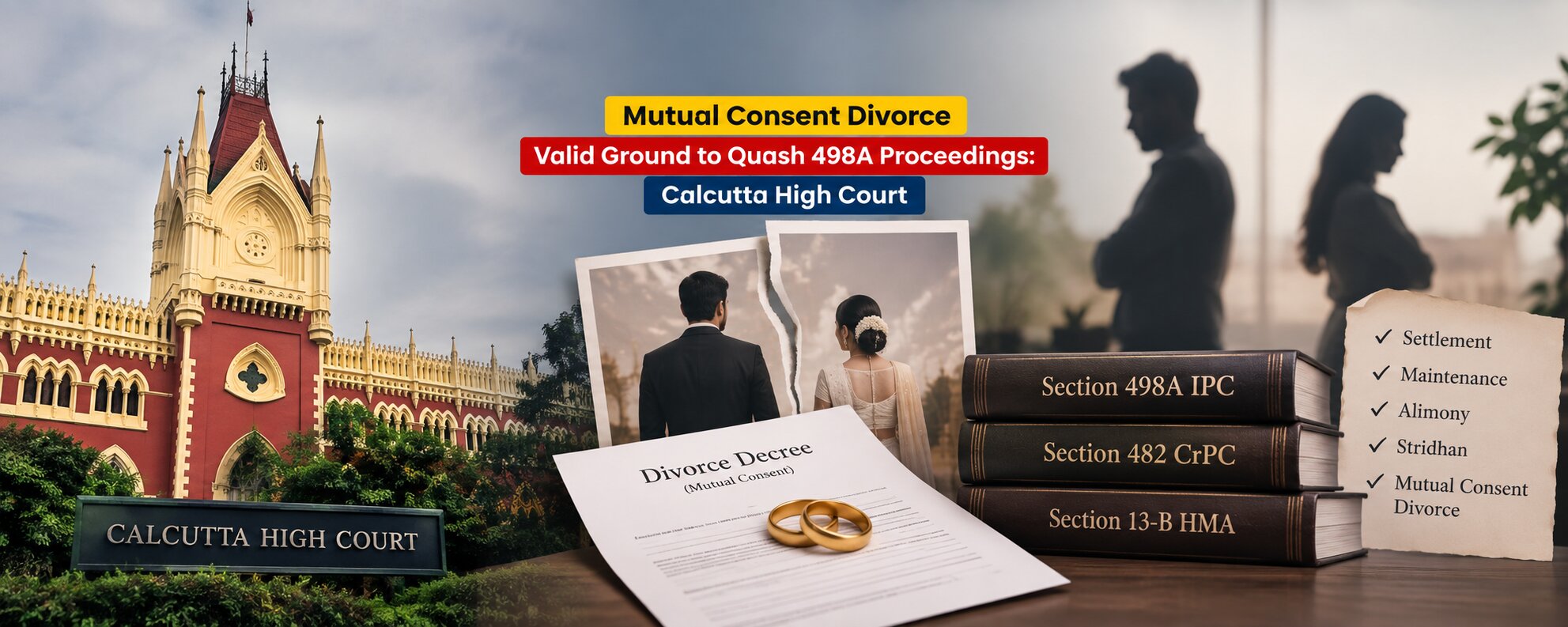
Judgement Details
Court
High Court at Calcutta
Date of Decision
16 September 2026
Judges
Justice Uday Kumar
Citation
Acts / Provisions
Facts of the Case
-
The petitioner, Sri Prince Bansal, and the complainant, Smt. Anamika Sarkar, initially solemnized a court marriage on 19 July 2018 before the Marriage Officer, North 24 Parganas, at Lake Town, Kolkata.
-
The parties subsequently solemnized a social marriage according to Hindu rites and customs on 11 December 2019 in Kolkata.
-
After the marriage, the complainant stayed at the matrimonial home in Meerut, Uttar Pradesh, for approximately 45 days.
-
Thereafter, owing to differences between the parties, they shifted to a rented apartment in Dwarka, New Delhi, where the complainant was employed with IndiGo Airlines.
-
The parties subsequently separated in March 2020.
-
Following the separation, the complainant initiated criminal proceedings against the petitioner under Section 498A IPC.
-
The case was registered as Lake Town Police Station Case No. 200 of 2020.
-
A charge sheet was subsequently filed against the petitioner on 31 January 2021.
-
After remaining separated for more than three years, the parties subsequently decided to resolve their matrimonial disputes amicably.
-
The parties jointly approached the Principal Judge, Family Court, South-West District, Dwarka Courts, Delhi, seeking dissolution of their marriage by mutual consent under Section 13-B of the Hindu Marriage Act, 1955.
-
The settlement between the parties covered various matrimonial claims, including maintenance, dowry, permanent alimony and stridhan.
-
As part of the settlement, the complainant gave an undertaking before the Family Court that she would withdraw the pending criminal proceeding after the mutual consent divorce was granted.
-
The Family Court allowed the first motion on 29 March 2023.
-
The Family Court subsequently allowed the second motion on 18 April 2023 and dissolved the marriage by mutual consent.
-
Despite the dissolution of the marriage and the undertaking given before the Family Court, the complainant did not cooperate in bringing the pending Section 498A criminal proceeding to an end.
-
The petitioner therefore approached the Calcutta High Court seeking quashing of the criminal proceeding, charge sheet and all consequential proceedings by invoking the High Court's inherent jurisdiction.
-
The High Court was therefore required to consider whether the subsequent settlement and mutual consent divorce constituted sufficient circumstances for exercising jurisdiction under Section 482 CrPC.
Issues
-
Whether the subsequent amicable settlement of matrimonial disputes and the formal dissolution of marriage by a decree of divorce by mutual consent under Section 13-B of the Hindu Marriage Act, 1955 constitute a valid, sufficient and legally sustainable ground for invoking the High Court's inherent jurisdiction under Section 482 of the Code of Criminal Procedure, 1973 to quash criminal proceedings arising from Section 498A of the Indian Penal Code?
-
Whether an undertaking given by the complainant before the Family Court to withdraw the pending criminal proceedings upon the grant of mutual consent divorce has legal significance when the complainant subsequently fails to cooperate in terminating those proceedings?
-
Whether continuation of the Section 498A IPC criminal proceeding after settlement of the matrimonial dispute and dissolution of the marriage by mutual consent amounts to an abuse of the process of law warranting exercise of the High Court's inherent jurisdiction under Section 482 CrPC?
Judgement
-
The Calcutta High Court allowed the criminal revision petition filed by Sri Prince Bansal.
-
The Court held that a subsequent amicable settlement of matrimonial disputes followed by dissolution of marriage through mutual consent under Section 13-B of the Hindu Marriage Act can constitute a valid ground for exercising the High Court's inherent jurisdiction under Section 482 CrPC.
-
The Court relied upon the principles established by the Supreme Court in B.S. Joshi v. State of Haryana, Gian Singh v. State of Punjab, and State of Madhya Pradesh v. Laxmi Narayan.
-
The Court recognised that although Section 498A IPC is a non-compoundable offence, its non-compoundable character does not prevent the High Court from exercising its independent inherent jurisdiction under Section 482 CrPC in appropriate circumstances.
-
The Court distinguished between compounding of an offence under Section 320 CrPC and quashing of proceedings under Section 482 CrPC.
-
The Court observed that Section 482 CrPC empowers the High Court to intervene where continuation of criminal proceedings would amount to an abuse of the process of law or where intervention is necessary to secure the ends of justice.
-
The Court gave significant importance to the undertaking given by the complainant before the Family Court to withdraw the pending criminal proceeding after the mutual consent divorce.
-
The Court observed that a party cannot obtain the benefit of a mutual settlement and divorce while subsequently repudiating the corresponding undertaking forming part of that settlement.
-
The Court also considered the fact that the parties had already settled their matrimonial claims concerning maintenance, dowry, permanent alimony and stridhan.
-
The Court found that the matrimonial relationship had already been legally dissolved through a decree of mutual consent divorce.
-
In the circumstances of the case, the Court concluded that continuation of the criminal proceeding would serve no useful purpose and would amount to an abuse of the process of law.
-
The Court consequently quashed General Register Case No. 815 of 2020, arising out of Lake Town Police Station Case No. 200 of 2020.
-
The Court also quashed Charge Sheet No. 14/2021 dated 31 January 2021 and all consequential proceedings.
-
The criminal revision petition was accordingly allowed.
Held
-
A genuine and subsequent amicable settlement of matrimonial disputes, followed by dissolution of marriage through mutual consent under Section 13-B of the Hindu Marriage Act, can constitute a valid ground for exercising the High Court's inherent jurisdiction under Section 482 CrPC.
-
The non-compoundable nature of Section 498A IPC does not by itself prevent the High Court from quashing the criminal proceedings under Section 482 CrPC.
-
An undertaking given by a party before a Family Court as part of a matrimonial settlement carries legal significance.
-
In the circumstances of the present case, the complainant could not accept the benefit of the mutual consent divorce while disregarding the corresponding undertaking concerning withdrawal of the criminal proceeding.
-
Continuation of the Section 498A proceeding after settlement of the matrimonial dispute and dissolution of the marriage, in the circumstances of the case, amounted to an abuse of the process of law.
-
The criminal proceeding, charge sheet and consequential proceedings against the petitioner were therefore quashed.
Analysis
-
The judgment reinforces the existing Supreme Court jurisprudence concerning the exercise of Section 482 CrPC in matrimonial disputes.
-
It demonstrates that the High Court can, in appropriate circumstances, quash a proceeding under Section 498A IPC even though the offence itself is non-compoundable.
-
The judgment highlights the importance of examining the substance and circumstances of a matrimonial settlement rather than treating the non-compoundable character of Section 498A as an absolute bar to quashing.
-
The decision also demonstrates that an undertaking made before a competent court during matrimonial proceedings can become an important factor when the High Court subsequently considers whether criminal proceedings should continue.
-
The judgment does not establish that every Section 498A proceeding automatically comes to an end merely because the parties obtain a mutual consent divorce.
-
The exercise of Section 482 jurisdiction remains dependent upon the facts and circumstances of each individual case and the principles governing the High Court's inherent jurisdiction.
-
The judgment therefore operates within the broader framework established by the Supreme Court in B.S. Joshi v. State of Haryana, Gian Singh v. State of Punjab, and State of Madhya Pradesh v. Laxmi Narayan.