
Sri Nandhini Devi and Others v. State of Tamil Nadu, 2026
Beneficial legislation concerning surrogacy should not be defeated by an unnecessarily hyper-technical interpretation.
Judgement Details
Court
Madras High Court
Date of Decision
3 September 2026
Judges
Justice Shamim Ahmed
Citation
Acts / Provisions
Facts of the Case
-
The petition arose from a dispute concerning an application for parentage and custody of a child to be born through surrogacy.
-
The intending couple had married in 2005.
-
They had a son who unfortunately died due to cardiac arrest in 2024.
-
The woman subsequently sought to have a child through surrogacy because she suffered from an absence of uterus.
-
The couple initiated the surrogacy procedure under the Surrogacy (Regulation) Act, 2021.
-
Their medical records and age-related documents were examined by the competent authorities.
-
The Appropriate Authority subsequently issued an Eligibility Certificate to the intending couple.
-
A relative of the couple agreed to act as the surrogate mother.
-
The surrogate mother submitted the required application and supporting documents.
-
The Appellate Authority issued an Eligibility Certificate to the surrogate mother as well.
-
The intending couple and surrogate mother thereafter approached the Magistrate seeking the statutory order concerning parentage and custody of the child.
-
The Magistrate rejected the application on two principal grounds.
-
The first ground concerned the alleged age ineligibility of the surrogate mother.
-
The second ground was the non-examination of the husband of the surrogate mother.
-
At the relevant time, the surrogate mother was 50 years, 9 months and 3 days old.
-
The High Court examined whether a woman who had not yet completed 51 years could be treated as ineligible merely because she had crossed 50 years.
-
The Court also examined whether the law required the husband of the surrogate mother to be examined before an order concerning parentage and custody could be passed.
-
The Court considered the respective statutory roles of the Magistrate, District Medical Board, Appropriate Authority and other agencies involved in the surrogacy process.
-
The Court concluded that the Magistrate had exceeded the permissible scope of judicial scrutiny by reassessing matters already determined by the competent authorities.
-
The High Court consequently set aside the Magistrate's order and remanded the matter for fresh consideration.
Issues
-
Whether the surrogate mother was ineligible merely because she was above 50 years of age but had not yet completed 51 years when the application was submitted?
-
Whether the Magistrate was required to examine the husband of the surrogate mother while considering an application for parentage and custody under Section 4(iii)(a)(II) of the Surrogacy (Regulation) Act, 2021?
-
Whether the Magistrate can reassess or sit in appeal over an Eligibility Certificate issued by the Appropriate Authority or findings of the District Medical Board?
-
Whether the Magistrate's role under Section 4(iii)(a)(II) is limited to examining voluntariness, statutory compliance, welfare of the child and legal certainty concerning parentage and custody?
-
Whether the Magistrate exceeded jurisdiction by rejecting the application on grounds not mandated by the Surrogacy (Regulation) Act, 2021?
-
Whether judicial guidelines are necessary to ensure uniformity in the processing of applications concerning parentage and custody of children born through surrogacy?
Judgement
-
The Madras High Court allowed the criminal revision petition and set aside the order passed by the Magistrate.
-
The Court held that the surrogate mother was not ineligible on the ground of age merely because she had crossed 50 years.
-
Since she was 50 years, 9 months and 3 days old when the application was submitted, she had not yet completed 51 years.
-
The Court adopted a liberal interpretation of the age requirement, consistent with the beneficial purpose of the surrogacy legislation.
-
The Court observed that statutory safeguards must be respected, but beneficial legislation should not be defeated through an unnecessarily hyper-technical interpretation.
-
The High Court held that the Magistrate had no statutory basis to insist upon examination of the husband of the surrogate mother.
-
The statutory scheme contemplated initiation of the proceedings by the intending couple or intending woman and the surrogate mother.
-
The Court therefore held that rejection of the application because the surrogate's husband had not been examined was unsustainable.
-
The Court further held that once the competent authority had issued an Eligibility Certificate, the Magistrate was not entitled to reassess its merits as though exercising appellate jurisdiction.
-
Such reassessment could be undertaken only where there was an apparent case of fraud, lack of jurisdiction or patent illegality.
-
The Court clarified that the Magistrate is not an appellate authority over the District Medical Board, Appropriate Authority, Insurance Authority or registered ART/Surrogacy Clinics.
-
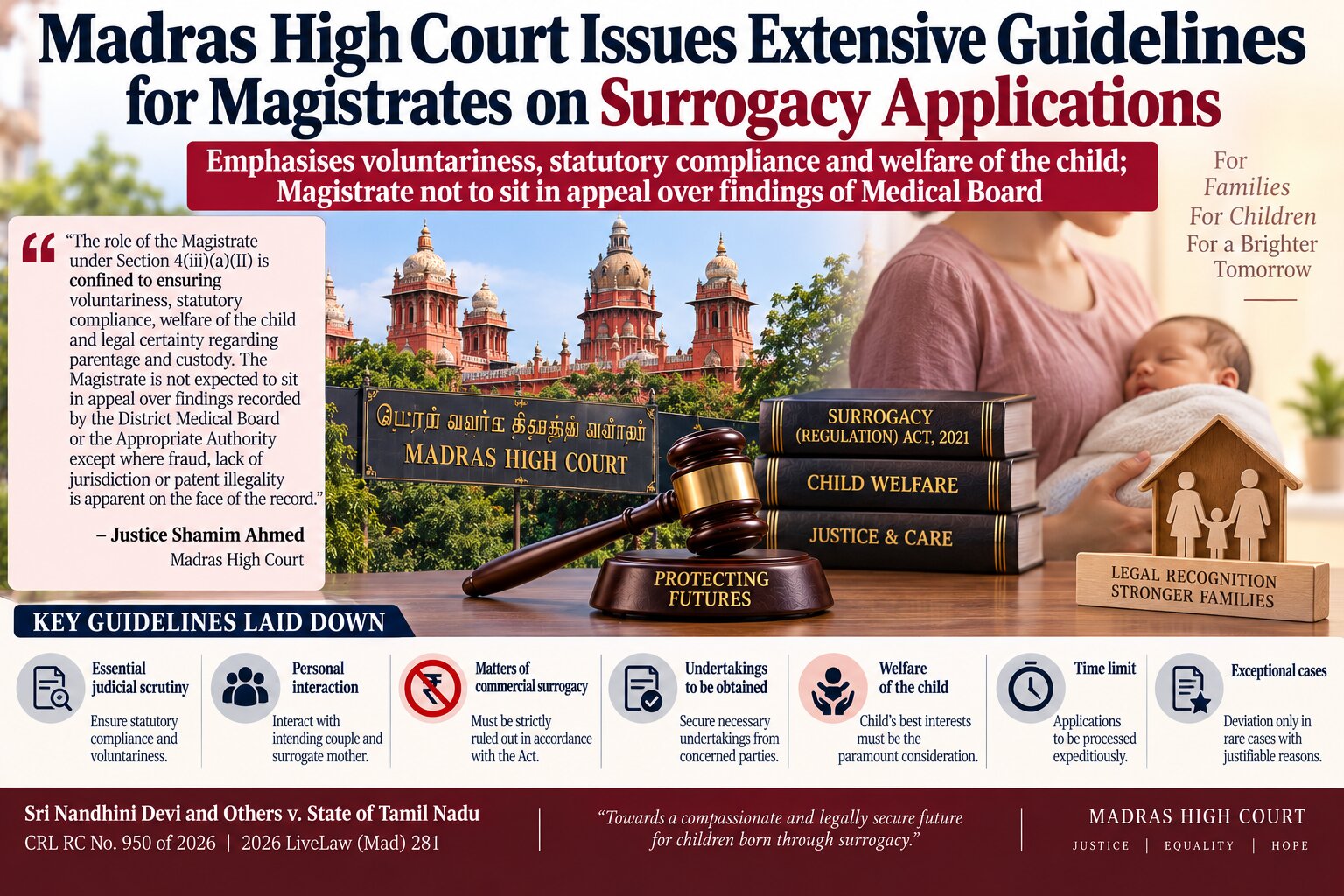
The Court observed that the Magistrate's role is primarily to ensure voluntariness, statutory compliance, welfare of the child and legal certainty regarding parentage and custody.
-
The Court laid down guidelines intended to bring uniformity in judicial practice concerning applications under Section 4(iii)(a)(II).
-
The matter was remanded to the Magistrate for fresh consideration in accordance with the law and the guidelines issued by the High Court.
Held
-
A surrogate mother who is 50 years old but has not completed 51 years cannot be treated as age-ineligible merely because she has crossed the age of 50.
-
The Magistrate cannot impose a requirement that is not prescribed by the statutory scheme, such as mandatory examination of the surrogate mother's husband in the present circumstances.
-
The Magistrate's role under Section 4(iii)(a)(II) is to ensure voluntariness, statutory compliance, welfare of the child and legal certainty concerning parentage and custody.
-
The Magistrate is not an appellate authority over the findings or certificates issued by competent statutory and medical authorities.
-
Findings of the District Medical Board and Appropriate Authority should not ordinarily be reassessed by the Magistrate.
-
Interference with such findings may be justified where fraud, lack of jurisdiction or patent illegality is apparent.
-
Courts must ensure compliance with statutory safeguards while simultaneously avoiding interpretations that defeat the purpose of the legislation.
-
Uniform judicial procedures are necessary to prevent unnecessary hardship to intending couples, surrogate mothers and children born through surrogacy.
-
The Magistrate must respect the division of responsibilities between the various agencies involved in the statutory surrogacy framework.
Analysis
-
The judgment provides important guidance on the limited but significant judicial role under Section 4(iii)(a)(II) of the Surrogacy (Regulation) Act, 2021.
-
The Court recognised that surrogacy involves multiple specialised authorities, including the District Medical Board, Appropriate Authority, Insurance Authority and registered ART/Surrogacy Clinics. Each has a distinct statutory responsibility.
-
The Magistrate's function is therefore not to duplicate the assessment already undertaken by those authorities but to ensure that the statutory requirements relevant to parentage, custody, voluntariness and welfare of the child have been satisfied.
-
The Court's approach prevents a situation in which an intending couple is required to undergo repeated assessments by different authorities for the same eligibility question.
-
The ruling on age reflects a purposive interpretation of beneficial legislation. The Court preferred an interpretation that preserved access to the statutory surrogacy framework where the applicant had not actually crossed the relevant upper age threshold.
-
The Court was particularly concerned that the age requirement should not be applied mechanically when the applicant was 50 years, 9 months and 3 days old and had already received the necessary eligibility certification.
-
The Court also rejected the Magistrate's insistence upon examination of the surrogate's husband because the statutory provision did not make such examination a mandatory prerequisite for the proceedings.
-
This is significant because judicial proceedings cannot ordinarily be burdened with additional requirements that Parliament has not prescribed, particularly where such requirements may delay a time-sensitive surrogacy process.
-
The Court nevertheless preserved judicial scrutiny. The Magistrate remains responsible for ensuring voluntary participation, compliance with statutory safeguards and the welfare and legal status of the child.
-
The judgment therefore does not eliminate judicial oversight; instead, it defines its proper boundaries.
-
The Court's guidelines are intended to bring consistency in how Magistrates process applications under the Surrogacy Act, thereby reducing variations in practice between different courts.
-
The decision also recognises that delays in surrogacy-related proceedings can cause significant hardship to the intending parents, surrogate mother and, most importantly, the child.
-
The ruling establishes an important principle of institutional separation of functions: specialised medical and statutory authorities make eligibility-related determinations, while the Magistrate performs the judicial function prescribed by the Act.
-
The judgment therefore seeks to balance three considerations: statutory compliance, judicial oversight and avoidance of unnecessary procedural hardship.
-
The remand means that the High Court did not itself grant the final parentage and custody order; instead, it directed the Magistrate to reconsider the application in accordance with the statutory framework and the guidelines laid down by the High Court.