
Sri Manjukiran v. Smt. Bindu M B, 2026
Loss of Interest Not Sufficient for Divorce
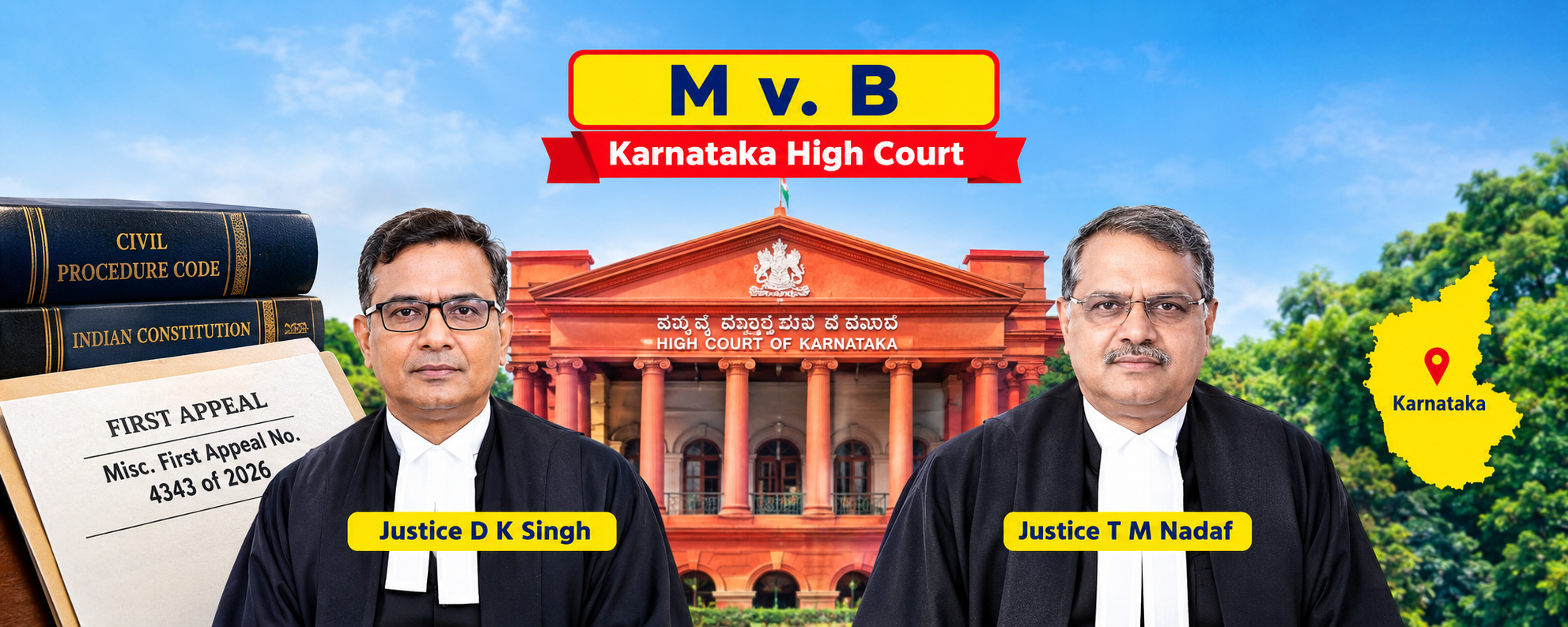
Judgement Details
Court
High Court of Karnataka
Date of Decision
26 September 2026
Judges
Justice D. K. Singh and Justice T. M. Nadaf
Citation
Acts / Provisions
Facts of the Case
-
The appellant-husband, Sri Manjukiran, and the respondent-wife, Smt. Bindu M B, solemnized their marriage on 15 December 2003.
-
It was a love marriage and inter-caste marriage.
-
A daughter was born from the marriage and, at the time of the proceedings, she was almost a major.
-
Earlier, the husband had filed M.C. No. 381/2019 seeking divorce.
-
The wife filed M.C. No. 857/2019 under Section 9 of the Hindu Marriage Act seeking restitution of conjugal rights.
-
Both proceedings were clubbed and decided by a common judgment. The wife's petition for restitution of conjugal rights was allowed, while the husband's divorce petition was dismissed.
-
After about 21 years of marriage, the husband again approached the Family Court in M.C. No. 404/2024, seeking divorce under Section 13(1A) of the Hindu Marriage Act.
-
The husband alleged that the parties had continued to live separately and had not resumed their conjugal relationship despite the decree for restitution of conjugal rights.
-
He argued that the marriage had irretrievably broken down and that he had made efforts to resume marital life.
-
The wife denied the allegations and stated that she had properly cared for her husband and his parents and had never insisted upon a separate residence or quarrelled with the husband or his family.
-
During cross-examination, however, the husband admitted that he had not resumed marital life because he was not interested and had no interest in resuming the marital relationship.
-
The Family Court dismissed his petition, following which he filed the present appeal under Section 19(1) of the Family Courts Act.
Issues
-
Whether the appellant was entitled to a decree of divorce under Section 13(1A) of the Hindu Marriage Act on the ground of non-resumption of marital life despite the earlier decree for restitution of conjugal rights?
-
Whether the husband could rely upon the continued separation of the parties when his own evidence showed that he was not interested in resuming the marital relationship?
-
Whether the Family Court's dismissal of the divorce petition called for interference by the High Court?
-
Whether the appellant could obtain relief by relying upon circumstances arising substantially from his own conduct?
Judgement
-
The Karnataka High Court dismissed the appeal and upheld the judgment and decree of the III Additional Principal Judge, Family Court, Mysuru, dated 6 March 2026.
-
The Court noted that the husband himself had admitted during cross-examination that he had no interest in resuming marital life with the respondent-wife.
-
The Bench rejected the argument that the marriage should be dissolved merely because the husband considered the marital relationship to be effectively over. The Court observed that under Hindu law, marriage is a sacrament and not merely a contract.
-
The Court further held that the appellant was attempting to take advantage of his own wrong, particularly in light of his own admission that he did not want to resume marital life.
-
Accordingly, the Division Bench found no ground to interfere with the Family Court's decision and dismissed the appeal. Any pending interlocutory applications were also disposed of as they did not survive after dismissal of the appeal.
Held
-
The appeal was dismissed.
-
Mere loss of interest in marriage is not by itself a basis for obtaining divorce.
-
A spouse cannot seek to benefit from a situation substantially attributable to his or her own conduct.
-
The husband's own admission that he had no interest in resuming marital life was significant.
-
The Court found no sufficient basis to interfere with the Family Court's decision.
-
The Family Court's dismissal of the husband's divorce petition was therefore confirmed.
Analysis
-
The case concerned the statutory consequences of non-resumption of marital life following a decree for restitution of conjugal rights. The Court did not treat the mere passage of time or physical separation as automatically entitling the husband to divorce.
-
A central feature of the judgment was the husband's admission in cross-examination that he had not resumed marital life because he was not interested in doing so. The High Court treated this evidence as important in assessing whether the appellant could obtain relief.
-
The Bench expressly stated that the appellant wanted to “take advantage of his own wrong.” The reasoning reflects the broader matrimonial-law principle that a party should not obtain statutory relief by relying upon circumstances substantially created or maintained through his or her own conduct.
-
The Court emphasised the traditional legal characterization of Hindu marriage as a sacrament rather than a contract. In the Court's reasoning, this meant that one spouse cannot simply withdraw from the marriage because he or she has lost interest in the relationship.
-
The husband contended that the marriage had effectively broken down. However, the High Court did not treat irretrievable breakdown of marriage, standing alone in the circumstances of this appeal, as sufficient to overturn the Family Court's judgment.
-
The Family Court had also found that the allegation of cruelty under Section 13(1)(ia) had not been established against the wife. This finding formed part of the background to the rejection of the husband's matrimonial claim.
-
The High Court ultimately found no ground to interfere with the Family Court's judgment and decree. Thus, the appeal was dismissed rather than substituting the High Court's view for the Family Court's factual assessment.
-
The judgment illustrates that prolonged separation, absence of marital interest, and a claimed breakdown of the relationship do not automatically result in a decree of divorce where the statutory requirements and surrounding conduct do not justify the relief sought. The case is particularly relevant to the relationship between restitution of conjugal rights, Section 13(1A), matrimonial conduct, and the principle against benefiting from one's own wrong.