
Sri Anumandala Rajesh Reddy v. State of Karnataka & Anr., 2026
Section 156(3) CrPC operates at the pre-cognizance stage.
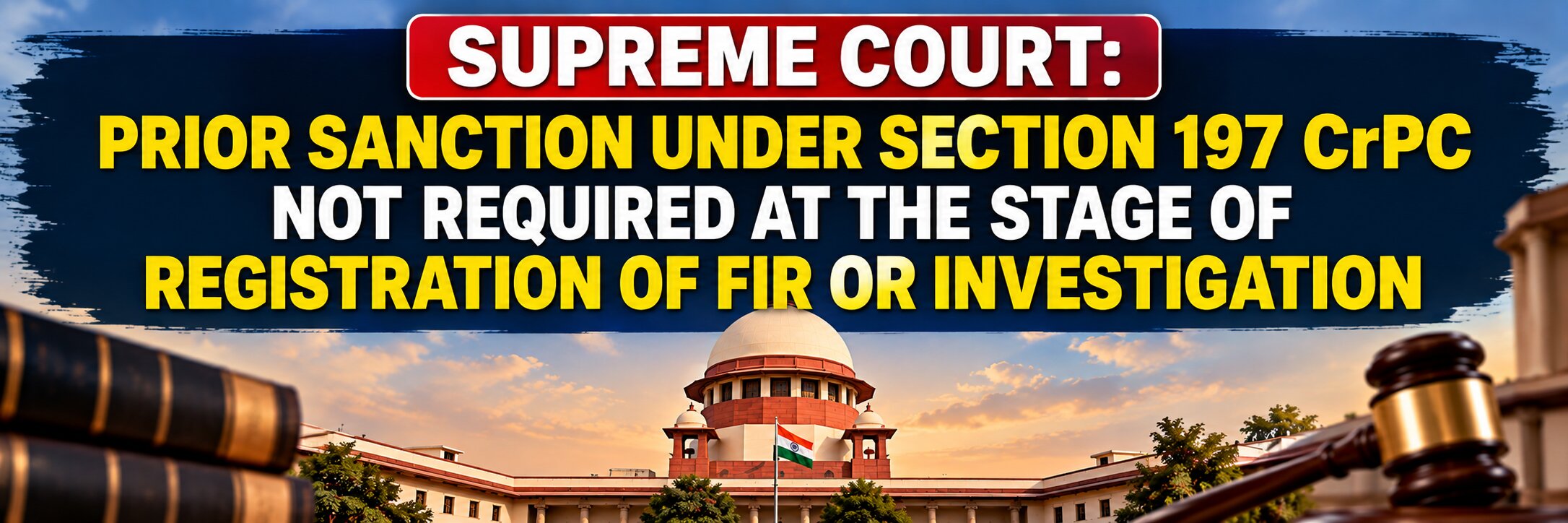
Judgement Details
Court
Supreme Court of India
Date of Decision
24 September 2026
Judges
Justice Vikram Nath and Justice Sandeep Mehta
Citation
Acts / Provisions
Facts of the Case
-
The appellant was involved in a business venture with a former business partner and others in Karnataka.
-
A dispute subsequently arose between the parties concerning their business relationship and interests.
-
The appellant alleged that, following the dispute, he was falsely implicated in a criminal case, illegally detained and subjected to pressure by police officials.
-
According to the allegations, the police officials coerced him into signing documents relinquishing his business interests, including his partnership and shares in a company.
-
The appellant was arrested in Crime No. 102 of 2020 and remained in custody for approximately seven days before being released on bail.
-
After the alleged incidents, the appellant approached the local police authorities with complaints seeking action against the persons allegedly responsible.
-
When no effective action was taken, he escalated his complaints to higher police authorities, including the Deputy Commissioner of Police and the Director General and Inspector General of Police.
-
The complaints nevertheless did not result in the action sought by him.
-
The appellant thereafter filed a private complaint under Section 200 CrPC before the Magistrate.
-
The Magistrate directed registration of an FIR and investigation under Section 156(3) CrPC against several persons, including police officials.
-
The concerned police officials approached the Karnataka High Court under Section 482 CrPC, seeking quashing of the FIR and the proceedings.
-
The High Court accepted two principal objections raised by the police officials.
-
First, it held that because the allegations related to acts allegedly performed in the discharge of official duties, prior sanction under Section 197 CrPC was necessary.
-
Second, the High Court held that the appellant had not complied with the safeguards laid down in Priyanka Srivastava v. State of Uttar Pradesh, particularly the requirement of approaching the police authorities before invoking Section 156(3) CrPC.
-
On these grounds, the High Court quashed the proceedings.
-
The appellant challenged the High Court's judgment before the Supreme Court.
-
The Supreme Court was therefore required to determine whether sanction under Section 197 was necessary at the FIR/investigation stage, and whether the appellant's prior complaints to various police authorities amounted to sufficient compliance with the object of Priyanka Srivastava.
Issues
-
Whether an order passed by a Magistrate under Section 156(3) CrPC directing registration of an FIR and investigation constitutes taking cognizance of an offence?
-
Whether prior sanction under Section 197 CrPC is required before registration of an FIR or commencement of investigation against a public servant?
-
Whether the requirement of sanction under Section 197 CrPC arises only when the court proceeds to take cognizance of the offence?
-
Whether the appellant had failed to comply with the safeguards laid down in Priyanka Srivastava v. State of Uttar Pradesh before invoking Section 156(3) CrPC?
-
Whether repeated complaints to local police authorities and subsequent approaches to superior police authorities can constitute substantial compliance with the object of Priyanka Srivastava?
-
Whether the Karnataka High Court was justified in quashing the FIR and proceedings on the grounds of absence of prior sanction and alleged non-compliance with Priyanka Srivastava?
-
Whether the Final Report submitted after the High Court's quashing order was liable to be reopened and the investigation resumed?
Judgement
-
The Supreme Court allowed the appeals and set aside the Karnataka High Court's judgment quashing the FIR and proceedings.
-
The Court held that a Magistrate's order under Section 156(3) CrPC directing registration of an FIR and investigation is a pre-cognizance step.
-
Such an order does not amount to the Magistrate taking cognizance of the offence under Section 190 CrPC.
-
The Court therefore rejected the High Court's conclusion that prior sanction under Section 197 CrPC was required before the FIR could be registered or investigation could commence.
-
Referring to State of Karnataka v. Pastor P. Raju and Ashwini Kumar Upadhyay v. Union of India, the Court reiterated that sanction under Section 197 is a condition precedent for taking cognizance, not for registration of an FIR or conducting an investigation.
-
The Court explained that criminal procedure follows a sequential structure: information regarding a cognizable offence, registration of FIR, investigation, submission of the police report and, thereafter, the question of sanction and cognizance arises.
-
The Court observed that treating sanction as a prerequisite for registration of an FIR would distort this statutory sequence and make the investigation mechanism unworkable.
-
The Supreme Court consequently held that the absence of Section 197 sanction could not justify quashing the FIR at the investigation stage.
-
On the second issue, the Court examined the purpose of the safeguards laid down in Priyanka Srivastava.
-
The Court recognised that those safeguards were intended to prevent the casual or mechanical invocation of Section 156(3) without first giving the police an opportunity to act.
-
The Court found that the appellant had in substance approached the police authorities and, when no action followed, had pursued the matter before superior police authorities.
-
In the particular circumstances, requiring the appellant to make another mechanically worded representation specifically to the Superintendent of Police would place form above substance.
-
The Court therefore held that the object underlying the Priyanka Srivastava safeguards had been substantially fulfilled.
-
The Supreme Court stressed that the Priyanka Srivastava guidelines should not be applied mechanically or divorced from the circumstances of an individual case.
-
The Court consequently held that both grounds relied upon by the High Court for quashing the proceedings were legally unsustainable.
-
Since the High Court's quashing order had resulted in the Investigating Agency submitting a Final Report closing the proceedings against the concerned accused, the Supreme Court directed that the Final Report be reopened.
-
The investigation was directed to resume from the stage at which the Final Report had been submitted, in accordance with law.
-
The Court clarified that if the investigation ultimately establishes the offences and the alleged acts of the public servants are found to have been committed in the discharge of official duty, the Investigating Officer should consider the requirement of sanction at the appropriate stage.
Held
-
A Magistrate's direction under Section 156(3) to register an FIR and investigate does not amount to taking cognizance.
-
Prior sanction under Section 197 CrPC is not required for registration of an FIR or investigation against a public servant.
-
The statutory requirement of sanction under Section 197 becomes relevant when the competent court proceeds to take cognizance of the offence.
-
The absence of prior sanction therefore cannot, by itself, be used to quash an FIR or investigation at the Section 156(3) stage.
-
The criminal process ordinarily proceeds sequentially through FIR registration, investigation, police report and cognizance, with the sanction requirement operating at the cognizance stage where applicable.
-
The safeguards in Priyanka Srivastava are intended to prevent casual or mechanical applications under Section 156(3), but they should not be applied as rigid technical formalities without considering whether their underlying purpose has been fulfilled.
-
Where a complainant has already approached the police and subsequently pursued the matter before superior police authorities, substantial compliance with the object of Priyanka Srivastava may be sufficient.
-
The High Court erred in treating the appellant as having approached the Magistrate without first pursuing police remedies when the record showed repeated approaches to police and superior officers.
-
The High Court's order quashing the FIR and proceedings was therefore set aside.
-
The Final Report submitted as a consequence of the quashing order was directed to be reopened, and investigation was ordered to resume from the relevant stage.
-
The requirement of sanction, if otherwise applicable, remains relevant at the appropriate later stage if the investigation establishes the offences and the acts are found to have been performed in the discharge of official duty.
Analysis
-
The judgment primarily clarifies the chronological architecture of criminal procedure. The Supreme Court separated the investigation stage from the cognizance stage and held that Section 197 operates only at the latter stage.
-
This distinction is important because a Section 156(3) order does not determine the guilt of the accused or even formally initiate judicial cognizance. Its immediate purpose is to set the investigative machinery in motion.
-
The Court's approach prevents Section 197 from becoming an early procedural barrier to investigation. Whether sanction will ultimately be required remains a question to be addressed when the court is called upon to take cognizance, subject to the statutory requirements applicable at that stage.
-
The decision therefore does not eliminate the protection afforded by Section 197 to public servants. Instead, it clarifies when that protection becomes operative.
-
The ruling also reinforces the principle that the existence of an official-duty defence or the possibility of a sanction requirement should not automatically prevent investigation into allegations that may disclose cognizable offences.
-
The Court's reliance on Pastor P. Raju and Ashwini Kumar Upadhyay places the decision within an established line of authority distinguishing FIR/investigation from cognizance.
-
The second major contribution of the judgment concerns Priyanka Srivastava. The Supreme Court did not discard its safeguards; rather, it interpreted them purposively.
-
The purpose of requiring prior approaches to the police is to ensure that Section 156(3) is not invoked casually when the ordinary police mechanism has not yet been tried.
-
In this case, the appellant had already complained to local police and subsequently approached senior police authorities, including the DCP and DG/IGP. Requiring another technically specific representation to the SP would not further the underlying purpose of the safeguard.
-
The Court's reasoning therefore illustrates the distinction between substantive compliance and mechanical procedural compliance.
-
Importantly, the judgment is fact-specific. It should not be read as eliminating the need to comply with Priyanka Srivastava in every Section 156(3) application. Where a complainant has genuinely made no prior attempt to approach the police, the safeguards may still be relevant.
-
The judgment also limits the use of the High Court's inherent jurisdiction under Section 482 CrPC at the investigation stage. The existence of a disputed factual narrative ordinarily provides a reason for caution before terminating an investigation at its inception.
-
The Court's direction to reopen the Final Report follows logically from setting aside the High Court's quashing order. The Final Report had been submitted specifically because the proceedings had been quashed; once that foundation disappeared, the investigation had to be restored to the stage at which it had been interrupted.
-
The judgment carefully preserves the eventual relevance of sanction under Section 197. If investigation establishes the offences and the alleged conduct is found to have been performed in discharge of official duty, the Investigating Officer must keep the question of sanction in view at the legally appropriate stage.
-
Thus, the decision does not prejudge whether sanction will ultimately be required or whether the accused public servants will be prosecuted. It only holds that lack of sanction cannot be used to prevent FIR registration and investigation at the pre-cognizance stage.
-
The decision has practical significance for complaints alleging misconduct by police or other public servants. It prevents an early sanction objection from stopping investigation before the factual record has been developed.
-
At the same time, the Court retained procedural safeguards against abuse by maintaining the underlying rationale of Priyanka Srivastava.
-
The judgment therefore balances two competing considerations: protecting public servants from vexatious prosecution through statutory safeguards while ensuring that those safeguards do not become a mechanism for preventing investigation altogether.
-
In practical terms, the judgment establishes a useful distinction: sanction is a protection at the cognizance stage, whereas Section 156(3) is an investigative mechanism at the pre-cognizance stage.
-
The decision is consequently significant for understanding the relationship among FIR registration, investigation, police report, sanction and cognizance under the CrPC and their corresponding framework under the BNSS.