
SPO/Constable IRB Satpal Singh v. State of Punjab & Ors., 2026
Probation Does Not Erase Criminal Conviction
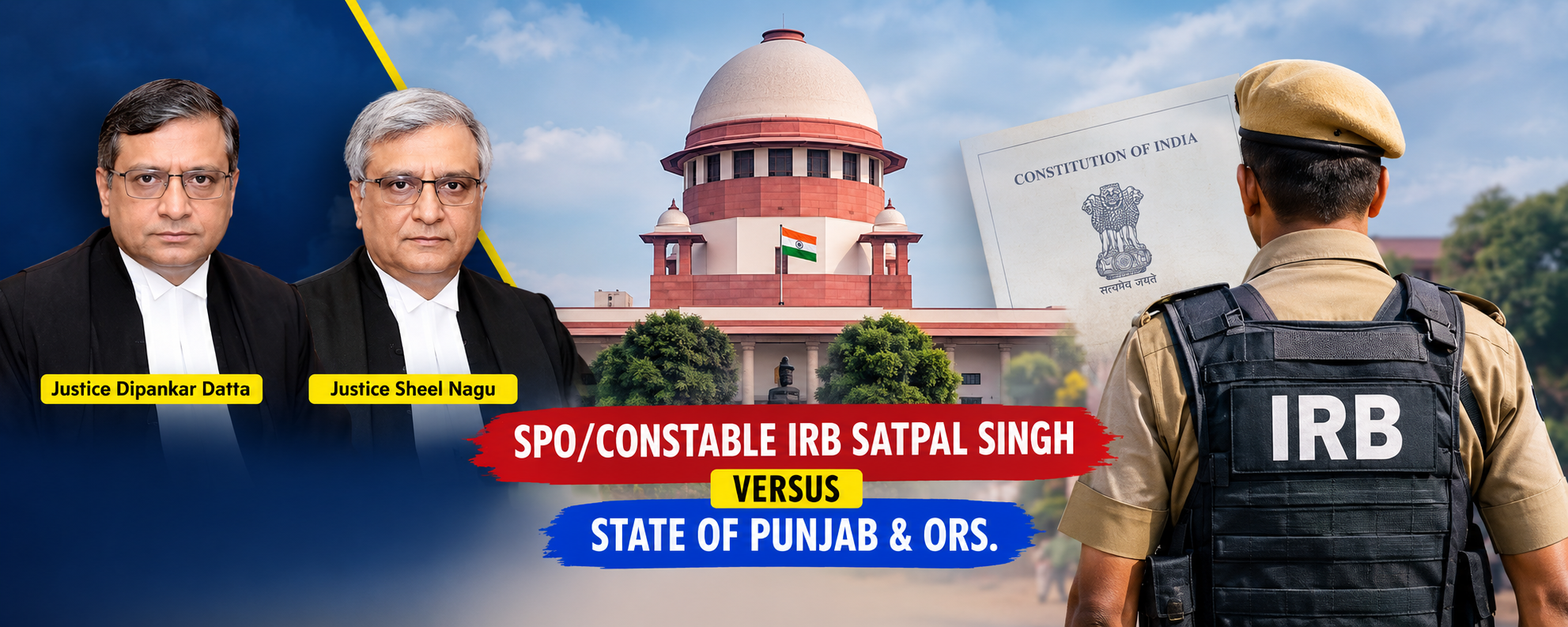
Judgement Details
Court
Supreme Court of India
Date of Decision
4 September 2026
Judges
Justice Dipankar Datta and Justice Sheel Nagu
Citation
Acts / Provisions
Facts of the Case
-
The appellant, Satpal Singh, was appointed as a Special Police Officer (SPO) in Police District Batala on 17 October 1991.
-
He was subsequently selected for appointment as a Constable in the First Indian Reserve Battalion (IRB), Patiala. Although he reported for joining on 30 August 2002, he was not permitted to join because a criminal case was pending against him.
-
The criminal case arose from FIR No. 159 dated 20 July 2001, registered under Sections 324/326/34 IPC.
-
On 14 January 2003, the appellant was discharged from service with reference to the pending criminal proceedings.
-
Subsequently, the criminal trial resulted in his conviction under Section 324 IPC, while the conviction under Section 326 IPC was set aside in appeal. He was released on probation of good conduct.
-
The appellate criminal court had observed that the conviction should not affect his service career. Relying upon this and Section 12 of the Probation of Offenders Act, the appellant sought relief through a civil suit.
-
The trial court decreed the suit and directed reinstatement. However, the first appellate court reversed the decree, and the Punjab and Haryana High Court dismissed his second appeal on 12 May 2016.
-
The matter ultimately reached the Supreme Court of India.
Issues
-
Whether mere pendency of a criminal case could legally justify the discharge/termination of the appellant from service.
-
Whether release on probation under the Probation of Offenders Act, 1958 prevents service-related consequences arising from a subsequent criminal conviction.
-
Whether Section 12 of the Probation of Offenders Act, 1958 effectively removes the consequences of a conviction for a person holding public employment.
-
Whether the appellant was entitled to reinstatement through a civil suit considering the applicable procedural and substantive law.
-
Whether the Supreme Court could grant compensation under Article 142 of the Constitution in the circumstances of the case.
Judgement
-
The Supreme Court examined the distinction between pendency of criminal proceedings and an actual criminal conviction.
-
The Court held that the appellant had been discharged from service at a time when the criminal case was merely pending. Such pendency, by itself, did not provide a lawful basis for terminating his service.
-
At the same time, the Court rejected the appellant's interpretation of Section 12 of the Probation of Offenders Act, 1958.
-
The Court clarified that release on probation does not obliterate a conviction. Section 12 protects against specified statutory disqualifications attached to a conviction, but it does not prevent lawful service action against a convicted public employee where the constitutional/service-law framework permits such action.
-
The Supreme Court also held that the earlier decision in Jaswant Singh v. State of Punjab did not lay down the correct law because it had failed to consider earlier Supreme Court precedents concerning the effect of probation on service.
Held
The Supreme Court held that:
-
Mere pendency of a criminal case cannot, by itself, be treated as a lawful ground for terminating or discharging a public employee.
-
However, release on probation does not erase or obliterate the criminal conviction and does not provide an absolute protection against service consequences arising from such conviction.
-
The Court did not order reinstatement, partly because of the procedural and evidentiary limitations in the civil proceedings and the absence of the original discharge order from the record.
-
Instead, exercising its power under Article 142, the Supreme Court directed the respondents to pay ₹5,00,000 (Rupees Five Lakh) as compensation to the appellant within three months.
Analysis
-
The judgment is significant for service law because it draws a clear distinction between a pending criminal case and a criminal conviction.
-
First, the Court found that the appellant's discharge was not justified because it occurred when the criminal case was only pending. The Court therefore treated the termination as legally unsustainable in the circumstances of the case.
-
Second, the Court clarified the scope of Section 12 of the Probation of Offenders Act, 1958. The provision does not mean that a person released on probation is treated as though no conviction occurred. Probation does not obliterate conviction.
-
The Court relied on a line of earlier Supreme Court decisions, including Southern Railway v. T.R. Chellapan, Trikha Ram v. V.K. Seth, Union of India v. Bakshi Ram, Karam Singh v. State of Punjab, DIG of Police v. P.R.K. Mohan, and Sushil Kumar Singhal v. Punjab National Bank.
-
The Court also clarified that Article 311 and its second proviso operate within the constitutional framework governing disciplinary action against holders of civil posts.
-
A further important aspect is the Court's discussion of the limitations of a civil suit. Since the matter arose from a civil suit rather than a writ petition, the Supreme Court emphasized that the case had to be considered on the basis of the pleadings, evidence and relief claimed. The original order of discharge and other important materials were not properly before the Court.
-
Consequently, instead of directing reinstatement, the Supreme Court invoked Article 142 to do complete justice and awarded ₹5 lakh compensation.