
Sobaran Singh (Dead) Through LRs v. Gordhan Singh (Dead) Through LRs, 2026
The Court must consider the actual consequences of the decree, including completed conveyance, ownership and long-standing possession.
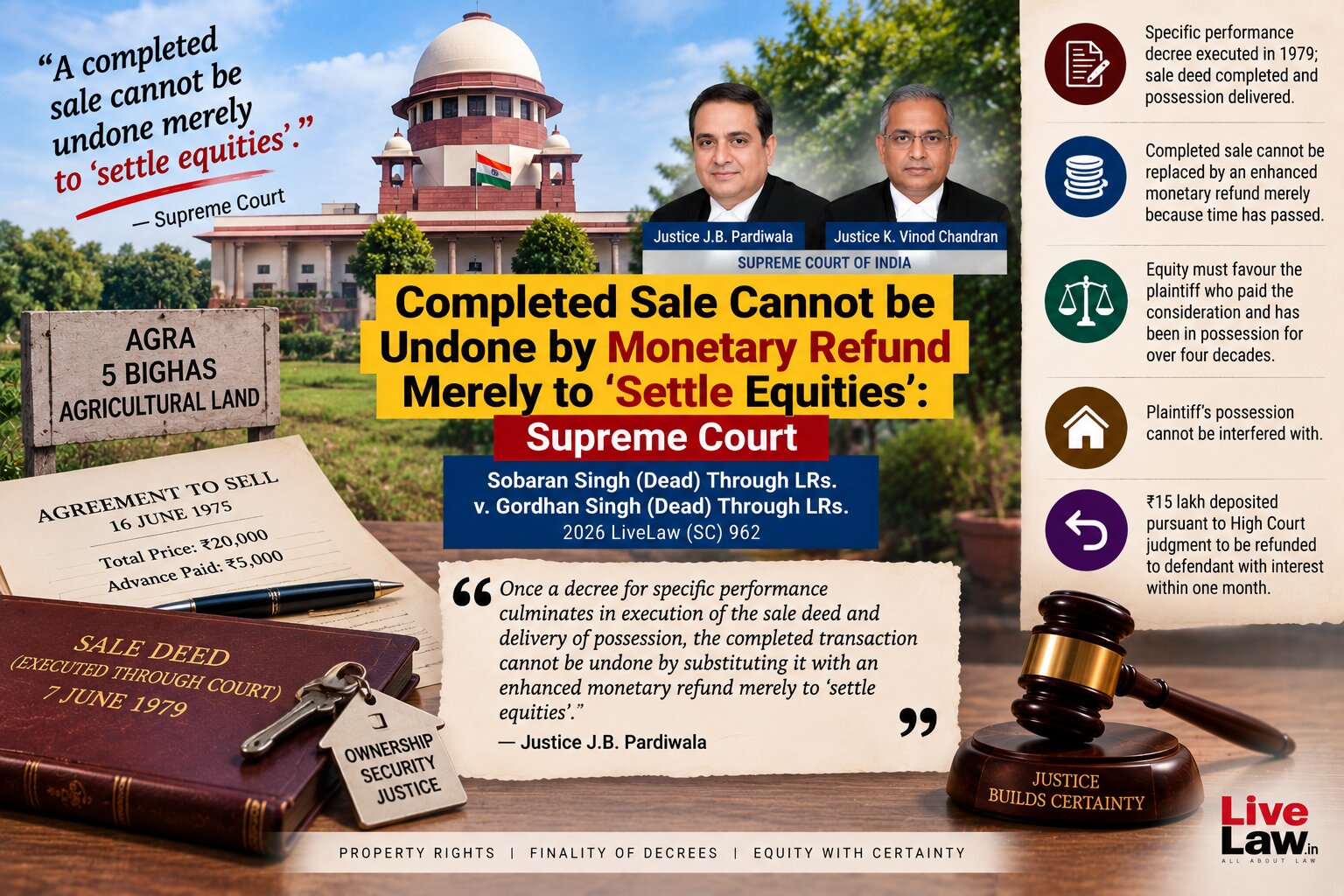
Judgement Details
Court
Supreme Court of India
Date of Decision
16 September 2026
Judges
Justice J.B. Pardiwala and Justice K. Vinod Chandran
Citation
Acts / Provisions
Facts of the Case
-
The dispute concerned approximately five bighas of agricultural land near Agra.
-
A registered agreement to sell was executed on June 16, 1975, under which the property was agreed to be sold within two years for ₹20,000.
-
The plaintiff paid ₹5,000 as advance under the agreement.
-
The Trial Court decreed specific performance on February 28, 1979.
-
Pursuant to the decree, the sale deed was executed through the Court on June 7, 1979.
-
The plaintiff was also stated to have remained in possession of the property since 1979.
-
The First Appellate Court reversed the Trial Court's decree, primarily holding that there was insufficient material establishing the plaintiff's readiness and willingness.
-
The Allahabad High Court found that the Trial Court's findings regarding the agreement and the defendant's defence were correct, but instead of restoring the completed sale, directed payment of ₹15 lakh with interest to the plaintiff to "settle equities" considering the passage of time.
-
The matter reached the Supreme Court, where the validity of replacing the completed sale transaction with monetary compensation was examined.
Issues
-
Whether a completed decree for specific performance, followed by execution of the sale deed and delivery of possession, can subsequently be replaced by an enhanced monetary payment merely on the ground that considerable time has elapsed?
-
Whether the High Court was justified in “settling equities” by directing payment of ₹15 lakh instead of restoring the completed sale transaction?
-
Whether the plaintiff's long-standing ownership and possession of the property pursuant to the 1979 decree could be displaced by a subsequent monetary award?
Judgement
-
The Supreme Court allowed the appeal and restored the Trial Court's decree for specific performance.
-
The Court held that the High Court's approach of replacing the completed sale with a monetary payment merely because considerable time had passed was unsustainable.
-
The Court noted that the sale deed had already been executed through the Court in 1979 and that the plaintiff had remained in possession for more than four decades.
-
The Court held that equity, in the circumstances, operated in favour of the plaintiff who had parted with the consideration decades earlier and obtained ownership and possession.
-
The ₹15 lakh deposited by the defendant pursuant to the High Court's judgment was directed to be refunded to the defendant, along with any interest accrued thereon, within one month.
-
The Court further directed that the plaintiff's possession could not be interfered with.
Held
-
Once a decree for specific performance has culminated in execution of the sale deed and delivery of possession, the completed transaction cannot ordinarily be undone merely to "settle equities" because of the passage of time.
-
In the present circumstances, equity favoured the plaintiff, who had paid consideration more than four decades earlier and obtained ownership and possession of the property.
-
The First Appellate Court's and High Court's decisions were therefore reversed and the Trial Court's decree was restored.
-
The plaintiff's possession was protected and the ₹15 lakh deposited pursuant to the High Court's order was ordered to be returned to the defendant.
Analysis
-
The judgment emphasizes the legal significance of a completed decree for specific performance. Once the decree has resulted in an executed sale deed and possession, the transaction acquires consequences that cannot be casually displaced by a later monetary adjustment.
-
The Supreme Court rejected the approach of treating the passage of time as, by itself, sufficient justification for converting the completed property transaction into a monetary claim.
-
The Court's reasoning gives importance to the fact that the plaintiff had parted with consideration decades earlier and had thereafter held the property in ownership and possession.
-
The judgment also illustrates that the concept of equity cannot be applied mechanically. Equity must be assessed in light of the actual circumstances and the rights already created through execution of the decree.
-
The decision distinguishes between awarding monetary compensation where appropriate and substituting an already completed conveyance with money after several decades.
-
By restoring the Trial Court's decree, the Supreme Court preserved the legal consequences flowing from the 1979 sale deed and the plaintiff's longstanding possession.
-
The case therefore underscores the importance of finality and stability of completed judicially directed property transactions.