
SN v. State of Odisha & Anr., 2026
The accused has a valuable right to prior disclosure of the material upon which the prosecution seeks to rely, enabling adequate preparation for trial.
Judgement Details
Court
Orissa High Court
Date of Decision
24 September 2026
Judges
Justice V. Narasingh
Citation
Acts / Provisions
Facts of the Case
-
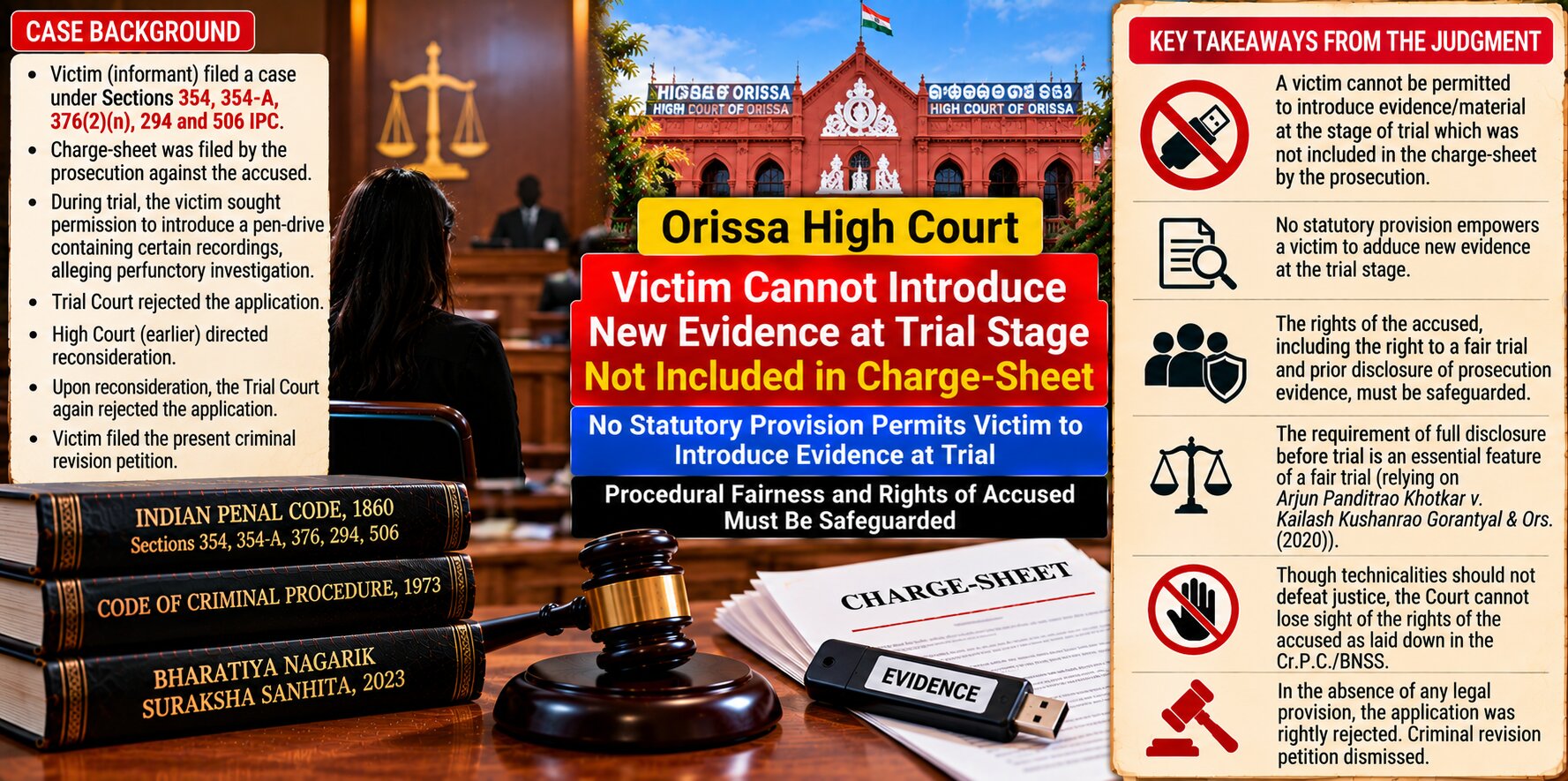
The petitioner was the informant/victim in a criminal case registered against the accused for offences under Sections 354, 354-A, 376(2)(n), 294 and 506 IPC.
-
The prosecution completed its investigation and submitted a charge-sheet against the accused.
-
After submission of the charge-sheet, the petitioner entered appearance in the criminal proceedings.
-
During the course of the trial, the petitioner sought permission to introduce a pen-drive containing recordings which, according to her, had a direct bearing on the allegations against the accused.
-
The petitioner contended that the additional material was necessary because the investigation conducted by the prosecution was allegedly perfunctory and had failed to place relevant evidence before the Trial Court.
-
The Trial Court rejected the petitioner's request to introduce the pen-drive.
-
The petitioner challenged that order before the High Court by filing a criminal revision petition.
-
In an earlier round, the High Court had directed the Trial Court to reconsider the petitioner's request.
-
Upon reconsideration, the Trial Court again rejected the application seeking to introduce the additional material.
-
The petitioner thereafter filed the present criminal revision petition challenging the renewed rejection.
-
In support of her contention, the petitioner relied upon the Supreme Court's judgment in Arjun Panditrao Khotkar v. Kailash Kushanrao Gorantyal (2020).
-
Interestingly, the opposite parties also relied upon the same Supreme Court judgment, contending that its principles relating to disclosure and fair trial supported the refusal to introduce the new material at that stage.
-
The High Court considered the unusual procedural situation in which the prosecution itself did not seek to introduce the additional material, while the victim sought permission to independently place it before the Trial Court.
-
The Court examined whether the victim possessed a statutory basis to introduce such new evidence during trial when the material had not formed part of the prosecution's charge-sheet and the accused had not received it as prosecution material before commencement of trial.
Issues
-
Whether the informant/victim can introduce new evidence or material during trial when such material was not included in the charge-sheet or prosecution material supplied before commencement of trial?
-
Whether the victim has an independent statutory power to place a pen-drive containing new recordings before the Trial Court when the prosecution itself does not seek to rely upon that material?
-
Whether permitting such additional material to be introduced during trial, without a statutory provision authorising the same, would prejudice the accused's right to a fair trial and prior disclosure of prosecution material?
-
Whether the principles laid down in Arjun Panditrao Khotkar v. Kailash Kushanrao Gorantyal support the petitioner's request to introduce the additional material at the trial stage?
-
Whether the Trial Court's refusal to permit introduction of the pen-drive material warranted interference in criminal revision?
Judgement
-
The Orissa High Court dismissed the criminal revision petition and upheld the Trial Court's refusal to permit the petitioner to introduce the additional pen-drive material during trial.
-
The Court recognised that the petitioner was the victim/informant and that she alleged deficiencies in the investigation conducted by the prosecution.
-
However, the Court held that the victim's status as informant or victim did not, by itself, confer an unrestricted statutory power to introduce new prosecution material at the trial stage.
-
The Court noted that the prosecution had already completed investigation and submitted its charge-sheet and that the prosecution itself was not seeking to add the disputed material.
-
The Court relied significantly upon the principle of fair disclosure to the accused before commencement of trial.
-
Referring to Arjun Panditrao Khotkar, the Court emphasised that an accused must be supplied the documents upon which the prosecution proposes to rely before trial so that the accused can properly prepare a defence.
-
The Court treated such disclosure not as a mere technical formality but as an important component of the accused's right to a fair trial.
-
The Court observed that although procedural rules are intended to advance justice, procedural flexibility cannot be used to tamper with or undermine the rights of the accused.
-
The petitioner could not identify a statutory provision authorising her to independently introduce the new material at that stage of the criminal trial.
-
The Court therefore declined to create such a procedural power through judicial interpretation in circumstances where the governing criminal procedure did not provide one.
-
The Court consequently found no basis to interfere with the Trial Court's order.
-
The criminal revision petition was accordingly dismissed.
Held
-
A victim cannot, as a matter of unrestricted right, introduce new evidence during trial that was not part of the prosecution's charge-sheet or disclosed prosecution material.
-
The principle of full disclosure before commencement of trial is an important component of the right to a fair trial.
-
The victim's participation in criminal proceedings does not automatically create an independent statutory power to introduce new prosecution evidence contrary to the procedural framework.
-
Where the prosecution itself does not seek to rely upon additional material, the victim cannot simply introduce such material during trial without identifying a statutory provision permitting the procedure.
-
Procedural rules may ordinarily be treated as handmaids of justice, but procedural flexibility cannot be exercised in a manner that prejudices or undermines the procedural rights of the accused.
-
The principles stated in Arjun Panditrao Khotkar concerning disclosure of prosecution material reinforce the importance of protecting the accused's ability to prepare for trial.
-
The Trial Court therefore acted within the permissible procedural framework in refusing the petitioner's request to introduce the pen-drive material.
-
The criminal revision petition was dismissed.
Analysis
-
The principal issue in the judgment concerns the balance between the victim's interest in placing relevant material before the criminal court and the accused's right to a fair and procedurally regular trial.
-
The Court did not proceed on the premise that evidence is irrelevant merely because it was not initially included in the charge-sheet. Instead, its concern was the procedural route and statutory authority for introducing such material during an ongoing trial.
-
The case is particularly significant because the additional material was sought to be introduced by the victim herself, rather than by the prosecution.
-
This distinction matters because a criminal prosecution is ordinarily conducted by the State through the prosecution agency, and the accused is entitled to know the case and material that the prosecution proposes to rely upon.
-
The Court therefore declined to equate the victim's participation in criminal proceedings with an unrestricted right to supplement the prosecution's evidentiary case at any stage.
-
The judgment places considerable emphasis on the fair-trial principle recognised in Arjun Panditrao Khotkar. The Supreme Court stressed that disclosure of prosecution documents before commencement of trial is an important safeguard because it allows the accused to understand the case and prepare an effective defence.
-
This principle becomes especially important where the proposed new material may have a direct bearing upon the guilt of the accused. Introducing such material unexpectedly during trial could alter the evidentiary case that the accused had prepared to meet.
-
The High Court consequently viewed the absence of a clear statutory provision authorising the victim to introduce the material as significant.
-
The Court's reasoning also reflects the principle that courts should not create a new procedural mechanism merely because it appears factually desirable, particularly where doing so may affect an accused's established procedural safeguards.
-
The judgment contains an important qualification to the expression that “procedure is the handmaid of justice.” Procedure should facilitate justice, but procedural flexibility cannot be exercised at the cost of a substantive fair-trial guarantee.
-
The Court therefore prioritised the accused's right to know and respond to the prosecution case in accordance with the procedure prescribed by law.
-
The decision is also important because the victim had alleged that the investigation was perfunctory. The Court did not treat an allegation of inadequate investigation as, by itself, sufficient to authorise the victim to introduce new material outside the prescribed procedural framework.
-
This does not mean that deficiencies in investigation are immune from judicial scrutiny. It means that any corrective mechanism must operate through a legally recognised procedure rather than through an unrestricted evidentiary right created for the victim at the trial stage.
-
The case also demonstrates why the stage of proceedings matters in criminal procedure. Material that could potentially have been considered during investigation or through an appropriate pre-trial procedure cannot necessarily be introduced for the first time during trial merely because a party considers it relevant.
-
The ruling reinforces the accused's right to prepare a defence on the basis of the prosecution case disclosed before trial.
-
At the same time, the judgment should not be read as establishing that no additional evidence can ever enter a criminal trial after the charge-sheet. Criminal procedure contains mechanisms through which courts may, in appropriate circumstances, summon witnesses, recall witnesses or consider additional material where statutory requirements are satisfied.
-
The narrower point decided here is that the victim cannot claim an independent, unrestricted entitlement to introduce new prosecution material during trial where no statutory provision was shown to authorise that course in the circumstances before the Court.
-
The judgment therefore places emphasis on statutory procedure rather than on the perceived usefulness of the proposed evidence.
-
The decision also reinforces the principle that an accused's fair-trial rights are not merely technical protections. They are designed to prevent surprise, allow meaningful cross-examination and enable the accused to prepare a coherent defence.
-
Ultimately, the Court concluded that permitting the pen-drive to be introduced in the manner sought, without a recognised statutory foundation, would risk disturbing the procedural balance of the criminal trial.
-
The revision was therefore dismissed, leaving the Trial Court to proceed in accordance with the material properly before it and the applicable criminal procedure.