
Smt. Kavitha Murthy v. State of Karnataka & Ors., 2026
The distinction between Section 305 and Section 306 IPC was material because the deceased was a child.
Judgement Details
Court
Karnataka High Court
Date of Decision
21 August 2026
Judges
Justice M. Nagaprasanna
Citation
Acts / Provisions
Facts of the Case
-
The petitioner's daughter, a Class 9 student, went missing from her home in Bengaluru in February 2022.
-
Her body was subsequently found near the railway tracks between Yeshwanthpur and Chikkabanavara.
-
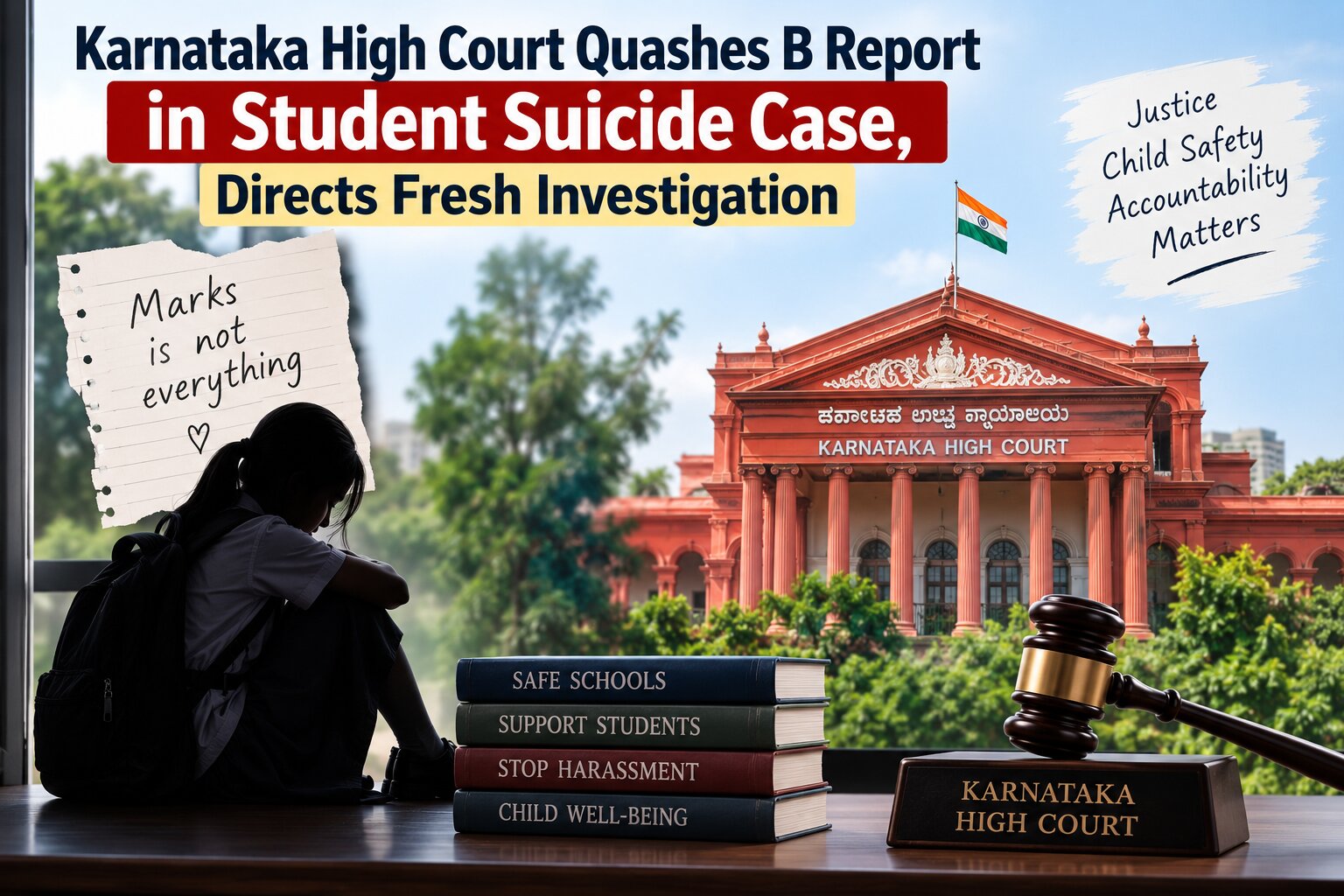
A death note was recovered in which the child allegedly referred to the school principal, teachers and classmates and stated that “marks is not everything.”
-
The FSL examination confirmed that the handwriting in the note belonged to the deceased child.
-
A criminal case was subsequently registered against the school management, principal and teachers under Sections 306 and 34 IPC.
-
The police initially submitted a B report, which the trial court rejected and directed further investigation.
-
A second investigating officer submitted another B report, which the trial court accepted in May 2025.
-
The mother challenged the acceptance of the second B report before the High Court.
Issues
-
Whether the investigation into the alleged abetment of suicide of a child was legally deficient by proceeding under Section 306 IPC instead of Section 305 IPC?
-
Whether the trial court was justified in accepting the second B report despite the death note and FSL report?
-
Whether the investigation adequately examined the alleged harassment and psychological impact of conduct by school authorities upon the child?
-
Whether a fresh investigation by a different police jurisdiction was warranted in the circumstances?
Judgement
-
The Karnataka High Court quashed the trial court's order accepting the second B report.
-
The Court also rejected the B report submitted by the investigating agency.
-
It found that the investigation had proceeded on the wrong legal premise by treating the matter as abetment of suicide by an adult under Section 306 IPC, despite the deceased being a child.
-
The Court held that abetment of suicide of a child under Section 305 IPC requires a different investigative approach.
-
The Court found that adequate significance had not been given to the death note and FSL report.
-
A fresh investigation was directed to be conducted by a different Investigating Officer from a different jurisdictional police unit.
-
The competent authority was directed to monitor the investigation and place the investigation papers before the concerned court within three months from its entrustment.
Held
-
Investigation concerning the alleged abetment of a child's suicide must take into account the child's particular psychological vulnerability.
-
The death note, particularly when its handwriting was forensically confirmed, required proper investigation and evaluation.
-
The second investigation was found to have substantially repeated the earlier approach instead of addressing the deficiencies identified in the first investigation.
-
The trial court ought not to have accepted the second B report in the circumstances.
-
The matter required re-investigation by an independent investigating officer from a different jurisdiction.
Analysis
-
The judgment underscores that the age of the deceased can fundamentally affect the legal framework and intensity of investigation into an alleged suicide.
-
The Court treated the distinction between Sections 305 and 306 IPC as substantive rather than merely technical.
-
A child's psychological response to alleged humiliation, harassment or pressure from teachers and school authorities cannot necessarily be assessed using the same approach applicable to an adult.
-
The Court was particularly concerned that the death note and FSL confirmation had not received appropriate investigative significance.
-
The findings in the second B report, including references to the child's academic difficulties, school rules and alleged parental shortcomings, could not substitute for a proper examination of the allegations against the school authorities.
-
The decision also highlights that a re-investigation must genuinely address earlier investigative deficiencies rather than simply reproduce the conclusions of the previous investigation.
-
By transferring the investigation to a different jurisdiction, the Court sought to ensure a fresh and impartial examination of the circumstances surrounding the child's death.
-
The ruling does not determine the guilt or innocence of the school authorities; it requires that the allegations be properly investigated under the correct legal framework.