
Smt. Indra Devi v. State of Rajasthan & Anr., 2026
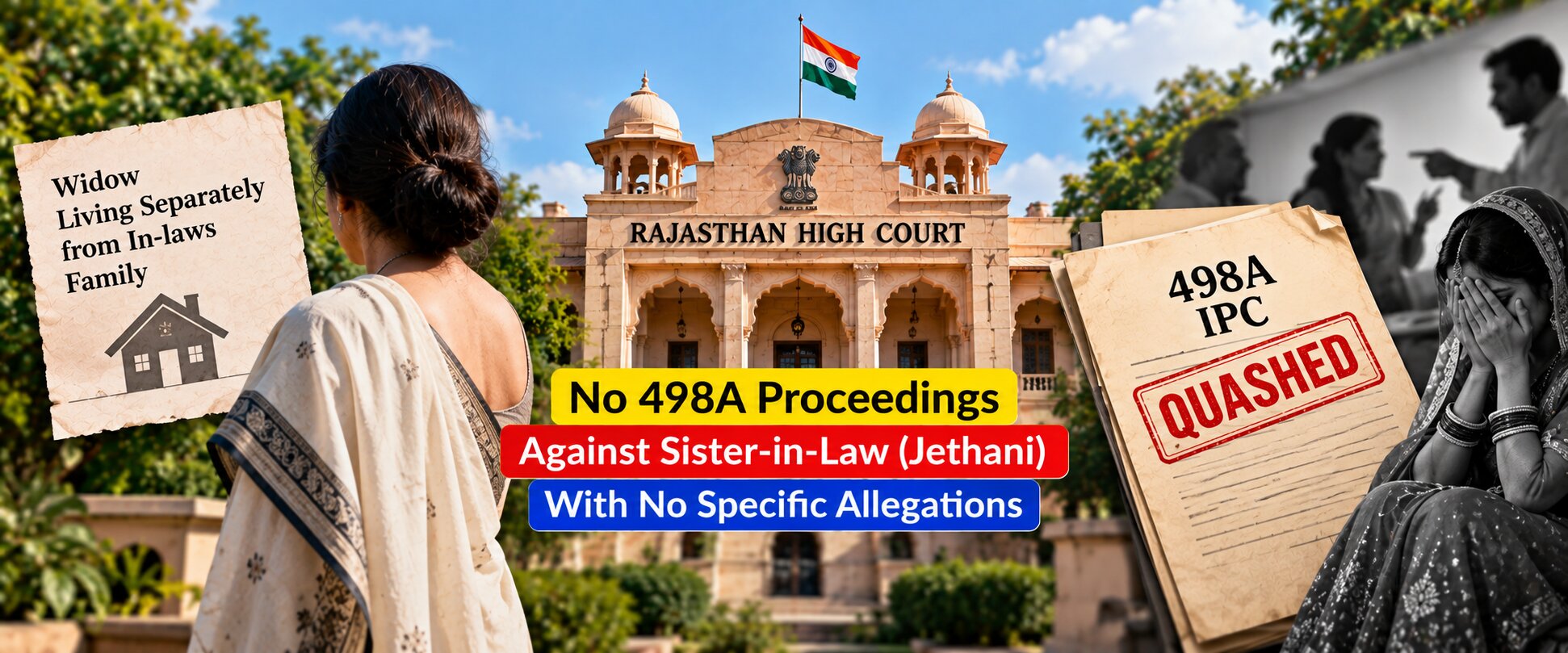
A person's mere relationship with the husband is not sufficient to sustain criminal proceedings under Section 498A IPC when specific allegations of individual involvement are absent.
Judgement Details
Court
High Court of Rajasthan
Date of Decision
1 September 2026
Judges
Justice Anoop Kumar Dhand
Citation
Acts / Provisions
Facts of the Case
-
The complainant was married to Lal Singh, who was the brother-in-law of the petitioner, Smt. Indra Devi.
-
The marriage took place on 19 February 2000, according to the factual findings recorded by the High Court.
-
At the time of marriage, both the complainant and Lal Singh were employed as government teachers.
-
They were posted at different places and were residing at their respective places of posting.
-
Matrimonial differences subsequently arose between the complainant and Lal Singh.
-
Lal Singh filed a divorce petition against the complainant.
-
Following the matrimonial dispute, the complainant lodged an FIR against Lal Singh and several members of his family, including the petitioner.
-
The allegations included dowry demand, harassment and cruelty.
-
The police conducted an investigation into the allegations.
-
After investigation, the police found sufficient material to submit a charge-sheet only against Lal Singh.
-
The police did not find the involvement of the petitioner and the other family members sufficiently established and submitted a negative final report in respect of them.
-
The criminal trial proceeded against Lal Singh.
-
During the trial, the complainant filed an application under Section 319 CrPC, seeking to bring the petitioner and other persons who had not been charge-sheeted into the proceedings.
-
The Magistrate initially rejected the Section 319 application on 1 December 2018.
-
The complainant challenged that decision before the Revisional Court.
-
The Revisional Court allowed the revision on 26 June 2019 and remanded the matter to the Magistrate for reconsideration.
-
Upon reconsideration, the Magistrate exercised power under Section 319 CrPC and took cognizance against the petitioner and other family members.
-
The impugned cognizance order was passed on 23 January 2023.
-
The petitioner was a widow and was residing at her matrimonial home, separately from the complainant and Lal Singh.
-
The petitioner contended that she had no involvement in the domestic affairs of the complainant and her husband.
-
She further argued that the allegations against her were general, vague and omnibus, without identifying any particular act of cruelty, harassment or dowry demand committed by her.
-
The petitioner also pointed out that the police investigation had not found sufficient material against her and that she had consequently not been charge-sheeted.
-
During the pendency of the proceedings, the petitioner's husband and the parents-in-law of the complainant also died.
-
The High Court therefore examined whether the material on record disclosed a prima facie case against the petitioner sufficient to sustain the Section 319 proceedings.
Issues
-
Whether a Magistrate can exercise power under Section 319 CrPC against a sister-in-law who was not charge-sheeted by the police?
-
Whether general, vague and omnibus allegations of dowry harassment are sufficient to sustain cognizance against a sister-in-law in the absence of any specific overt act?
-
Whether the mere relationship of a person as the jethani of the complainant is sufficient to establish a prima facie case under Section 498A IPC?
-
Whether the fact that the petitioner was a widow living separately from the complainant and her husband is relevant while determining her alleged involvement in the matrimonial dispute?
-
Whether the absence of specific allegations showing how the petitioner demanded dowry or subjected the complainant to cruelty or harassment justified quashing of the cognizance order?
-
Whether the order taking cognizance under Section 319 CrPC could be sustained when the police investigation had not found sufficient material against the petitioner and no specific overt act was subsequently demonstrated against her?
Judgement
-
The Rajasthan High Court allowed the petition filed by Smt. Indra Devi.
-
The Court examined the circumstances in which the petitioner had been brought into the criminal proceedings through Section 319 CrPC.
-
The Court noted that the police investigation had not established the involvement of the petitioner.
-
Consequently, the police had submitted the charge-sheet only against Lal Singh, while the petitioner and other family members were not charge-sheeted.
-
The Court recognized that a trial court is not automatically bound by the police decision not to charge a person and may, in appropriate circumstances, exercise power under Section 319 CrPC.
-
However, the existence of such power requires sufficient material before the Court to justify proceeding against the additional accused.
-
The Court examined the specific allegations made against the petitioner.
-
It found that no specific overt act had been attributed to her explaining precisely how she had subjected the complainant to cruelty or harassment.
-
The allegations against the petitioner were found to be general, vague and omnibus.
-
The Court considered the petitioner's relationship with the complainant. She was the complainant's jethani, meaning the wife of the elder brother of the complainant's husband.
-
The Court also considered the fact that the petitioner was a widow.
-
The petitioner was residing at her matrimonial home, whereas the complainant and her husband were both government employees living at their respective places of posting.
-
The Court therefore found little material connecting the petitioner with the day-to-day matrimonial affairs of the complainant and her husband.
-
The Court observed that the petitioner had no apparent benefit or interest in any alleged dowry demanded by the complainant's husband or parents-in-law.
-
The Court relied upon the Supreme Court's decision in Preeti Gupta v. State of Jharkhand, which had cautioned against unnecessarily implicating numerous relatives of a husband in Section 498A proceedings through broad allegations.
-
The High Court emphasized that mere relationship with the husband is not sufficient to sustain criminal proceedings where specific allegations of individual involvement are absent.
-
The Court concluded that there was no prima facie case against the petitioner.
-
The High Court therefore quashed and set aside the Magistrate's order dated 23 January 2023 taking cognizance against the petitioner.
-
As a consequence, the Revisional Court's order dated 26 June 2023 was also quashed and set aside.
-
The criminal miscellaneous petition was accordingly allowed.
Held
-
General, vague and omnibus allegations against a sister-in-law are insufficient to establish a prima facie case where no specific overt act is attributed to her.
-
The Court must examine whether there is material showing how the particular accused participated in the alleged cruelty, harassment or dowry demand.
-
The fact that the petitioner was a widow living separately from the complainant and her husband was relevant to assessing the alleged involvement in the matrimonial affairs.
Analysis
- The petitioner's separate residence and lack of demonstrated involvement in the couple's domestic affairs weakened the basis for proceeding against her.
-
The police investigation had not found sufficient material against the petitioner and had not charge-sheeted her.
-
Although Section 319 CrPC permits the Court to proceed against a person who has not been charge-sheeted, that power must be supported by sufficient material establishing the person's involvement.
-
The absence of a specific overt act and the presence of only general allegations rendered the cognizance order unsustainable against the petitioner.
-
The Magistrate's order taking cognizance against Smt. Indra Devi and the subsequent revisional order were therefore quashed and set aside.