
Smt. Bipasha Paria @ Mondal v. Sri Kanak Kanti Paria, 2026
Mere procedural irregularities in service of summons are insufficient to set aside an ex parte decree when the defendant had notice and opportunity to contest.
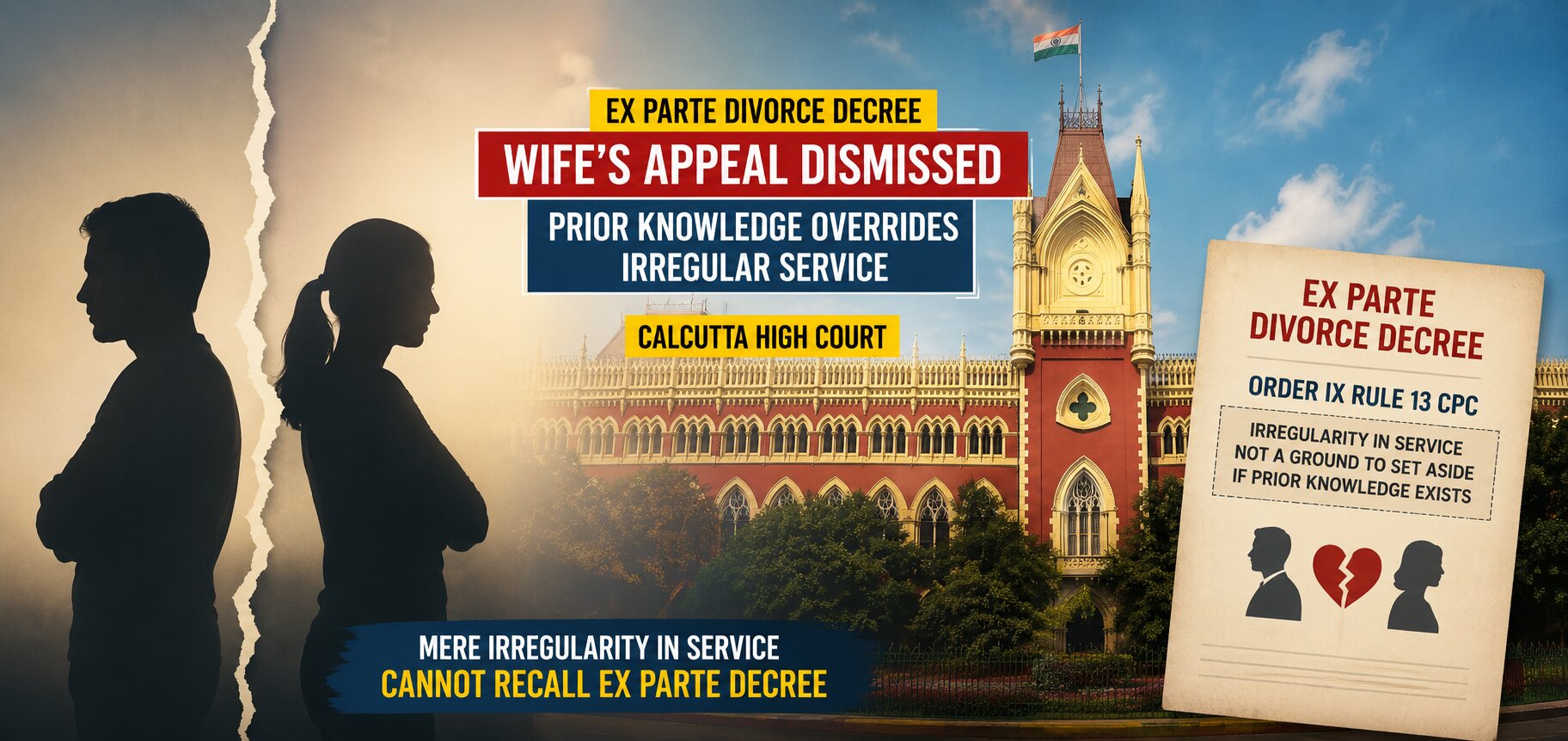
Judgement Details
Court
Calcutta High Court
Date of Decision
18 July 2026
Judges
Justice Sabyasachi Bhattacharyya & Justice Supratim Bhattacharya
Citation
Acts / Provisions
Facts of the Case
-
The husband filed a matrimonial suit seeking divorce before the District Judge at Alipore.
-
The wife did not appear in the matrimonial proceedings, leading to the passing of an ex parte divorce decree.
-
The wife subsequently filed an application under Order IX Rule 13 CPC seeking to set aside the ex parte decree.
-
She contended that she had never been properly served with summons in the matrimonial suit and came to know of the decree only at a later stage.
-
The wife argued that the husband deliberately avoided serving summons at her New Town address despite knowing it, as reflected from an eviction notice issued after obtaining the divorce decree.
-
She further alleged that the trial court improperly ordered substituted service under Order V Rule 20 CPC without exhausting ordinary modes of service and that the process server and postal official were never examined.
-
The Additional District Judge, Alipore dismissed her application under Order IX Rule 13 CPC.
-
Aggrieved by the dismissal, the wife filed an appeal before the Calcutta High Court.
-
The husband opposed the appeal by relying upon the second proviso to Order IX Rule 13 CPC and the Supreme Court judgment in Parimal v. Veena, asserting that the wife had prior knowledge of the divorce proceedings through his written objection filed in the maintenance proceedings under Section 125 CrPC.
Issues
-
Whether the ex parte divorce decree could be set aside under Order IX Rule 13 CPC on the ground of alleged irregularities in the service of summons?
-
Whether the wife had prior knowledge of the matrimonial proceedings and sufficient opportunity to contest the divorce petition?
-
Whether the substituted service ordered under Order V Rule 20 CPC was legally valid despite the alleged procedural defects?
-
Whether procedural irregularities in service of summons alone are sufficient to recall an ex parte decree in view of the second proviso to Order IX Rule 13 CPC?
-
Whether the trial court committed any legal or factual error in refusing to set aside the ex parte divorce decree?
Judgement
-
The Calcutta High Court dismissed the wife's appeal and affirmed the order of the Additional District Judge refusing to set aside the ex parte divorce decree.
-
The Court held that the wife had prior knowledge of the pending matrimonial proceedings through the husband's written objection filed in the maintenance proceedings under Section 125 CrPC.
-
The Court observed that even though the matrimonial case was subsequently renumbered after transfer, the original case number mentioned in the husband's objection was sufficient to enable the wife to trace the pending proceedings.
-
The Bench held that the second proviso to Order IX Rule 13 CPC is mandatory and bars setting aside an ex parte decree merely because of irregularities in service where the defendant had notice of the proceedings.
-
The Court relied upon the Supreme Court decision in Parimal v. Veena alias Bharti (2011) to reiterate that actual knowledge of the proceedings is more significant than technical defects in service.
-
The Court found that the alleged defects regarding substituted service and non-examination of the postal official were only procedural irregularities.
-
The Bench observed that judicial orders directing substituted service carry a presumption of correctness unless successfully rebutted.
-
The Court noted that the address where service was attempted had been furnished by the wife herself in earlier maintenance proceedings and had never been updated.
-
Finding no illegality or perversity in the trial court's order, the High Court dismissed the appeal.
Held
-
The wife had prior knowledge of the matrimonial proceedings.
-
Mere procedural irregularities in service of summons are insufficient to set aside an ex parte decree when the defendant had notice and opportunity to contest.
-
The second proviso to Order IX Rule 13 CPC bars relief in such circumstances.
-
The substituted service was not shown to be legally invalid.
-
The ex parte divorce decree remained valid, and the appeal was dismissed.
Analysis
-
The judgment reinforces that substantive justice prevails over procedural technicalities when a party has actual knowledge of legal proceedings.
-
The Court strictly applied the second proviso to Order IX Rule 13 CPC, emphasizing its mandatory nature.
-
Reliance on Parimal v. Veena ensures consistency with Supreme Court jurisprudence concerning ex parte decrees.
-
The decision underscores that procedural defects in service cannot be used as a tactical device to reopen concluded litigation where prior knowledge is established.
-
The Court reaffirmed the evidentiary presumption attached to judicial orders directing substituted service.
-
The ruling places responsibility upon litigants to remain vigilant once they become aware of pending proceedings.
-
The judgment discourages abuse of procedural provisions intended solely to delay the finality of judicial decisions.
-
The decision strengthens certainty and finality in matrimonial litigation by preventing unnecessary reopening of ex parte decrees on purely technical grounds.