
Smt. Anita Bhakat v. State of Jharkhand and Ors., 2026
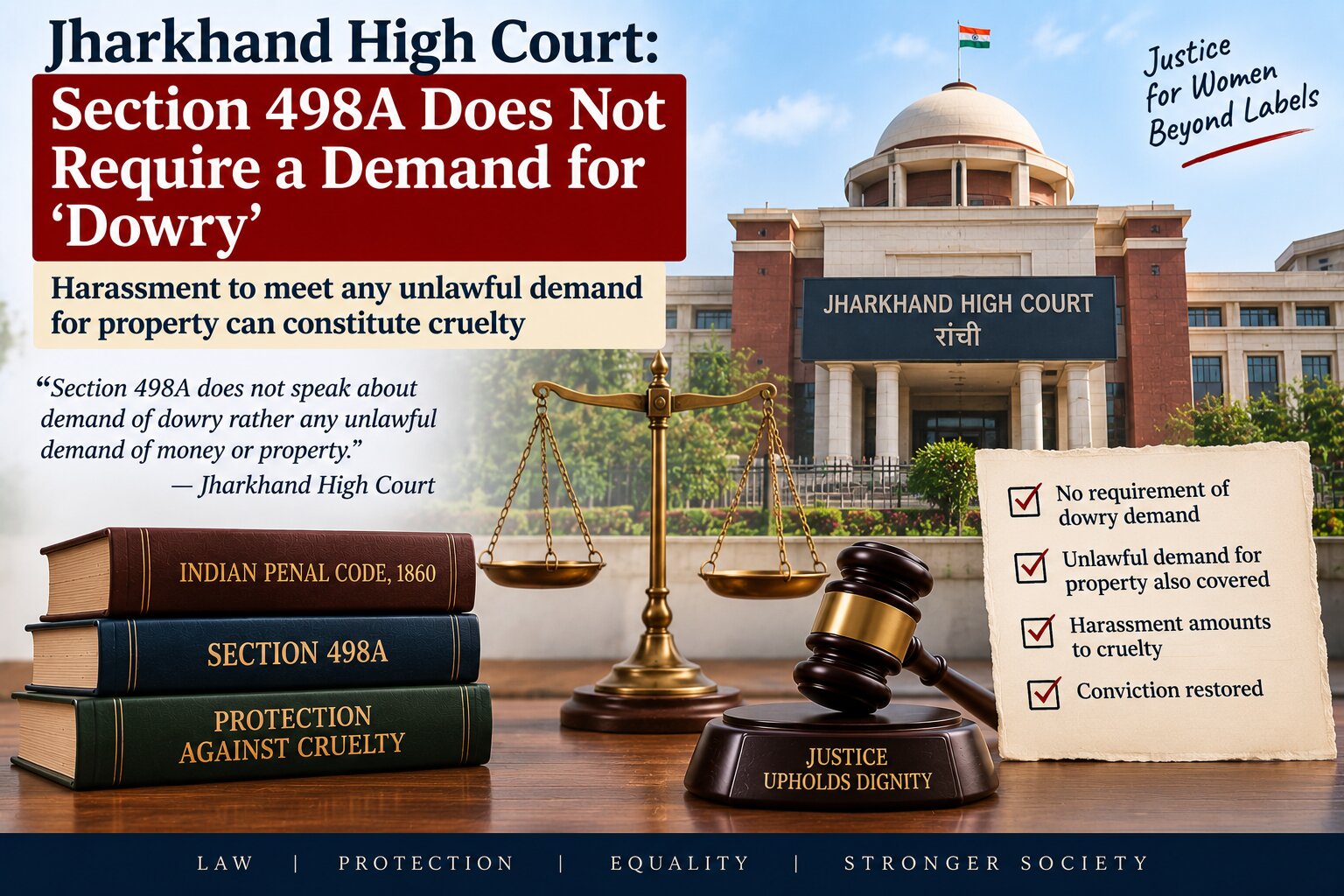
Section 498A IPC does not require every unlawful demand to be a dowry demand.
Judgement Details
Court
Jharkhand High Court
Date of Decision
27 August 2026
Judges
Justice Pradeep Kumar Srivastava
Citation
Acts / Provisions
Facts of the Case
-
The complainant married one of the accused in June 2008.
-
She alleged that cash of ₹1 lakh, gold ornaments and household articles were given to her husband and his family at the time of marriage.
-
After she became pregnant, her husband allegedly demanded another ₹1 lakh from her father for purchasing a hauler machine for his rice business.
-
When her father expressed inability to meet the demand, the complainant alleged that she was subjected to physical and mental cruelty by her husband and in-laws.
-
The Trial Court convicted the accused under Sections 498A and 323 IPC.
-
The Appellate Court subsequently acquitted them, holding that the demand was for business purposes and was not a dowry demand.
-
The complainant challenged the acquittal before the High Court.
Issues
-
Whether Section 498A IPC requires the unlawful demand to specifically constitute a demand for dowry?
-
Whether harassment to compel a woman or her relatives to meet an unlawful demand for money or property can constitute cruelty under Section 498A IPC?
-
Whether the Appellate Court erred in holding that a demand made for business purposes falls outside the scope of Section 498A IPC?
-
Whether the findings of the Appellate Court were perverse and legally unsustainable warranting interference in revision?
Judgement
-
The High Court allowed the criminal revision.
-
It set aside the Appellate Court's judgment of acquittal.
-
The Court held that Section 498A IPC is not confined to demands specifically described as dowry.
-
The provision also covers harassment intended to coerce a woman or her relatives to meet an unlawful demand for property or valuable security.
-
The Court found that the Appellate Court had adopted an excessively narrow interpretation of Section 498A.
-
The demand for ₹1 lakh could not be taken outside Section 498A merely because the alleged purpose was to purchase machinery for the husband's business.
-
The Trial Court's conviction and sentence under Sections 498A and 323 IPC were restored and upheld.
Held
-
Harassment intended to compel a woman or her relatives to satisfy an unlawful demand for property or valuable security can constitute cruelty.
-
The fact that money was allegedly demanded for business development does not by itself make the demand lawful.
-
The statutory expression “any unlawful demand” cannot be artificially restricted to dowry.
-
Where the unlawful demand is accompanied by harassment or coercive conduct satisfying the ingredients of Section 498A, the provision can be attracted.
-
The Appellate Court's reasoning that the absence of a dowry demand excluded Section 498A was held to be unwarranted and perverse.
-
The Trial Court's conviction was therefore restored.
Analysis
-
The judgment is important because it distinguishes between dowry demand and the broader statutory concept of an unlawful demand for property or valuable security.
-
The High Court relied upon the actual language of the Explanation to Section 498A rather than restricting the provision to situations expressly labelled as dowry.
-
The Court rejected the argument that a demand automatically falls outside Section 498A merely because the money was allegedly intended for a commercial or business purpose.
-
What matters is whether the demand was unlawful and whether the woman was subjected to harassment to compel her or her relatives to satisfy that demand.
-
The decision prevents an accused from escaping Section 498A merely by describing the demanded money as being required for business, investment or another personal purpose.
-
At the same time, the ruling does not mean that every request for financial assistance between spouses or families constitutes cruelty. The statutory ingredients, including unlawful demand and connected harassment, must still be established.
-
The High Court also found that the complainant's allegations were supported by other evidence, including testimony from an independent witness.
-
The Appellate Court's focus on whether the demand technically amounted to “dowry” caused it to overlook the wider wording of Section 498A.
-
The judgment reinforces the principle that courts cannot introduce a limitation into a statutory provision that the legislature itself has not imposed.
-
The broader legal principle is that Section 498A protects against coercive cruelty connected with unlawful property demands, not merely demands bearing the label of dowry.