
Sinjini Mukherjee v. State of West Bengal, 2026
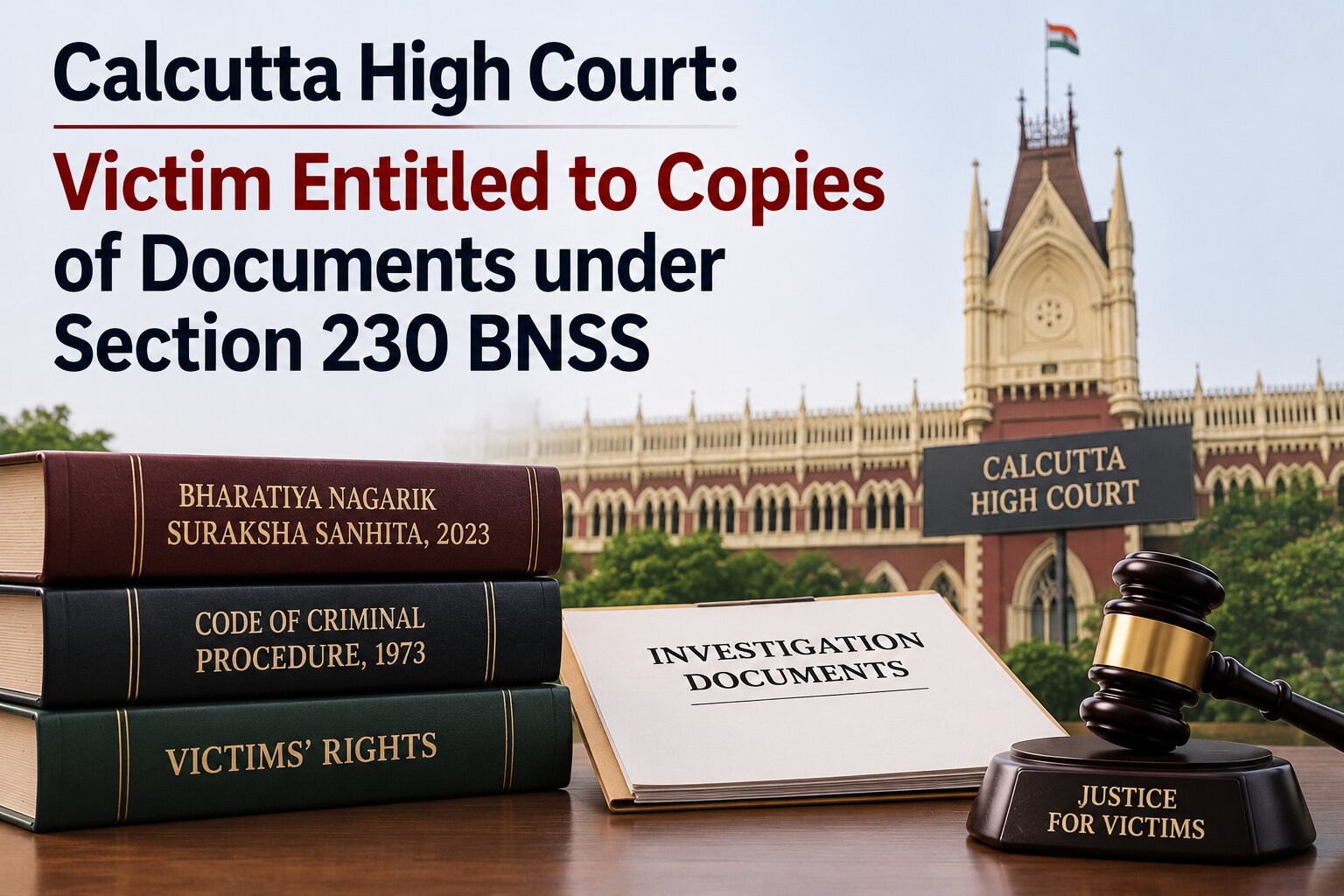
A victim represented by an advocate is entitled to the documents specified under Section 230 BNSS, subject to the statutory framework.
Judgement Details
Court
Calcutta High Court
Date of Decision
20 August 2026
Judges
Justice Dr. Ajoy Kumar Mukherjee
Citation
Acts / Provisions
Facts of the Case
- The petitioner was the de facto complainant/victim in G.R. No. 798 of 2022.
-
She sought legible copies of documents forming part of the investigation material.
-
Her application dated 15 July 2024 mistakenly referred to Section 207 CrPC.
-
The Magistrate rejected the request, reasoning that the proceedings had commenced when the CrPC was in force and that Section 207 did not provide such documents to a victim.
-
The petitioner contended that the application was substantively one under Section 230 BNSS, which expressly recognises the victim's entitlement to specified documents where represented by an advocate.
-
The State argued that the incorrect reference to Section 207 CrPC prevented the petitioner from claiming the benefit of Section 230 BNSS.
-
The High Court examined the effect of the BNSS coming into force on 1 July 2024 and the savings provision under Section 531 BNSS.
Issues
-
Whether a victim is entitled to copies of investigation documents under Section 230 BNSS when the application seeking such copies is filed after 1 July 2024?
-
Whether the repeal and savings provision under Section 531 BNSS preserves the applicability of the CrPC to a fresh application filed after the BNSS came into force?
-
Whether mentioning an incorrect statutory provision in an application can defeat a substantive legal right otherwise available under the applicable law?
-
Whether the Magistrate was justified in refusing copies of investigation documents to the victim on the ground that the underlying criminal proceeding commenced under the CrPC?
Judgement
-
The High Court allowed CRR 1162 of 2025.
-
It set aside the Magistrate's order dated 6 February 2025.
-
The Court held that the petitioner's application, filed on 15 July 2024, was governed by the BNSS because the CrPC had already been repealed on 1 July 2024.
-
Section 531(2)(a) BNSS saves proceedings that were already pending immediately before the commencement of the BNSS, but does not make the repealed CrPC applicable to a fresh application filed thereafter.
-
The Court held that Section 230 BNSS was therefore applicable and entitled the victim to the documents contemplated by that provision.
-
The incorrect reference to Section 207 CrPC was held not to be fatal.
-
The trial court was directed to provide the relevant documents to the petitioner within 10 days from communication of the High Court's order.
Held
-
A fresh application filed after 1 July 2024 is governed by the BNSS, even if the underlying criminal proceeding commenced during the operation of the CrPC.
-
Section 531 BNSS does not preserve the repealed CrPC for every subsequent procedural application.
-
A litigant's reference to the wrong statutory provision does not automatically defeat an otherwise available legal remedy.
-
Courts must examine the substance of the prayer, rather than mechanically relying upon the provision incorrectly cited by the applicant.
-
A victim's right to effective participation in criminal proceedings includes meaningful access to documents that the law entitles the victim to receive.
-
The Magistrate therefore erred in refusing the documents without considering Section 230 BNSS.
Analysis
-
The judgment is significant because it addresses the practical consequences of the transition from CrPC to BNSS.
-
The High Court distinguished between the underlying criminal proceeding and a fresh application filed after the new procedural law came into force.
-
The Court's interpretation of Section 531 prevents the savings clause from being used to indefinitely extend the operation of a repealed statute to every subsequent procedural step.
-
The decision also reinforces the principle that substantive rights should not ordinarily be defeated by technical drafting errors.
-
The petitioner clearly sought copies of investigation documents; the fact that she described the request under Section 207 CrPC did not change the substance of the relief.
-
The Court placed responsibility on the judiciary to identify and apply the correct law to the facts and relief presented before it.
-
This is particularly important in criminal proceedings, where victims may not always be legally trained and should not lose statutory rights merely because an application contains an erroneous section number.
-
The judgment further strengthens the evolving recognition of the victim as an active participant in criminal proceedings, rather than merely an informant or witness.
-
Access to investigation documents can be essential for determining whether the investigation was properly conducted and whether further legal remedies, including a protest petition, should be pursued.
-
By relying on Jagjeet Singh v. Ashish Mishra @ Monu, the Court connected the statutory right under Section 230 BNSS with the broader constitutional and procedural principle of fair and effective victim participation.
-
The ruling therefore combines two important principles: courts must apply the correct law, and victims must be afforded meaningful participation in criminal proceedings.
-
The decision ultimately ensures that a technical mistake in citing Section 207 CrPC does not become a barrier to a substantive right expressly recognised under the BNSS.