
Sidagam Jatlamma v. Pandaranki Veerababu & Ors., 2026
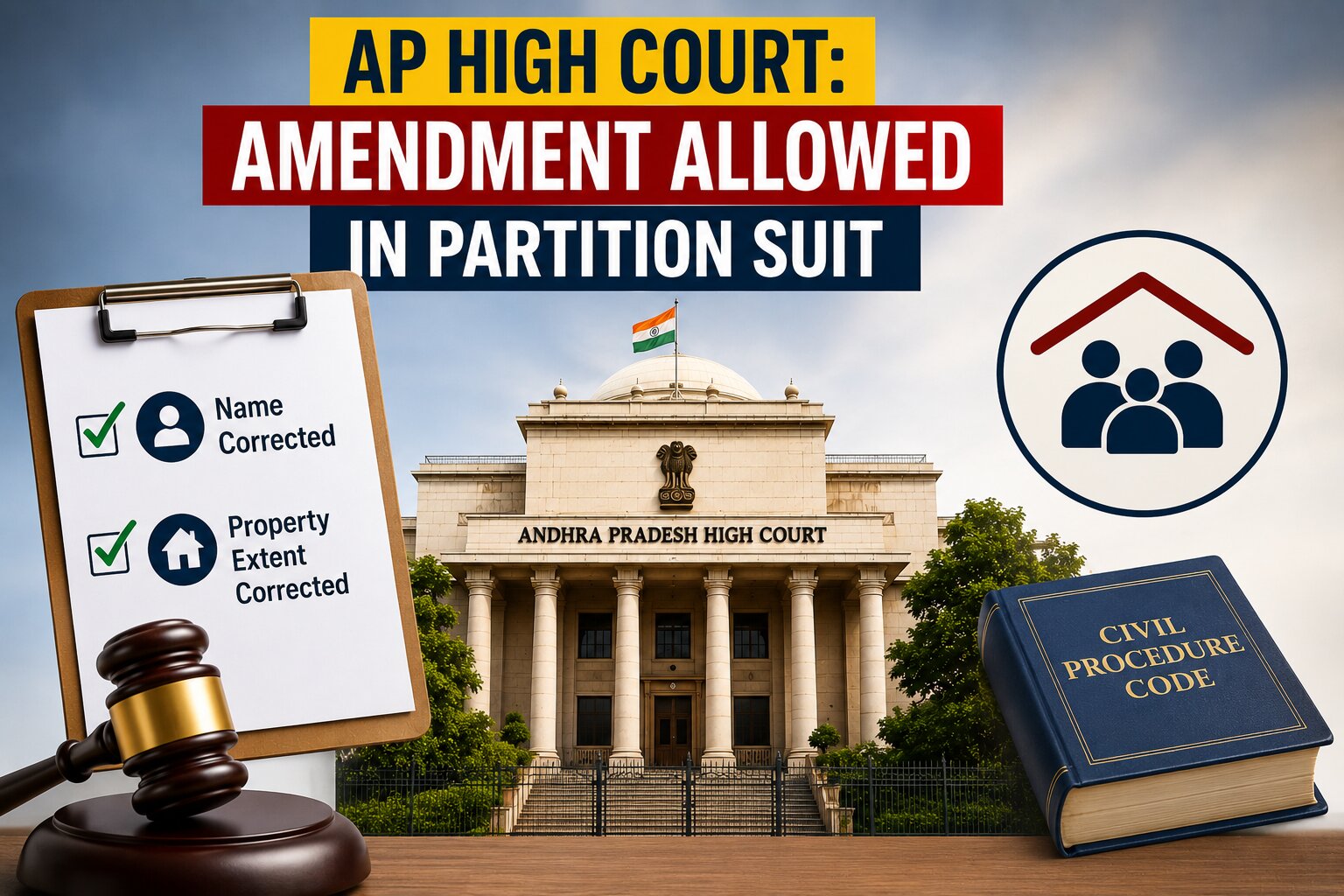
Amendment of the plaintiff's name to correct a typographical error is permissible under Order VI Rule 17 CPC.
Judgement Details
Court
Andhra Pradesh High Court
Date of Decision
21 July 2026
Judges
Justice Ravi Cheemalapati
Citation
Acts / Provisions
Facts of the Case
-
The petitioner instituted a partition suit seeking partition of the suit schedule properties.
-
During the pendency of the suit, she filed an application under Order VI Rule 17 CPC seeking amendment of the plaint.
-
The first amendment sought correction of her name in the cause title by removing an extra alphabet that had been inadvertently added due to a typographical error.
-
The second amendment sought correction of the extent of Item No. 1 of the plaint schedule property (A Schedule Property) from 1100 square yards/square metres to Ac.0.03 cents.
-
By the time the amendment application was filed, the plaintiff's evidence had already been completed and the case had reached the stage of recording the defendants' evidence.
-
The trial Court dismissed the amendment application holding that the plaintiff had failed to exercise due diligence, had approached the Court at a belated stage, and that the proposed amendment would alter the nature of the suit.
-
Aggrieved by the dismissal, the plaintiff filed a Civil Revision Petition before the Andhra Pradesh High Court.
-
The petitioner argued that the proposed amendments merely corrected typographical mistakes, did not alter the cause of action, and would not prejudice the defendants.
-
The respondents opposed the revision, contending that amendments after commencement of trial are permissible only upon proof of due diligence, which had not been established.
Issues
-
Whether an amendment application under Order VI Rule 17 CPC can be allowed after commencement of trial to correct the plaintiff's name and the extent of the suit property?
-
Whether the proposed amendments changed the nature or character of the partition suit?
-
Whether the plaintiff had demonstrated sufficient grounds to justify amendment despite filing the application after commencement of trial?
-
Whether the proposed amendments would prejudice the rights or defence of the respondents?
-
Whether the trial Court erred in dismissing the amendment application under Order VI Rule 17 CPC?
Judgement
-
The Andhra Pradesh High Court allowed the Civil Revision Petition and set aside the order of the trial Court.
-
The Court held that correction of the plaintiff's name in the cause title merely rectified a typographical mistake and did not affect the substance of the suit.
-
It further held that correction of the extent of Item No. 1 of the plaint schedule property from 1100 square yards/square metres to Ac.0.03 cents did not alter the identity of the property or the nature of the proceedings.
-
The Court observed that the proposed amendments did not change the cause of action or convert the suit into one of a different nature, as the litigation would continue to remain a partition suit.
-
The Bench reiterated that amendments should ordinarily be permitted if they are necessary for determining the real controversy between the parties.
-
The Court acknowledged that the proviso to Order VI Rule 17 CPC requires due diligence where amendments are sought after commencement of trial.
-
However, it held that even after commencement of trial, amendments may be permitted where they do not alter the nature of the suit, introduce a new cause of action, or prejudice the opposite party.
-
The Court accepted the petitioner's contention that boundaries prevail over the extent mentioned in the schedule and that the proposed correction was merely clerical in nature.
-
Since no prejudice would be caused to the defendants, the Court concluded that the trial Court had committed an error in rejecting the amendment application.
-
Accordingly, the amendment application was allowed.
Held
-
Correction of the extent of the suit schedule property did not alter the nature of the partition suit.
-
Amendments sought after commencement of trial are not automatically barred if they satisfy the requirements of justice.
-
The proposed amendments neither introduced a new cause of action nor prejudiced the respondents.
-
The trial Court erred in rejecting the amendment application.
-
The Civil Revision Petition was allowed.
-
The amendment application under Order VI Rule 17 CPC was permitted.
Analysis
-
The judgment reiterates the liberal approach adopted by courts while considering amendment of pleadings, provided the amendment facilitates adjudication of the real dispute between the parties.
-
The Court clarified that the proviso to Order VI Rule 17 CPC is intended to prevent abuse of the amendment process but should not be applied mechanically to reject genuine and innocuous corrections.
-
The decision emphasizes that procedural law is meant to advance the cause of justice rather than defeat substantive rights on technical grounds.
-
By permitting correction of typographical mistakes even after commencement of trial, the Court reaffirmed that amendments of a formal or clerical nature stand on a different footing from amendments introducing a new cause of action.
-
The judgment also reinforces the settled principle that in disputes relating to immovable property, property boundaries generally prevail over errors in measurement or extent, thereby reducing the significance of minor clerical mistakes.
-
The Court balanced the requirement of due diligence with the broader objective of ensuring complete and effective adjudication of disputes.
-
The ruling provides useful guidance to trial courts that amendments should not be refused solely because they are filed after commencement of trial if no prejudice is caused to the opposite party.
-
The decision strengthens the principle that procedural rules should be interpreted in a manner that furthers substantial justice rather than encouraging technical dismissals.