
Shri Suraj Chetry v. Smti. Nayanmoni Choudhury, 2026
Contradictions regarding the date or place of an alleged marriage do not automatically justify quashing maintenance proceedings.
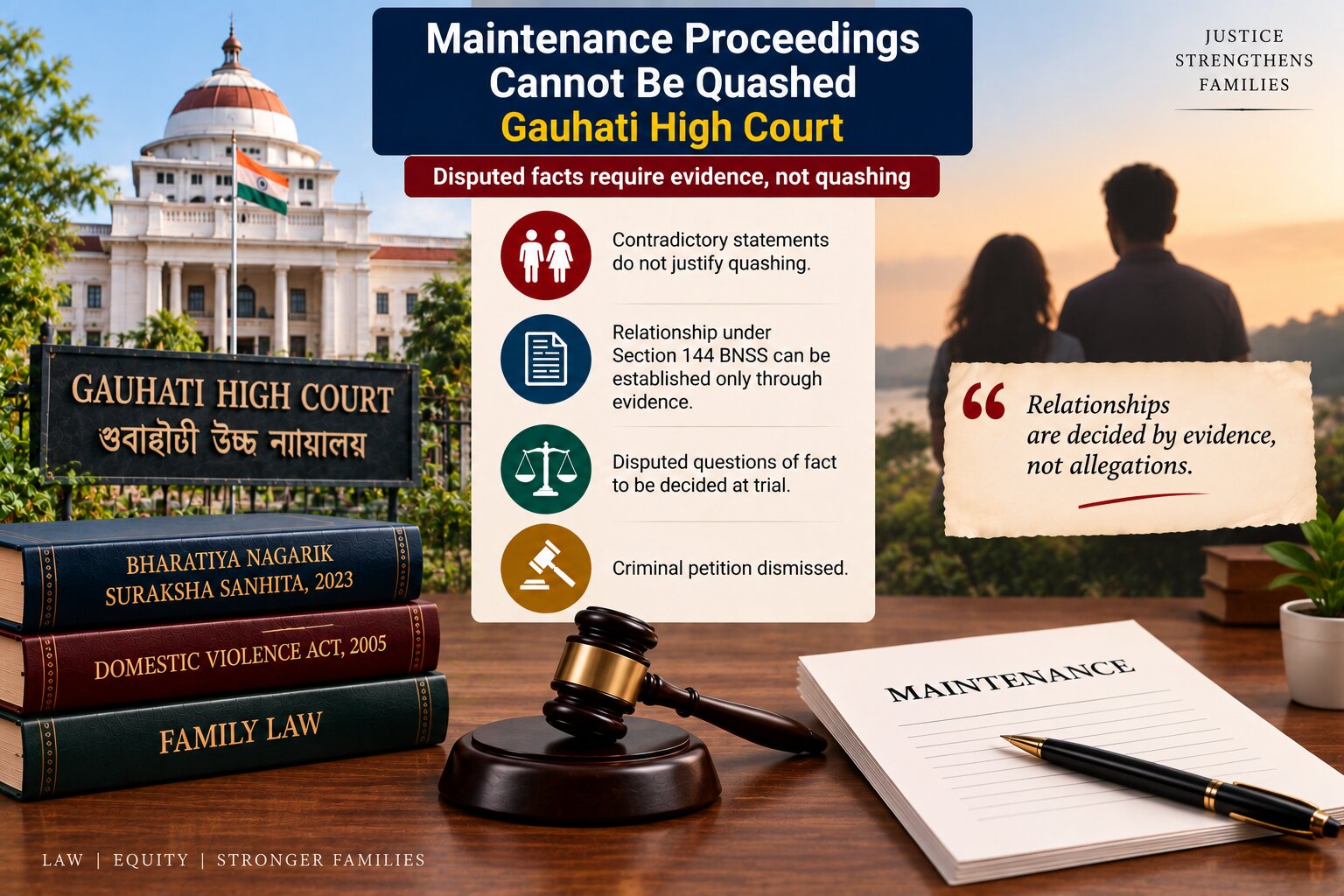
Judgement Details
Court
Gauhati High Court
Date of Decision
21 September 2026
Judges
Justice Sanjeev Kumar Sharma
Citation
Acts / Provisions
Facts of the Case
-
The petitioner and respondent had known each other through common friends while studying in Guwahati between September 2014 and August 2016.
-
According to the petitioner, the respondent proposed marriage to him, but he declined.
-
The petitioner alleged that following this, the respondent initiated several criminal and other proceedings against him.
-
One criminal case resulted in the petitioner's acquittal, while another was disposed of following withdrawal of prosecution.
-
The respondent also initiated proceedings under the Domestic Violence Act, 2005.
-
The respondent subsequently instituted maintenance proceedings under Section 144 BNSS before the Family Court.
-
The petitioner disputed that the respondent was his lawfully wedded wife.
-
He also denied that they had lived together in a relationship having the nature of husband and wife.
-
The petitioner relied upon alleged contradictions in the respondent's statements concerning the date and place of their alleged marriage.
-
In an affidavit filed in another proceeding, the respondent stated that the marriage had taken place on 27 January 2015 at Krishna Mandir, Narengi, Guwahati.
-
In the maintenance proceedings, however, she stated that the marriage had taken place at Dhemaji on 15 January 2015.
-
The petitioner also relied upon alleged inconsistencies in the respondent's statements concerning her pregnancies.
-
On the basis of these inconsistencies, the petitioner argued that the maintenance proceedings were motivated and deserved to be quashed.
-
The respondent argued that the disputed questions concerning marriage and the nature of the relationship required evidence and a full trial.
-
She contended that the High Court, while exercising inherent jurisdiction, should not determine disputed questions of fact that properly belonged before the trial court.
-
The High Court acknowledged that the contradictory statements regarding the date and place of marriage created some doubt concerning the alleged marriage.
-
However, the Court held that this doubt could not justify quashing the maintenance proceedings because the parties' actual relationship required determination through evidence.
Issues
-
Whether the maintenance proceedings under Section 144 BNSS can be quashed at the threshold merely because the respondent has made contradictory statements regarding the date and place of the alleged marriage?
-
Whether the question of whether the parties were legally married or were in a relationship in the nature of husband and wife requires determination through evidence at trial?
-
Whether disputed questions of fact concerning the nature of the relationship can be adjudicated by the High Court while exercising its inherent jurisdiction under Section 528 BNSS?
-
Whether the alleged inconsistencies in the respondent's statements regarding marriage and pregnancy provide sufficient grounds for quashing the pending maintenance proceedings?
Judgement
-
The Gauhati High Court declined to quash the maintenance proceedings pending before the Family Court.
-
The Court acknowledged that the respondent's different statements concerning the date and place of marriage created some doubt regarding the factum of marriage.
-
However, the Court held that such discrepancies were matters to be examined during the trial.
-
The Court observed that in proceedings under Section 144 BNSS, it is sufficient at the relevant stage to establish a relationship in the nature of husband and wife, and that this issue requires evidence.
-
The Court held that the question was not limited to determining whether a formally valid marriage had taken place.
-
It was also necessary to examine whether the parties had a relationship having the nature of husband and wife for determining entitlement to maintenance.
-
The disputed factual questions could therefore not appropriately be finally determined in proceedings seeking exercise of the High Court's inherent powers.
-
The petitioner would have an opportunity during the trial to challenge the respondent's evidence and establish his defence.
-
The Court consequently found no sufficient ground to exercise its inherent jurisdiction to terminate the maintenance proceedings.
-
The criminal petition was accordingly dismissed.
Held
-
Whether the parties were legally married, or whether their relationship was one in the nature of husband and wife, is a factual question that may require evidence.
-
Such disputed questions should ordinarily be determined during the trial rather than at the threshold while exercising inherent jurisdiction.
-
In proceedings under Section 144 BNSS, the nature of the relationship is relevant to determining whether the claimant is entitled to maintenance.
-
The High Court should exercise caution before quashing proceedings where the disputed facts require examination of evidence.
-
The petitioner can raise his objections and challenge the respondent's version during the proceedings before the competent court.
-
The petition seeking quashing was therefore dismissed.
Analysis
-
Disputed facts require evidence: The central principle of the judgment is that inconsistencies in pleadings or statements do not necessarily justify terminating proceedings when their resolution requires examination of witnesses and other evidence.
-
Marriage versus relationship in the nature of marriage: The Court treated these as separate factual questions. Even if the precise fact of a formal marriage is disputed, the nature of the parties' relationship may still require examination for the purpose of maintenance.
-
Section 144 BNSS: The decision demonstrates that maintenance proceedings under the BNSS involve examination of the factual relationship between the parties, rather than merely a preliminary determination based on documents or competing statements.
-
Limits of inherent jurisdiction: Section 528 BNSS gives the High Court inherent powers, but those powers are not ordinarily intended to conduct a mini-trial or conclusively determine disputed factual matters.
-
Contradictions are not automatically decisive: The Court expressly acknowledged the discrepancies concerning the alleged marriage but held that their significance should be assessed after evidence is led.
-
Opportunity to defend: The petitioner retains the opportunity to cross-examine the respondent, produce his own evidence and challenge the claim before the Family Court.
-
Procedural stage matters: The ruling reinforces the distinction between deciding whether a proceeding should continue and deciding the ultimate merits of the maintenance claim.
-
Practical significance: Where entitlement to maintenance depends upon the nature of a disputed relationship, parties generally cannot expect the High Court to conclusively resolve factual controversies at the quashing stage.
-
Limited scope of ruling: The Court did not hold that the respondent was in fact married to the petitioner or that she was ultimately entitled to maintenance. It only held that these questions required examination in the appropriate proceedings.