
Shri Prakash Narain Sharma (Dead) Through Legal Representative v. M/s. Burmah Shell Co-operative Respondents Housing Society (Regd.) Through Managing Committee Member Sh. P. Jindal & Others, 2026
SC Upholds HC Power to Correct Tribunal Findings Based on No Evidence
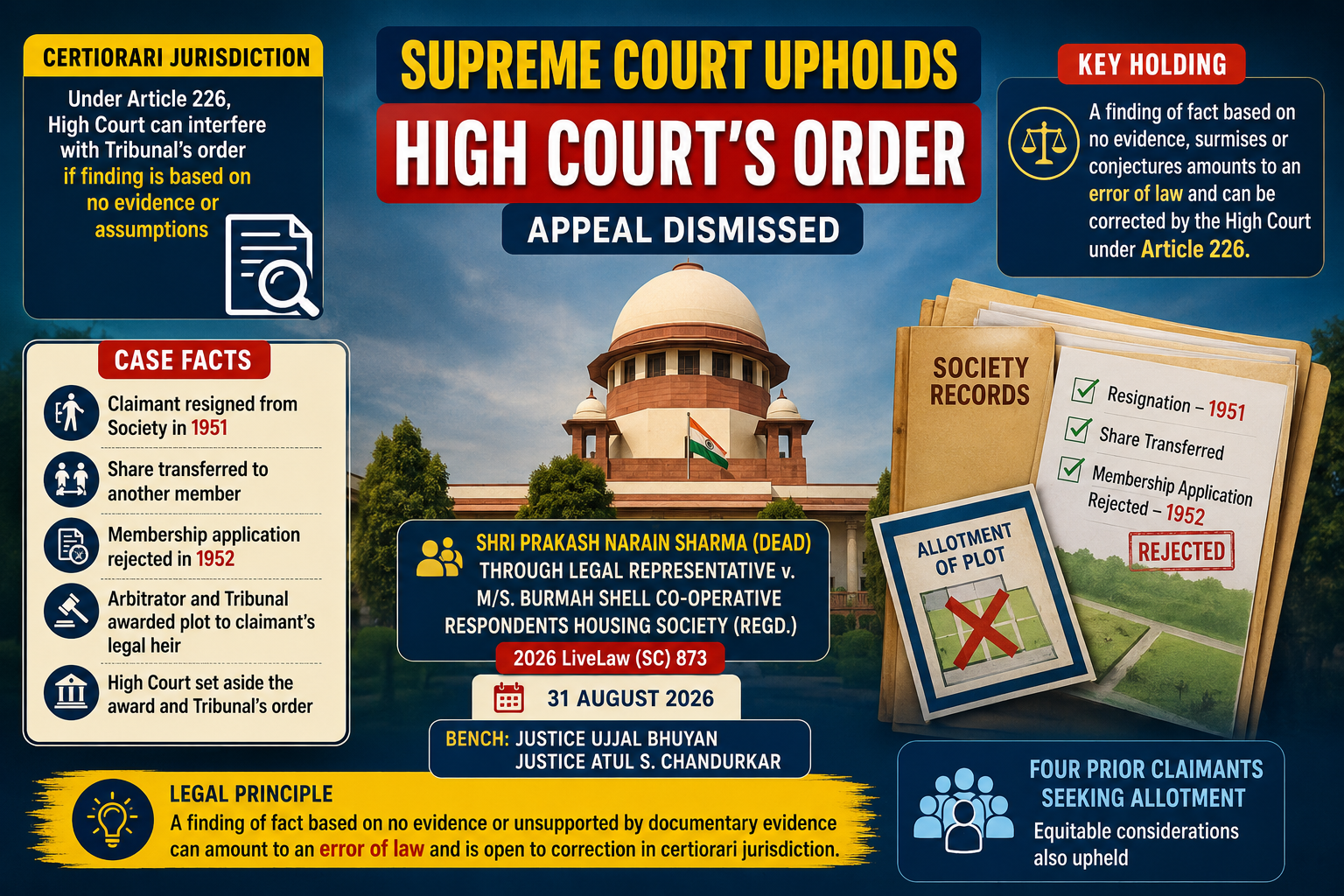
Judgement Details
Court
Supreme Court of India
Date of Decision
31 August 2026
Judges
Justice Ujjal Bhuyan and Justice Atul S. Chandurkar
Citation
Acts / Provisions
Facts of the Case
-
The original claimant asserted that he continued to be a member of the respondent cooperative housing society and was consequently entitled to allotment of a plot.
-
However, the Society's documentary records showed that the claimant had resigned from the Society in 1951.
-
His share in the Society was subsequently transferred to another member.
-
His later application for membership was also rejected in 1952.
-
Despite these records, the Registrar, acting as Arbitrator, proceeded on the assumption that the claimant had continued to remain a member and awarded the plot to his legal heir.
-
The Delhi Co-operative Tribunal upheld the Arbitrator's award.
-
The Delhi High Court, exercising its jurisdiction under Article 226, interfered with the Tribunal's order and set aside both the Tribunal's decision and the Arbitrator's award.
-
The legal representatives of the original claimant then approached the Supreme Court challenging the High Court's decision.
Issues
-
Whether a High Court can interfere under Article 226 with an order of a Tribunal when the findings recorded by the Tribunal are unsupported by evidence or documentary material?
-
Whether a finding of fact based on no evidence, or merely on surmises and conjectures, can constitute an error of law warranting interference in certiorari jurisdiction?
-
Whether the High Court was justified in setting aside the Arbitrator's award when relevant documentary evidence had been ignored?
-
Whether the original claimant, having resigned from the Society and having his subsequent membership application rejected, could claim entitlement to allotment of a plot?
-
Whether equitable considerations could also be taken into account by the High Court while exercising its certiorari jurisdiction?
Judgement
The Supreme Court dismissed the appeal and upheld the judgment of the Delhi High Court.
The Court held that although the scope of interference under certiorari jurisdiction is limited, the High Court can interfere where an error of law is apparent from the record.
The Supreme Court found that the Arbitrator's conclusion that the original claimant continued to be a member of the Society was not supported by documentary evidence. On the contrary, the Society's records demonstrated that:
-
the claimant had resigned in 1951;
-
his share had been transferred to another member; and
-
his subsequent application for membership had been rejected in 1952.
Therefore, the Arbitrator's conclusion was based upon an assumption rather than evidence.
The Court held that a finding of fact based on no evidence, or purely on surmises and conjectures, may amount to an error of law and can therefore be corrected by the High Court in certiorari proceedings.
The Supreme Court also agreed with the High Court that the relevant documents, if properly considered, would have resulted in a decision in favour of the Society. Further, considering that there were four prior claimants seeking allotment of a plot, the High Court was justified in taking equitable considerations into account.
Held
-
A High Court, while exercising its certiorari jurisdiction under Article 226, can interfere with a Tribunal's order where a finding is based on no evidence, unsupported documents, assumptions, surmises or conjectures, because such a finding can constitute an error of law.
-
The Supreme Court held that the Delhi High Court was fully justified in setting aside the Arbitrator's award and the Tribunal's order.
-
Appeal dismissed.
Analysis
-
Normally, while exercising certiorari jurisdiction, a High Court does not function as an appellate court and does not ordinarily reappreciate evidence or substitute its own view merely because another view is possible.
-
However, this restricted scope does not prevent the High Court from correcting an error of law apparent from the record.
-
The Supreme Court clarified that where an adjudicating authority records a factual finding without any supporting evidence, that finding can cross the boundary from a mere factual error into an error of law.
-
In the present case, the Society's records directly contradicted the Arbitrator's assumption that the claimant continued to be a member. Ignoring such material documentary evidence undermined the legal validity of the decision.
-
A finding cannot legally be sustained merely because an authority assumes a particular factual position. A finding founded on surmises or conjectures rather than evidence may be corrected through certiorari.
-
The judgment maintains the principle that Article 226 jurisdiction should not become a routine appellate review while simultaneously ensuring that Tribunals do not make legally unsustainable findings unsupported by the record.
-
The Court also approved the High Court's consideration of the fact that there were four prior claimants for allotment. Thus, even on equitable grounds, the claimant's case did not justify interference with the High Court's decision.