
Shivraj Singh v. State of U.P. Thru. Prin. Secy. Home Deptt. Lko., 2026
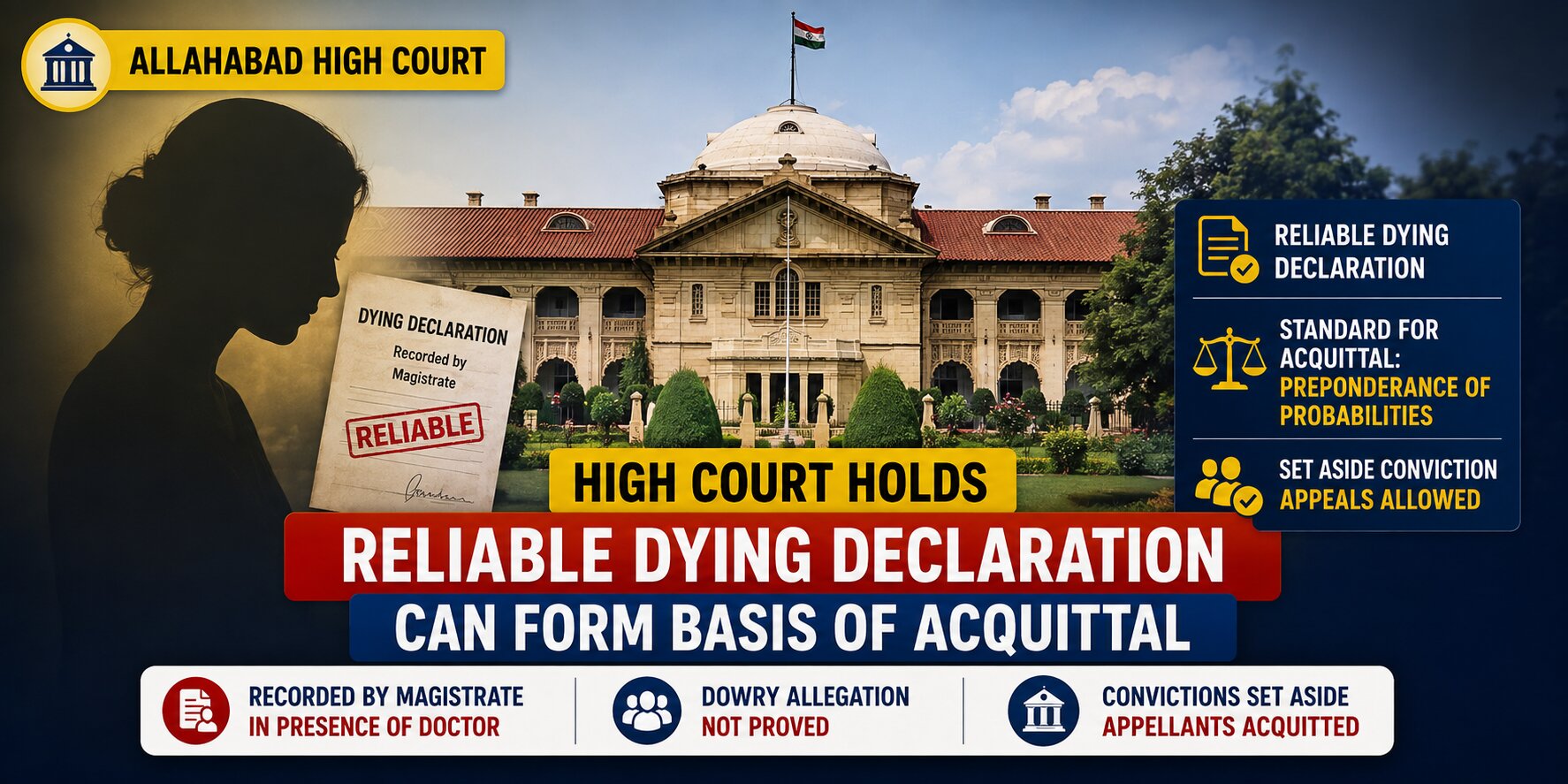
A reliable dying declaration can support both conviction and acquittal.
Judgement Details
Court
Allahabad High Court
Date of Decision
19 August 2026
Judges
Justice Subhash Vidyarthi
Citation
Acts / Provisions
Facts of the Case
-
Ruby Singh was married to Shivraj Singh in 2007.
-
On 6 December 2011, Ruby suffered extensive burn injuries at her matrimonial home.
-
She was taken to SIPS Hospital, Lucknow, for medical treatment.
-
An Additional City Magistrate recorded Ruby's dying declaration in the presence of a doctor.
-
The Magistrate ensured she was conscious and medically fit to give the statement.
-
Ruby stated she was cleaning the kitchen when a lit candle was present.
-
A container of kerosene fell, causing accidental fire.
-
She stated no one else was present and her husband took her to hospital.
-
Ruby died on 13 December 2011 due to septicemia from burn wounds.
-
On 14 December 2011, her mother alleged dowry demand of ₹1 lakh and a motorcycle.
-
Allegations were made against husband and in-laws under Sections 498-A, 304-B, 302, 201 IPC and Sections 3 & 4 Dowry Prohibition Act.
-
Trial Court rejected dying declaration and relied on forensic expert opinion (PW-13).
-
Conviction was recorded under Section 498-A and 304-B IPC and Dowry Prohibition Act provisions.
-
Appeals were filed before the Allahabad High Court.
Issues
-
Whether prosecution proved dowry demand and cruelty beyond reasonable doubt.
-
Whether ingredients of Section 304-B IPC (dowry death) were satisfied.
-
Whether the dying declaration was reliable and sufficient to create doubt.
-
Whether a reliable dying declaration can support acquittal on preponderance of probabilities.
-
Whether oral forensic opinion without written report could override dying declaration.
-
Whether Trial Court properly appreciated medical evidence of burn injuries.
-
Whether prosecution proved guilt beyond reasonable doubt.
Judgement
-
The High Court allowed both appeals.
-
Conviction order dated 30 October 2025 was set aside.
-
Court found no reliable evidence of dowry demand.
-
No demand was made at marriage; only customary gifts were given.
-
No list of dowry articles was produced.
-
Allegations surfaced only after death of Ruby Singh.
-
Court gave strong weight to dying declaration recorded by Magistrate.
-
Doctor certified Ruby was fit to give statement.
-
Court found no reason to doubt truthfulness of dying declaration.
-
Forensic expert opinion (PW-13) was rejected as unreliable.
-
Opinion was oral, unsupported by written report, and based on unproduced material.
-
Medical evidence was inconsistent with expert inference.
-
Court held dying declaration prevails over weak expert opinion.
-
Prosecution failed to prove guilt beyond reasonable doubt.
-
Accused were acquitted and released on bonds under Section 437-A CrPC.
Held
-
Standard for conviction is beyond reasonable doubt, while acquittal requires preponderance of probabilities.
-
Dying declaration recorded by Magistrate with medical certification is highly reliable evidence.
-
Prosecution failed to prove dowry demand and cruelty.
-
Oral expert opinion cannot override dying declaration.
-
Convictions were set aside and appeals allowed.
Analysis
-
Court re-evaluated entire evidentiary record.
-
Gave primacy to contemporaneous dying declaration.
-
Emphasized distinction between conviction standard and acquittal standard.
-
Found dowry allegations weak and belated.
-
Considered surrounding circumstances like financial status and conduct of accused.
-
Found forensic expert opinion procedurally defective.
-
Highlighted inconsistency in burn injury pattern vs medical report.
-
Reinforced that expert evidence is only opinion evidence.
-
Noted possibility of septicemia due to improper wound care.
-
Held Trial Court committed error in appreciation of evidence.
-
Reinforced principle of benefit of doubt in criminal law.