
Shivam Gupta v. The State (Govt. of NCT of Delhi), 2026
The Court held that the gravity of an offence, by itself, cannot operate as an absolute bar to the grant of bail where the accused's right to speedy trial has been infringed.
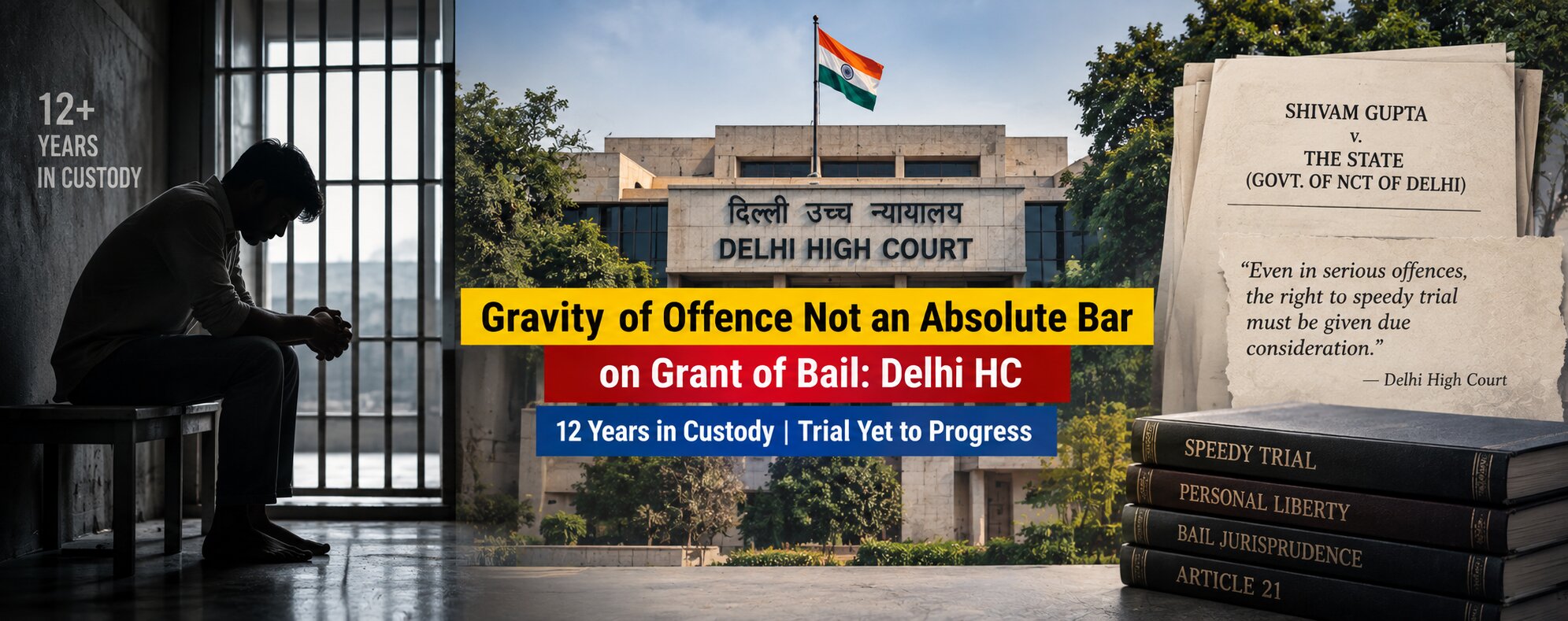
Judgement Details
Court
High Court of Delhi
Date of Decision
14 September 2026
Judges
Justice Purushaindra Kumar Kaurav
Citation
Acts / Provisions
Facts of the Case
-
The petitioner, Shivam Gupta, sought regular bail before the Delhi High Court.
-
The case arose out of FIR No. 568/2013, registered at Police Station New Ashok Nagar, East Delhi.
-
The FIR was registered in connection with offences punishable under Sections 396, 412 and 120-B of the IPC.
-
The prosecution alleged that on 7 November 2013, the petitioner, along with three to four associates, entered a house in Mayur Vihar, Phase III.
-
According to the prosecution, the accused persons induced the 14-year-old son of the complainant to open the gate by pretending that they had arrived to deliver a courier.
-
After entering the house, the intruders were allegedly armed with a knife and pistol.
-
The prosecution alleged that the deceased woman, Madhubala Gupta, was held at knife-point and taken to a rear bedroom.
-
Her two minor children were allegedly confined and threatened by the intruders.
-
The house was allegedly searched and jewellery, cash and other valuable articles were taken away.
-
The accused persons allegedly fled from the house after locking the gate from outside.
-
The minor children subsequently came out and found their mother unresponsive.
-
The woman was declared brought dead at the hospital.
-
The post-mortem report attributed the cause of death to asphyxia resulting from manual strangulation and smothering.
-
The petitioner was arrested on 5 January 2014 and remained continuously in judicial custody thereafter.
-
According to the prosecution, certain articles, including silver jewellery weighing more than two kilograms, the deceased's bank passbook and cheque books, were recovered from the petitioner.
-
A child witness examined as PW-3 allegedly identified the petitioner during the Test Identification Parade and subsequently through video conferencing.
-
The petitioner had previously sought regular bail before the Trial Court on three occasions.
-
Those applications were rejected on 11 August 2020, 7 February 2022 and 29 October 2025, principally taking into account the seriousness of the offence, his criminal antecedents and other circumstances.
-
The State also relied upon his alleged involvement in another criminal case concerning the abduction and murder of two minor children and another criminal case.
-
Despite the seriousness of the allegations, the trial had progressed very slowly.
-
As on 30 March 2026, the petitioner had undergone 12 years, 2 months and 25 days of custody.
-
Out of 32 prosecution witnesses, only 15 witnesses had been examined.
-
The High Court examined the reasons for the delay and found that a substantial part of the delay was attributable to the non-appearance of police witnesses, rather than to any conduct of the accused.
-
One police officer had sought exemption from personal appearance on four occasions.
-
The original Investigating Officer had failed to appear before the Trial Court on five occasions.
-
The Trial Court had previously indicated that the trial could be completed expeditiously, but similar assurances had been given during earlier bail proceedings without any significant improvement in the pace of trial.
-
The High Court therefore considered whether continued incarceration for such a prolonged period was constitutionally justified in circumstances where the trial had not progressed with reasonable expedition.
Issues
-
Whether the gravity of the offences alleged against the accused can, by itself, constitute an absolute bar to the grant of bail when the accused has remained in custody for more than twelve years and the trial has not progressed with reasonable expedition?
-
Whether prolonged incarceration coupled with substantial delay in the conclusion of trial amounts to infringement of the accused's fundamental right to speedy trial under Article 21 of the Constitution of India?
-
Whether the accused was entitled to regular bail under Section 483 of the Bharatiya Nagarik Suraksha Sanhita, 2023, notwithstanding the seriousness of the allegations and his criminal antecedents?
-
Whether the delay in the trial was substantially attributable to the non-appearance of police witnesses and investigating officers rather than to any act or omission on the part of the accused?
-
Whether the period of more than twelve years already spent by the accused in custody constituted a substantial period warranting consideration of his release on bail?
-
Whether the grant of bail to similarly placed adult co-accused was a relevant circumstance in determining whether the petitioner should also be granted regular bail?
-
Whether the continued incarceration of the accused was warranted in the facts and circumstances of the case despite the seriousness of the offences alleged against him?
Judgement
-
The Delhi High Court granted regular bail to Shivam Gupta.
-
The Court acknowledged at the outset that the allegations against the petitioner were extremely serious and that his criminal antecedents could not be ignored.
-
However, the Court held that the gravity of an offence cannot by itself be treated as the sole or predominant consideration for refusing bail once the accused's constitutional right to speedy trial has been infringed.
-
The Court emphasised that even a person charged with a serious offence is entitled to have the trial conducted within a reasonable period.
-
The Court relied upon the Supreme Court's decision in Sahil Manoj Machare v. State of Maharashtra, where bail was granted to an accused charged with murder after prolonged incarceration and failure of the trial to make meaningful progress.
-
The High Court also relied upon Union of India v. K.A. Najeeb, where the Supreme Court recognised that constitutional courts retain the power to grant bail where continued incarceration would offend the guarantee of personal liberty under Article 21.
-
The Court observed that statutory restrictions on bail cannot completely exclude the constitutional jurisdiction of the courts where prolonged incarceration results in violation of fundamental rights.
-
The Court further referred to Satender Kumar Antil v. Central Bureau of Investigation, particularly in relation to the problem of prolonged undertrial incarceration and the need to avoid mechanically equating a serious accusation with denial of bail.
-
The Court noted that the petitioner had already spent more than twelve years in custody.
-
Section 396 IPC provides for death, imprisonment for life or rigorous imprisonment up to ten years, along with fine.
-
The Court observed that the period already spent by the petitioner in custody had exceeded the ten-year term prescribed for the non-capital punishment under Section 396 IPC and constituted a substantial fraction of even the maximum non-capital sentence that could follow upon conviction.
-
The Court found the pace of the trial particularly significant because only 15 out of 32 prosecution witnesses had been examined after more than twelve years.
-
The Court examined the reasons for the delay rather than merely noting its existence.
-
It found that the delay was substantially attributable to the non-appearance of police witnesses and investigating officers.
-
One police officer had sought exemption from personal appearance on four occasions.
-
The original Investigating Officer had failed to appear on five occasions.
-
The Court noted that similar assurances regarding expeditious completion of the trial had been given during previous bail proceedings without any material improvement in the pace of proceedings.
-
The High Court therefore directed the Commissioner of Police, Delhi, to ensure the appearance of investigating officers and police witnesses on the dates fixed by the Trial Court.
-
The Court also considered the fact that there were eight accused persons in the case, including four adult accused and four Children in Conflict with Law.
-
Of the four adult accused, three had already been granted regular bail.
-
The Court clarified that parity alone cannot determine the question of bail, particularly where the roles of co-accused may differ.
-
However, the Court held that parity remains a relevant circumstance when it operates alongside the independent and substantial ground of prolonged incarceration.
-
After considering all these factors together, the Court concluded that the petitioner's continued incarceration was not warranted.
-
The Court accordingly directed that the petitioner be released on regular bail, subject to conditions imposed by the concerned Trial Court.
Held
-
The Court held that prolonged incarceration of an undertrial must be considered in light of the constitutional guarantee of personal liberty under Article 21.
-
The Court held that the right to speedy trial remains relevant even in cases involving grave offences such as murder and dacoity with murder.
-
The Court held that where the trial has failed to progress with reasonable expedition and the delay is not attributable to the accused, prolonged incarceration can constitute a strong ground for bail.
-
The Court held that the petitioner's more than twelve years of incarceration constituted a substantial period requiring serious consideration while deciding his bail application.
-
The Court held that the non-appearance of police witnesses and investigating officers substantially contributed to the delay in the trial.
-
The Court held that the fact that three similarly placed adult co-accused had already been granted bail was a relevant circumstance, although parity by itself was not determinative.
-
The Court held that continued incarceration of Shivam Gupta was not warranted in the circumstances of the case.
-
The Court consequently granted regular bail to the petitioner, subject to conditions imposed by the Trial Court.
Analysis
-
Speedy trial is a constitutional right: The judgment strongly reinforces that an accused cannot be kept in custody indefinitely merely because the allegations against him are serious.
-
Gravity is not an absolute bar: The Court did not minimise the seriousness of the alleged crime. Instead, it held that seriousness must be balanced against the constitutional right to speedy trial and personal liberty.
-
Article 21 acts as a safeguard against indefinite detention: The judgment demonstrates the practical application of Article 21 where an accused has remained an undertrial prisoner for an exceptionally long period.
-
Delay attributable to the prosecution is significant: The Court paid particular attention to the fact that the delay was substantially caused by the failure of police witnesses and investigating officers to appear before the Trial Court.
-
The accused should not bear the consequences of institutional delay: Where the accused himself has not caused the delay, prolonged incarceration resulting from systemic or prosecutorial delay becomes a powerful consideration in favour of bail.
-
Duration of custody must be assessed realistically: The Court did not merely count the years of incarceration. It compared the period already spent in custody with the sentence that could potentially follow upon conviction.
-
Section 396 IPC was particularly significant: Since the petitioner had already spent more than twelve years in custody, his incarceration had exceeded the ten-year non-capital imprisonment term contemplated under Section 396 IPC.
-
No prediction of acquittal was necessary: The Court did not decide whether the petitioner was guilty or innocent. The bail decision was based primarily on prolonged incarceration, delay in trial and constitutional liberty.
-
K.A. Najeeb principle: The judgment reinforces the Supreme Court's principle that constitutional courts retain the power to grant bail when continued incarceration becomes inconsistent with fundamental rights.
-
Parity is a supporting factor: The Court carefully distinguished between parity and an independent entitlement to bail. The fact that co-accused were on bail was relevant, but it was not treated as sufficient by itself.
-
Institutional accountability: The direction to the Commissioner of Police demonstrates that courts may take administrative steps to address repeated non-appearance of investigating officers and police witnesses.
-
Trial expedition must be meaningful: The Court was particularly concerned that previous assurances of speedy trial had not translated into meaningful progress.
-
Serious offences require careful balancing: The judgment does not establish that every accused in a serious offence must receive bail after a fixed period. Instead, the Court requires consideration of the total circumstances, including the nature of the offence, custody period, trial progress, reasons for delay, criminal antecedents and parity.
-
Impact on bail jurisprudence: The decision strengthens the principle that bail cannot be denied indefinitely merely by repeatedly invoking the seriousness of the offence when the trial itself is moving at an unreasonably slow pace.
-
Important limitation: The judgment should not be understood as creating an automatic right to bail after twelve years or after any particular period. The decisive consideration was the combination of prolonged incarceration, slow trial progress, prosecution-attributable delay, constitutional speedy-trial concerns and other circumstances of the case.