
Shiv Narain @ Surya Narain v. State of U.P. and Connected Appeals, 2026
The prosecution must establish the foundational fact of dowry-related cruelty or harassment soon before the woman's death before the presumption under Section 113-B of the Evidence Act can operate.
Judgement Details
Court
Allahabad High Court
Date of Decision
28 August 2026
Judges
Justice Manoj Bajaj
Citation
Acts / Provisions
Facts of the Case
-
The deceased, Urmila, was married to accused Shiv Narain @ Surya Narain on May 12, 1987.
-
The prosecution alleged that after the marriage, the deceased was subjected to cruelty and harassment by her husband and his relatives in connection with demands for dowry.
-
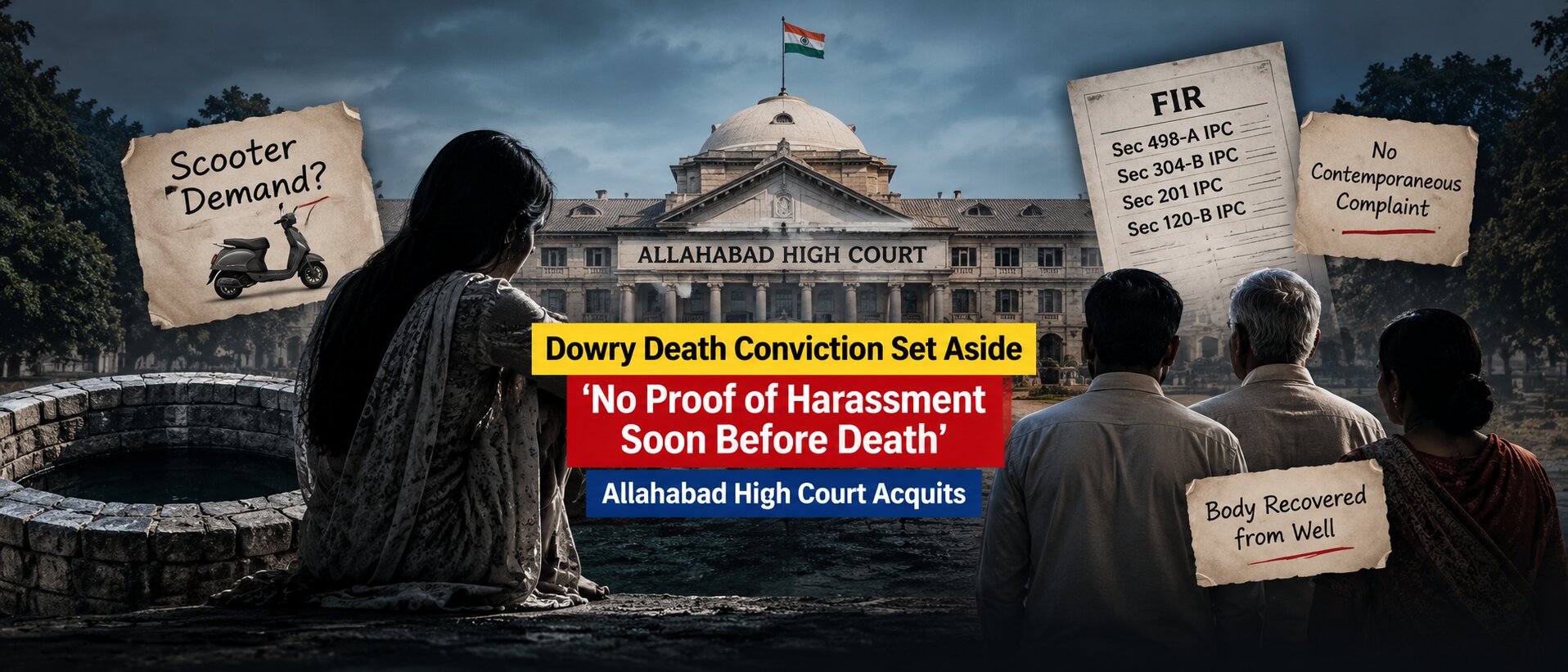
According to the deceased's parents, she initially returned to her parental home following matrimonial difficulties. Her matrimonial relatives subsequently came to take her back, during which a scooter was allegedly demanded as dowry.
-
The High Court found that this alleged scooter demand was not mentioned in the FIR or in the statements recorded during investigation. The allegation emerged for the first time during the parents' testimony before the trial court.
-
According to the prosecution evidence, the alleged scooter demand was made in November 1987, whereas the deceased disappeared in September 1991, creating a gap of approximately four years.
-
The deceased subsequently stayed at her matrimonial home for approximately two and a half years and returned there again in August 1990.
-
During the intervening night of September 19–20, 1991, the deceased went missing from her matrimonial home.
-
Her body was recovered from a well situated approximately 115 steps from the matrimonial home on September 21, 1991.
-
At the time of the inquest, the complainant and close relatives apparently expressed the view that the deceased had probably died by drowning and did not allege that she had been murdered or subjected to a dowry-related death.
-
The FIR was subsequently lodged on October 2, 1991, alleging offences under Sections 498-A, 304-B, 201 and 120-B IPC.
-
The trial court convicted the accused under the relevant provisions.
-
The accused challenged their convictions before the Allahabad High Court.
-
The High Court examined whether the prosecution had established dowry-related cruelty or harassment “soon before” the deceased's death, as required for Section 304-B IPC and the presumption under Section 113-B of the Evidence Act.
-
The Court also examined the prosecution's alternative allegation that the deceased had been murdered and that her body had subsequently been thrown into the well.
-
The post-mortem examination disclosed a solitary ante-mortem head injury. The doctor stated that the injury could have resulted if the deceased had fallen into the well and struck her head against a tubewell pipe.
-
The High Court found that the prosecution had not established the manner or place of the alleged murder and had not produced sufficient medical or other evidence demonstrating that the deceased had been murdered before her body was placed in the well.
-
The Court further noted that Section 302 IPC had neither been included in the charge-sheet nor framed as a charge, yet the trial court had nevertheless concluded that the accused had committed murder.
Issues
-
Whether the prosecution established beyond reasonable doubt that the deceased was subjected to cruelty or harassment for, or in connection with, a demand for dowry soon before her death so as to attract Section 304-B IPC?
-
Whether the alleged scooter demand, said to have been made approximately four years before the deceased's death, could satisfy the statutory requirement of cruelty or harassment “soon before” death?
-
Whether the presumption of dowry death under Section 113-B of the Indian Evidence Act, 1872 could arise in the absence of proof of the foundational fact of dowry-related cruelty or harassment soon before death?
-
Whether the prosecution established beyond reasonable doubt that the deceased had been murdered and that her body had subsequently been thrown into the well?
-
Whether the conviction under Section 201 IPC could be sustained when the prosecution failed to establish the underlying allegation of murder or the disappearance of evidence relating to such murder?
-
Whether the trial court could legally record a finding of murder under Section 302 IPC when the accused had neither been charge-sheeted nor charged under that provision?
Judgement
-
The Allahabad High Court allowed the criminal appeals filed by the accused.
-
The Court held that the prosecution had failed to establish the essential connection between the alleged dowry harassment and the deceased's death.
-
The alleged scooter demand was considered insufficient because, according to the prosecution's own evidence, it had occurred approximately four years before the incident.
-
The Court attached significance to the absence of any contemporaneous complaint by the deceased concerning dowry harassment.
-
The complainant had visited the deceased approximately one month before her death, but his testimony did not establish that any dowry demand or related harassment had occurred during that visit.
-
The Court also noted that several close relatives who could potentially have corroborated the allegations were not examined.
-
Consequently, the prosecution failed to prove the foundational facts necessary to invoke Section 113-B of the Evidence Act.
-
The Court rejected the allegation that the deceased had been murdered and her body thrown into the well because the prosecution had not established the manner or place of the alleged murder.
-
The medical evidence did not conclusively establish murder because the head injury could have resulted from the deceased falling into the well and striking a tubewell pipe.
-
The conviction under Section 201 IPC consequently could not survive because the prosecution had not established the underlying offence or disappearance of evidence arising from it.
-
The High Court also found the trial court's conclusion regarding murder to be “apparently erroneous in law and perverse”, particularly because no charge under Section 302 IPC had been framed.
-
The judgment of conviction and sentence was therefore set aside.
-
Shiv Narain @ Surya Narain, Jai Narayan and Pateshwar were acquitted of all charges.
Held
-
An alleged dowry demand made several years before the death, without evidence demonstrating a proximate connection with the death, was insufficient to satisfy Section 304-B IPC.
-
In the absence of proof of the required cruelty or harassment, the statutory presumption of dowry death under Section 113-B was unavailable.
-
The prosecution also failed to prove beyond reasonable doubt that the deceased had been murdered and that her body was thrown into the well.
-
The accused were therefore entitled to the benefit of reasonable doubt and acquittal.
Analysis
-
“Soon before death” is a substantive requirement: The judgment reinforces that Section 304-B IPC requires more than proof that a woman died unnaturally within the statutory period after marriage. There must be evidence connecting dowry-related cruelty or harassment with the period sufficiently proximate to her death.
-
Foundational fact precedes statutory presumption: Section 113-B does not automatically presume dowry death merely because the circumstances of death appear suspicious. The prosecution must first establish the foundational fact of dowry-related cruelty or harassment.
-
Temporal proximity is important: The alleged scooter demand occurred approximately four years before the death. In the circumstances of this case, the substantial time gap weakened the prosecution's attempt to establish the required “soon before” connection.
-
Evidence must be consistent and reliable: The Court considered it significant that the alleged scooter demand did not appear in the FIR or investigation statements and was introduced during the parents' testimony before the trial court. This inconsistency affected the reliability of the prosecution's case.
-
Absence of contemporaneous complaint: The deceased had not made any complaint during her lifetime alleging dowry harassment. Although the absence of a complaint is not necessarily conclusive by itself, the Court considered it relevant when assessing the prosecution's overall evidence.
-
Presumption cannot replace proof: The judgment demonstrates an important evidentiary principle: a statutory presumption cannot be used to cure a failure to prove the facts that trigger the presumption.
-
Murder allegation required independent proof: The Court distinguished suspicion from proof. The recovery of a body from a well and the existence of a head injury did not, by themselves, establish that the deceased had been murdered.
-
Medical evidence was not conclusive: The doctor's opinion that the head injury could have been caused by a fall into the well provided a plausible alternative explanation inconsistent with the prosecution's murder theory.
-
Importance of proper framing of charges: The High Court strongly disapproved of the trial court recording a finding of murder despite the absence of a Section 302 IPC charge. An accused must have a fair opportunity to defend against the specific offence alleged.
-
Benefit of reasonable doubt: Since the prosecution evidence contained material gaps and inconsistencies and failed to establish the essential ingredients of the offences beyond reasonable doubt, the accused were entitled to acquittal.
-
Broader legal significance: The decision illustrates the distinction between suspicion, evidentiary circumstances and proof beyond reasonable doubt, particularly in prosecutions involving dowry death and allegations of matrimonial violence.