
Shiny S. Nair v. State of Kerala & Ors., 2026
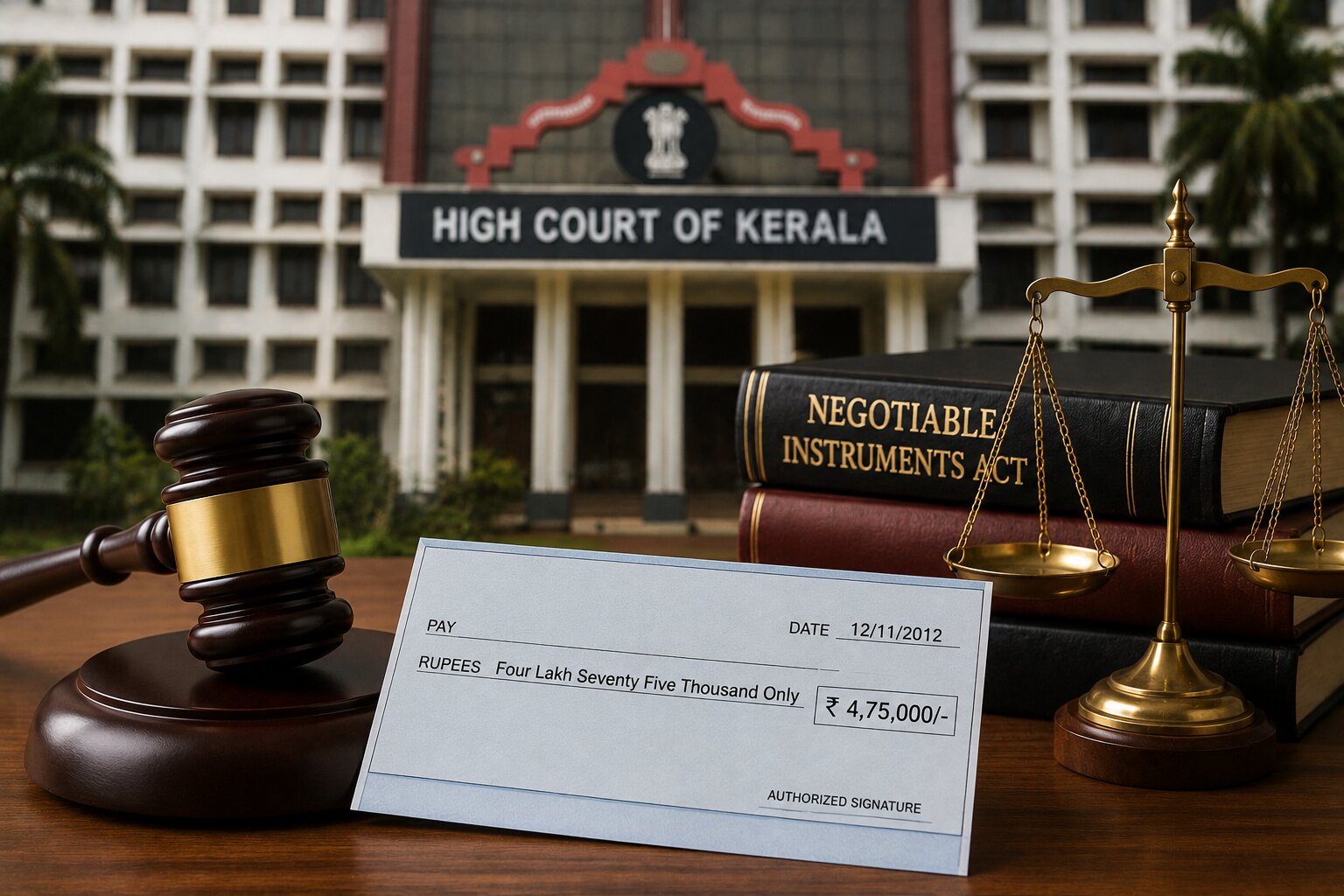
A typewritten cheque is legally valid and cannot be disbelieved merely because it is not handwritten.
Judgement Details
Court
Kerala High Court
Date of Decision
21 July 2026
Judges
Justice A. Badharudeen
Citation
Acts / Provisions
Facts of the Case
-
The complainant alleged that the accused had borrowed ₹1,75,000 on 14 June 2012.
-
Subsequently, owing to the close relationship between the parties, the accused requested an additional loan of ₹3,00,000, which was allegedly advanced by the complainant on 12 November 2012.
-
Towards repayment of the combined liability of ₹4,75,000, the accused issued a cheque in favour of the complainant.
-
When the cheque was presented for encashment, it was dishonoured, leading to prosecution under Section 138 of the Negotiable Instruments Act, 1881.
-
During trial, the complainant relied on oral evidence and documentary evidence (Exts. P1 to P6) to establish the transaction and execution of the cheque.
-
The Judicial First Class Magistrate, Mavelikkara, acquitted the accused.
-
The Magistrate considered it improbable that the complainant would advance an additional ₹3,00,000 when an earlier loan remained unpaid.
-
The trial court also doubted the complainant's case because the cheque produced was typewritten instead of handwritten.
-
Aggrieved by the acquittal, the complainant preferred an appeal before the Kerala High Court.
Issues
-
Whether the mere fact that a cheque is typewritten is sufficient to disbelieve its genuineness or deny the statutory presumptions under Sections 118 and 139 of the Negotiable Instruments Act?
-
Whether the complainant had proved the underlying transaction and execution of the cheque sufficient to invoke the statutory presumptions under the Negotiable Instruments Act?
-
Whether advancing a second loan despite the earlier loan remaining unpaid rendered the complainant's version inherently improbable?
-
Whether the Trial Court erred in acquitting the accused under Section 138 of the Negotiable Instruments Act?
-
Whether the accused was liable to be convicted for the offence punishable under Section 138 of the Negotiable Instruments Act?
Judgement
-
The Kerala High Court allowed the criminal appeal and set aside the judgment of acquittal passed by the Judicial First Class Magistrate.
-
The Court held that there is no legal prohibition against issuing a typewritten cheque.
-
It observed that although typewritten cheques may be uncommon, their uncommon nature alone cannot create suspicion regarding the genuineness of the transaction.
-
The Court ruled that once the complainant proves the underlying transaction and execution of the cheque, the statutory presumptions under Sections 118 and 139 of the Negotiable Instruments Act automatically become available.
-
The Bench held that the typewritten nature of the cheque cannot be used as a ground to deny those statutory presumptions.
-
The Court further observed that where parties are close relatives, advancing another loan despite an outstanding liability cannot be treated as inherently improbable.
-
The Court noted that the two loans were advanced within a period of approximately five months and that the cheque represented the combined liability arising out of both transactions.
-
The Court also considered the fact that the accused herself admitted liability to a certain extent, thereby lending further support to the complainant's version.
-
Holding that the complainant had successfully established the transaction beyond reasonable doubt, the Court concluded that the Trial Court had erred in appreciating the evidence.
-
Accordingly, the accused was convicted under Section 138 of the Negotiable Instruments Act.
-
The Court sentenced the accused to imprisonment till the rising of the Court and imposed a fine of ₹4,75,000, payable to the complainant as compensation, with six months' default imprisonment in case of non-payment.
Held
- The complainant successfully proved the transaction and execution of the cheque.
-
The statutory presumptions under Sections 118 and 139 of the Negotiable Instruments Act were fully attracted.
-
Advancing a further loan to a close relative despite an earlier unpaid loan is not inherently improbable.
-
The Trial Court erred in acquitting the accused.
-
The accused was convicted under Section 138 of the Negotiable Instruments Act.
-
The acquittal was set aside and compensation of ₹4,75,000 was awarded to the complainant.
Analysis
-
The judgment reinforces the strong statutory presumptions incorporated under Sections 118 and 139 of the Negotiable Instruments Act, emphasizing that they cannot be displaced by mere suspicion or unconventional features of a cheque.
-
The Court clarified that the law does not prescribe any mandatory requirement that a cheque must be handwritten, thereby recognizing the legal validity of typewritten cheques.
-
The decision reiterates that courts must focus on proof of the underlying transaction and execution of the cheque rather than on superficial characteristics of the instrument.
-
By rejecting the Trial Court's reasoning regarding multiple loans between relatives, the Court acknowledged that financial dealings within families often differ from ordinary commercial transactions and cannot be judged by rigid assumptions.
-
The judgment strengthens the object of Section 138 of the Negotiable Instruments Act, namely enhancing the credibility and reliability of cheque transactions.
-
The ruling also serves as a reminder that statutory presumptions continue to operate unless rebutted by cogent evidence and cannot be denied merely because the transaction appears unusual.
-
The decision contributes to consistency in cheque dishonour jurisprudence by preventing technical objections from defeating otherwise genuine claims.
-
The judgment is significant for future cases involving electronically prepared or typewritten cheques, affirming that the mode of filling the cheque does not affect its legal enforceability.