
Shephali Chakraborty v. State of West Bengal, 2026
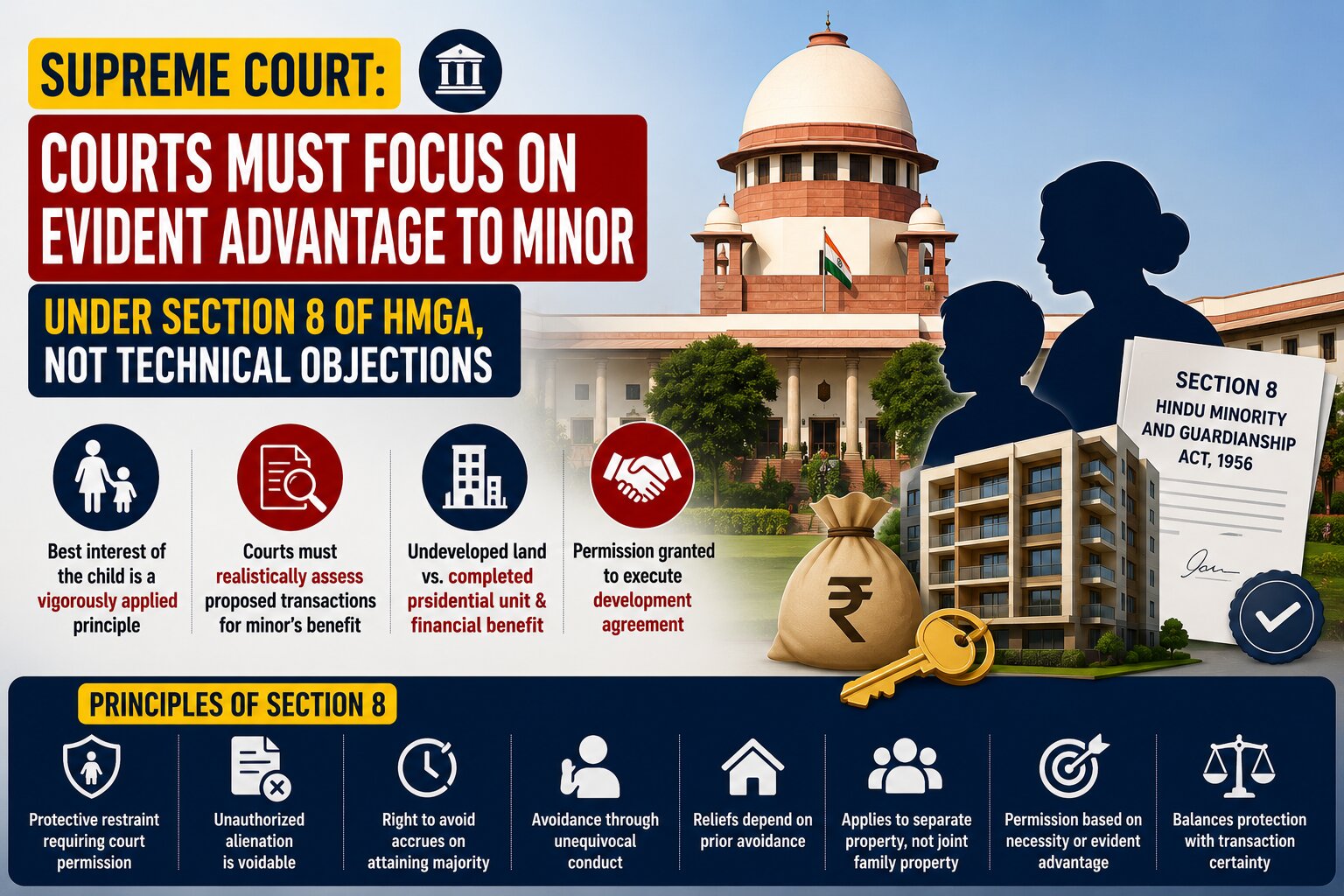
The expression "evident advantage to the minor" must be interpreted in light of the minor's present and future welfare.
Judgement Details
Court
Supreme Court of India
Date of Decision
7 July 2026
Judges
Justice Sanjay Karol & Justice Nongmeikapam Kotiswar Singh
Citation
Acts / Provisions
Facts of the Case
-
e dispute concerned an immovable property originally purchased in 1957 by the minor's paternal great-grandfather.
-
Following successive family inheritances, including the death of the minor's father in 2018, the minor inherited an undivided share in the property.
-
In 2022, the co-owners proposed to enter into a development agreement with a builder for redevelopment of the property.
-
Under the proposed arrangement, the minor would receive a one-third share in a first-floor residential flat measuring approximately 399.33 square feet along with ₹10 lakh as monetary consideration.
-
The minor's mother, being the natural guardian, approached the District Court seeking permission under Section 8 of the Hindu Minority and Guardianship Act, 1956.
-
The District Court rejected the application on the ground that the mother failed to establish "necessity" or "evident advantage" to the minor.
-
The High Court affirmed the District Court's decision.
-
Aggrieved by these concurrent findings, the mother approached the Supreme Court.
Issues
-
Whether courts considering applications under Section 8 of the Hindu Minority and Guardianship Act, 1956 should assess the proposed transaction on the basis of the "evident advantage" of the minor rather than technical or speculative considerations?
-
Whether the proposed development agreement satisfied the requirement of being necessary or evidently beneficial to the minor under Section 8(4) of the HMGA?
-
Whether the rejection of the mother's application by the District Court and the High Court was legally sustainable?
Judgement
-
The Supreme Court allowed the appeal and set aside the orders of the District Court and the High Court.
-
The Court held that a natural guardian manages the minor's property in a fiduciary capacity, and therefore every proposed transaction must be examined from the perspective of the minor's welfare.
-
It observed that courts must undertake a realistic and practical assessment of whether the transaction offers an "evident advantage" to the minor instead of rejecting applications on technical or speculative grounds.
-
The Bench emphasized that the best interest of the child is not a passive consideration but a dominant legal principle requiring careful scrutiny of every transaction affecting the minor's estate.
-
The Court accepted that an undeveloped and undivided share in land may have limited practical value, whereas a completed residential flat coupled with monetary consideration could provide immediate and tangible benefits to the minor.
-
It held that the proposed development agreement fulfilled the statutory requirement of providing an evident advantage to the minor.
-
The Court observed that Section 8 is intended to protect the proprietary interests of minors while simultaneously permitting transactions genuinely beneficial to them.
-
Consequently, permission was granted to the mother to execute the development agreement on behalf of the minor.
Held
-
Courts must evaluate applications under Section 8 HMGA by adopting a practical and welfare-oriented approach.
-
Technical or speculative objections should not defeat transactions demonstrably beneficial to the minor.
-
The mother's application seeking permission to execute the development agreement was allowed.
Analysis
-
The judgment reinforces that the welfare of the minor remains the paramount consideration while dealing with the management of a minor's property.
-
The Court clarified that the role of a natural guardian is fiduciary and therefore subject to judicial supervision whenever immovable property is proposed to be alienated.
-
By emphasizing a realistic assessment of "evident advantage," the Court discouraged mechanical rejection of applications under Section 8 HMGA.
-
The decision balances protection of minors' proprietary rights with the practical realities of modern property development and redevelopment projects.
-
The Court reaffirmed the doctrine of parens patriae, requiring courts to actively safeguard the present and future interests of children.
-
The judgment provides important guidance for District Courts while deciding applications under Section 8 HMGA involving redevelopment, sale, exchange, or other transactions concerning a minor's immovable property.
-
By recognizing that unauthorized alienations are voidable rather than void, the Court reiterated the legislative balance between protecting minors and preserving certainty in property transactions.
-
The ruling is likely to serve as a leading precedent on judicial approval of transactions involving minors' immovable property under the Hindu Minority and Guardianship Act.