
Sheo Kumar Singh & Others v. M/s Sharda Educational Society & Others, 2026
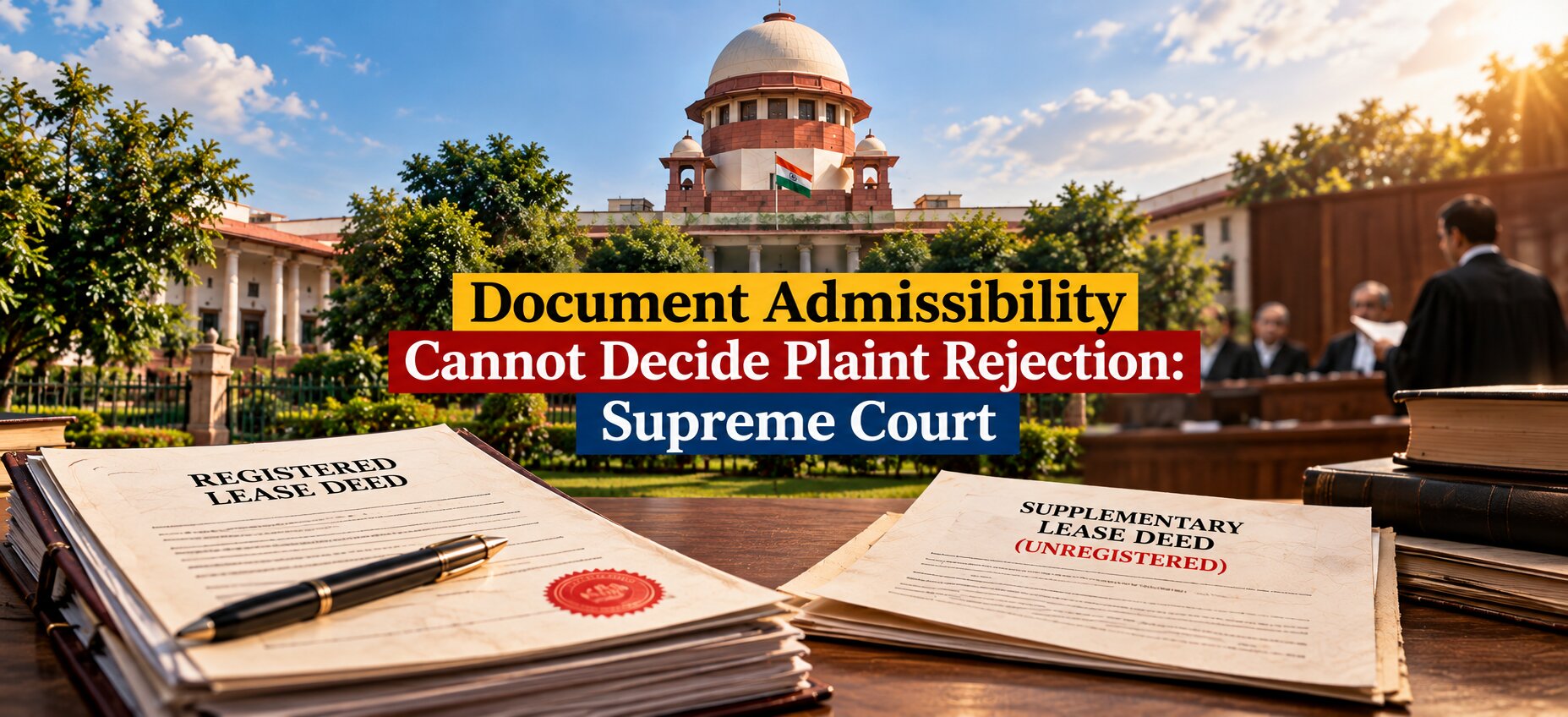
Admissibility of a document cannot ordinarily be adjudicated at the stage of an application under Order VII Rule 11 CPC.
Judgement Details
Court
Supreme Court of India
Date of Decision
18 September 2026
Judges
Justice Ujjal Bhuyan and Justice Atul S. Chandurkar
Citation
Acts / Provisions
Facts of the Case
-
The plaintiffs had executed a registered lease deed in favour of the defendants for a 33-year period at a monthly rent of ₹92,550, subject to an annual escalation of 7%.
-
Subsequently, the parties executed a supplementary lease deed dated 15.02.2013, which modified certain terms of the original lease, including the rent payable based on the constructed area.
-
The plaintiffs contended that the supplementary lease deed merely modified the already registered lease deed and, therefore, did not independently require registration.
-
The defendants allegedly failed to pay rent according to the revised terms. The plaintiffs consequently issued a notice under Section 106 of the Transfer of Property Act, 1882, terminating the tenancy.
-
The plaintiffs thereafter instituted a suit for eviction and recovery of arrears of rent.
-
The defendants denied having executed the supplementary lease deed and sought rejection of the plaint under Order VII Rule 11(a) and (d) CPC, arguing that the unregistered document was inadmissible under Section 49 of the Registration Act, 1908.
-
The Trial Court rejected the defendants' objection.
-
The Patna High Court, however, held that the supplementary lease deed was inadmissible for want of registration and set aside the Trial Court's order.
-
The plaintiffs approached the Supreme Court challenging the High Court's decision.
Issues
-
Whether non-admissibility of a document relied upon by the plaintiff can be made a ground for rejection of the plaint under Order VII Rule 11(a) and (d) CPC before commencement of trial?
-
Whether the question of admissibility of an unregistered document under Section 49 of the Registration Act, 1908 can be conclusively decided at the stage of considering an application under Order VII Rule 11 CPC?
-
Whether the defendant's objection regarding registration and admissibility of the supplementary lease deed can be considered when determining whether the plaint discloses a cause of action or is barred by law?
-
Whether the Trial Court or High Court could record a finding regarding the inadmissibility of the supplementary lease deed before the parties had led evidence at trial?
Judgement
-
The Supreme Court allowed the appeal filed by the plaintiffs.
-
The Court set aside the Patna High Court's order.
-
It held that the admissibility or otherwise of a document relied upon by the plaintiff is a matter for trial and cannot ordinarily form the basis for rejection of the plaint under Order VII Rule 11(a) or (d) CPC.
-
At the stage of Order VII Rule 11, the Court must primarily examine the averments contained in the plaint and the documents relied upon by the plaintiff, rather than adjudicating the defendant's defence.
-
The Court held that whether the supplementary lease deed was required to be registered, whether it was admissible in evidence, and whether the proviso to Section 49 of the Registration Act could be invoked were matters requiring adjudication during trial.
-
The Supreme Court found that the High Court had prematurely decided the admissibility of the supplementary lease deed without permitting the parties to lead evidence.
-
The Trial Court was directed to proceed with the suit and decide it on its merits.
-
The Supreme Court expressly clarified that it had not decided the ultimate question of admissibility of the supplementary lease deed.
Held
-
Order VII Rule 11 requires examination of the plaint as a whole, including its averments, to determine whether it discloses a cause of action or is barred by law.
-
The defendant's defence or objections regarding the evidentiary value of a document cannot be used to prematurely reject the plaint.
-
Whether an unregistered document can be admitted under the proviso to Section 49 of the Registration Act for proving a collateral transaction is a matter that may require evidence and must ordinarily be considered at trial.
-
A document cannot be declared inadmissible before the parties have had an opportunity to lead evidence where its admissibility depends upon factual and legal determination.
-
The Supreme Court emphasized that rejection of a plaint under Order VII Rule 11 is a drastic power, because it non-suits the plaintiff without a full trial.
-
Since the plaint disclosed a cause of action and was not shown, on its own averments, to be barred by law, the suit could not be rejected at the threshold.
Analysis
-
The judgment reinforces the limited scope of Order VII Rule 11 CPC. The provision is concerned with whether the plaint itself discloses a cause of action or is barred by law, rather than with determining the ultimate evidentiary merits of the plaintiff's case.
-
The Supreme Court distinguished between maintainability of a suit and admissibility of evidence. A document may ultimately face an objection regarding admissibility without that objection necessarily destroying the cause of action pleaded in the plaint.
-
The Court reaffirmed the principle that, while considering Order VII Rule 11, the court cannot ordinarily travel beyond the plaint and documents relied upon by the plaintiff to examine the defendant's version.
-
The decision is particularly significant for disputes involving unregistered documents. Non-registration may affect the evidentiary use of a document, but the question of whether the document can nevertheless be relied upon for a collateral purpose under the proviso to Section 49 requires proper adjudication.
-
The judgment prevents courts from conducting a mini-trial at the preliminary stage by determining disputed questions concerning execution, registration, admissibility or evidentiary value of documents.
-
The Court also cautioned against recording findings on the merits of disputed documents before evidence has been led, as doing so may prejudice the eventual trial.
-
The decision therefore preserves the distinction between threshold scrutiny under Order VII Rule 11 and final adjudication after evidence.