
Sheikh Ghulam Hassan v. Mohammad Amin Dar, 2026
Failure to fulfil the requirements of Order XXXVII CPC does not automatically mean that the entire suit must be rejected.
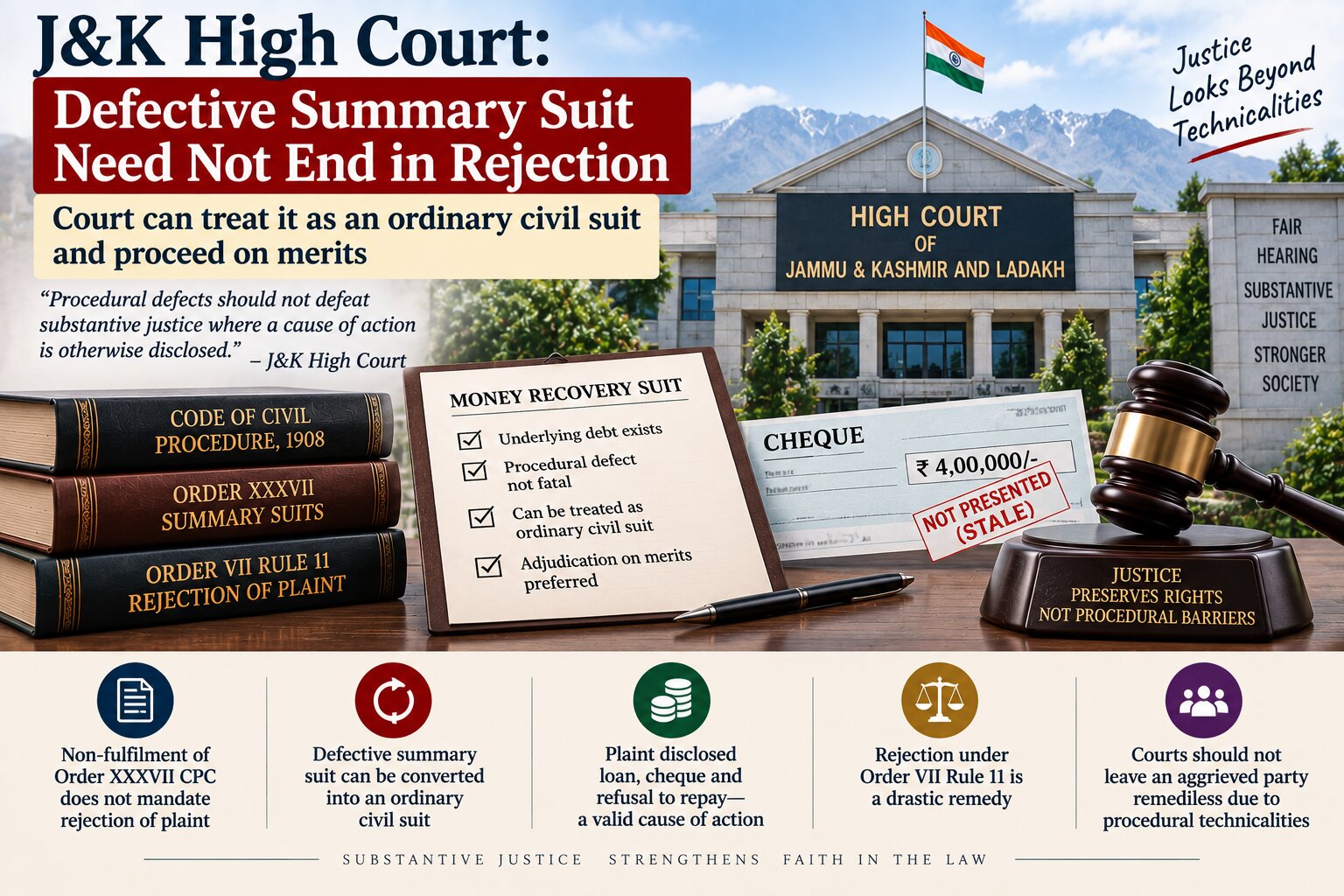
Judgement Details
Court
High Court of Jammu & Kashmir and Ladakh
Date of Decision
20 August 2026
Judges
Justice Shahzad Azeem
Citation
Acts / Provisions
Facts of the Case
-
The appellant allegedly advanced a friendly loan of ₹5 lakh to the respondent for expenses connected with his father's Hajj.
-
The respondent allegedly issued a ₹4 lakh cheque towards part payment/acknowledgment of the debt.
-
At the respondent's request, the cheque was not presented for encashment on the assurance that payment would be made in cash.
-
The cheque subsequently became stale and the respondent allegedly refused to repay the outstanding amount.
-
The appellant instituted a summary suit under Order XXXVII CPC for recovery of ₹4 lakh.
-
The Trial Court held that the cheque had never been presented or dishonoured and therefore the suit was not maintainable under Order XXXVII.
-
The plaint was consequently rejected under Order VII Rule 11 CPC.
-
The appellant challenged the rejection before the High Court.
Issues
-
Whether failure to satisfy the requirements of Order XXXVII CPC warrants rejection of the plaint under Order VII Rule 11?
-
Whether a suit which is not maintainable as a summary suit can nevertheless proceed as an ordinary money recovery suit?
-
Whether the plaint disclosed a cause of action based on the underlying loan transaction despite the cheque not having been presented or dishonoured?
-
Whether rejection of the plaint was justified when the defendant had raised triable issues requiring adjudication on merits?
Judgement
-
The High Court allowed the appeal and set aside the Trial Court's judgment and decree.
-
The Court agreed that the requirements for maintaining a summary suit based on the cheque had not been fulfilled because the cheque was never presented and dishonoured.
-
However, the Court held that this procedural defect did not extinguish the underlying money claim.
-
The plaint, read as a whole, disclosed a cause of action arising from the alleged loan, issuance of the cheque towards the debt and subsequent refusal to repay.
-
The Court directed that the matter be treated and tried as an ordinary money recovery suit.
-
The Court emphasised that rejection of a plaint is a drastic remedy and should not be adopted where a substantive cause of action is otherwise disclosed.
Held
-
A defective summary suit can be converted into an ordinary civil suit where the plaint independently discloses a valid cause of action.
-
A cheque that was never presented or dishonoured may not sustain a summary suit based on the cheque, but the underlying debt may still provide an independent cause of action.
-
Order VII Rule 11 CPC should not be invoked merely because the plaintiff selected an inappropriate procedural mechanism.
-
Where the plaint discloses an actionable claim, the court should ordinarily preserve the claim and permit adjudication on merits.
-
The existence of serious triable disputes further supported proceeding through the ordinary civil process.
Analysis
-
The judgment draws a clear distinction between maintainability of a summary procedure and existence of a cause of action.
-
The High Court accepted that the cheque could not support an Order XXXVII action because it had never been presented and dishonoured. However, that finding did not determine whether the alleged loan itself was legally recoverable.
-
The Court treated the cheque as part of the broader transaction rather than allowing its procedural defect to completely destroy the underlying claim.
-
This approach prevents procedural technicalities from defeating substantive rights where the pleadings disclose a genuine civil dispute.
-
Order VII Rule 11 is intended to eliminate suits that disclose no legally enforceable cause of action; it is not intended to punish a litigant merely for choosing the wrong procedural route.
-
The Court's approach also protects the defendant because conversion into an ordinary suit gives both parties the opportunity to lead evidence and establish their respective claims and defences.
-
The ruling is particularly significant because rejection of the plaint would have forced the appellant to institute a fresh proceeding, potentially creating limitation and procedural complications.
-
The judgment therefore favours preservation of adjudicable claims while still respecting the mandatory requirements of the summary procedure.
-
The broader principle is that failure of a special remedy does not necessarily result in failure of the substantive claim.