
Sheetal Vasant Thakur v. Chirag Arora, 2026
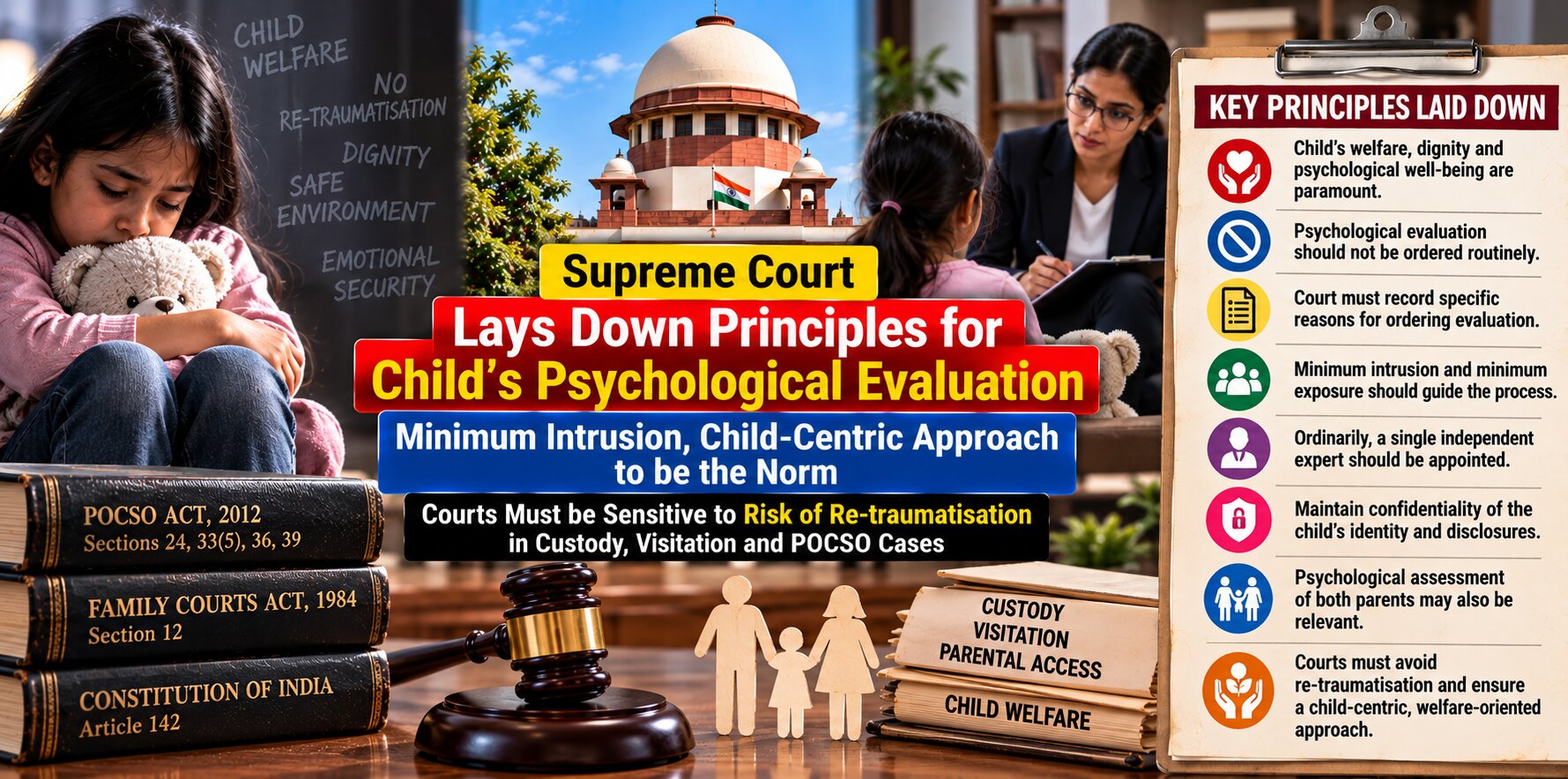
The welfare, emotional security, dignity and psychological well-being of the child are paramount considerations in custody, visitation and parental-access proceedings.
Judgement Details
Court
Supreme Court of India
Date of Decision
4 September 2026
Judges
Justice Sanjay Karol and Justice Nongmeikapam Kotiswar Singh
Citation
Acts / Provisions
Facts of the Case
-
The case concerned a matrimonial and child-custody dispute between the appellant-mother and respondent-father concerning their minor daughter, who was approximately 10 years old when the Supreme Court considered the matter.
-
The parties had married in 2015 and subsequently moved to the United States, where their daughter was born in 2016.
-
The appellant returned to India with the child in December 2019 following serious matrimonial discord and allegations concerning the conduct of the respondent.
-
The appellant subsequently initiated proceedings under the Protection of Women from Domestic Violence Act, 2005 and proceedings for dissolution of marriage under the Hindu Marriage Act, 1955.
-
Criminal proceedings were subsequently initiated against the respondent, including allegations under Sections 376, 376(2)(n), 323, 504 and 506 IPC and Sections 4, 5(l), 5(n) and 6 of the POCSO Act.
-
The appellant alleged that the minor child was also a victim of sexual abuse by the respondent-father. The respondent denied the allegations and contended that they were connected with the matrimonial dispute and the appellant's alleged alienation of the child.
-
The Family Court had continued the child's custody with the appellant and, in the circumstances of the pending POCSO proceedings, was initially reluctant to permit further psychological evaluation of the child for purposes of visitation.
-
The respondent subsequently sought appointment of an independent psychiatric/psychological expert to evaluate the child, the child's living circumstances and both parents, with the stated objective of facilitating reconnection between the father and daughter.
-
The Family Court initially declined to appoint an independent child psychiatrist, noting, among other things, that the child was already receiving therapeutic treatment and that exposing her to further evaluative processes could be harmful.
-
The Bombay High Court, however, partly allowed the respondent's challenge and directed appointment of an independent expert specialising in child psychology.
-
Subsequently, the Bombay High Court modified its earlier direction by replacing the reference to a single independent expert with a panel of experts.
-
On 7 December 2023, the High Court constituted a four-member panel to evaluate the minor child, including professionals suggested by the respondent and experts located outside Maharashtra and outside India.
-
The appellant challenged these directions before the Supreme Court, contending that repeated psychological evaluation by multiple professionals would expose the child to unnecessary psychological distress, re-traumatisation and secondary victimisation.
-
The Supreme Court was therefore required to examine not only whether psychological assistance could be sought in custody proceedings, but also the limits and safeguards governing court-directed psychological evaluation of a child allegedly subjected to sexual abuse.
Issues
-
Whether the Bombay High Court was justified in replacing its earlier direction for appointment of a single independent expert with a panel of experts for psychological evaluation of the minor child?
-
Whether psychological or psychiatric evaluation of a child allegedly subjected to sexual abuse should be directed routinely in custody, visitation or parental-access proceedings?
-
Whether repeated or multi-layered psychological evaluations of a child victim may result in re-traumatisation or secondary victimisation and therefore conflict with the child's welfare and dignity?
-
Whether the court must record specific reasons demonstrating the necessity, purpose, relevance and proportionality of psychological evaluation before subjecting a child to such a process?
-
Whether psychological assessment of the parents should be considered before subjecting the child to any further psychological evaluation?
-
Whether the High Court's directions satisfied the principles of minimum intrusion, minimum exposure, neutrality, proportionality and child-centric adjudication?
-
Whether the impugned orders dated 27 April 2023 and 7 December 2023 required modification and the matter remand to the Family Court for fresh consideration?
Judgement
-
The Supreme Court partly allowed the appeals and modified the Bombay High Court's impugned orders.
-
The Court held that psychological evaluation of a child is not prohibited merely because allegations under the POCSO Act are pending or because the dispute concerns custody or visitation.
-
At the same time, such evaluation cannot be ordered routinely merely because parents are involved in a custody or access dispute.
-
Before directing an evaluation, the court must record specific reasons demonstrating why the evaluation is necessary, what purpose it serves, its relevance, and why less intrusive alternatives are inadequate.
-
The Court held that minimum intrusion and minimum exposure must guide judicially directed psychological interaction with a child victim.
-
Repeated, overlapping or multi-layered psychological evaluations should ordinarily be avoided unless compelling circumstances exist and the court records reasons for adopting such a course.
-
Where psychological evaluation is considered necessary, it should ordinarily be conducted by one independent and court-appointed child psychologist, psychiatrist or similarly qualified professional possessing expertise in child psychology and child trauma.
-
A panel of experts should remain an exceptional measure, to be adopted only where the peculiar circumstances make it indispensable.
-
The expert must remain demonstrably independent and neutral and should ordinarily have no prior engagement with either litigating party except in a purely professional capacity.
-
The evaluative process must remain child-centric and welfare-oriented, rather than becoming an adversarial or evidence-gathering exercise designed to support either parent's case.
-
The Court emphasised the possibility of re-traumatisation where a child is repeatedly required to narrate traumatic experiences.
-
Courts must therefore regulate the number of sessions, duration of interactions, number of professionals involved and the overall manner in which evaluation takes place.
-
Any evaluation must be consistent with the child-friendly framework reflected in Sections 24, 33(5), 36 and 39 of the POCSO Act and with trauma-informed adjudication.
-
The Court further held that the child's identity, disclosures, therapeutic records and evaluative reports should remain strictly confidential.
-
Audio/video recordings, session notes and therapeutic material should not ordinarily be made directly accessible to the parties unless the court specifically finds disclosure necessary.
-
Reports prepared pursuant to a court-directed evaluation must remain confined to the purpose for which the evaluation was ordered and should not contain findings regarding criminal culpability.
-
Where a child is already receiving treatment from a qualified and neutral therapist or counsellor, disruption of that therapeutic environment should ordinarily be avoided.
-
In virtual or hybrid evaluations, courts must ensure safeguards relating to privacy, emotional safety, absence of external influence and suitability of the method considering the child's age and psychological condition.
-
The Court held that the supervising court must retain continuing jurisdiction over the evaluation and may modify, regulate or discontinue it if continuation threatens the child's welfare or psychological well-being.
-
Importantly, the Court directed attention not only to the psychological condition of the child but also to the psychological condition of both parents. It held that assessment of the parents may provide useful material before the court decides whether further psychological assessment of the child is necessary.
-
The Court therefore directed that a psychologist appointed by the Family Court interact with both parents and assess their present psychological conditions.
-
The court-appointed psychologist was directed to interact with the child's existing Child Psychologist and assess the child's current psychological condition through that professional rather than immediately subjecting the child to another independent multi-member evaluation.
-
The Family Court was directed to consider these reports and then determine whether any further psychological assessment of the child was actually desirable.
-
The Court also directed the parties to inform the Family Court about the status of the pending POCSO proceedings because their outcome and progress could materially affect questions concerning custody and visitation.
-
The matter was remitted to the Family Court for appropriate orders in accordance with the Supreme Court's directions.
-
The Supreme Court expressly clarified that the principles laid down are not exhaustive or rigid rules to be mechanically applied in every case. The assessment must remain sensitive to the individual child's age, circumstances, psychological condition and changing needs.
Held
-
Psychological or psychiatric evaluation of a child victim should not be ordered routinely merely because custody or visitation is disputed.
-
Courts must provide specific reasons before directing such an evaluation.
-
The principles of minimum intrusion and minimum exposure must govern psychological interaction with child victims.
-
Repeated or overlapping evaluations should ordinarily be avoided unless compelling circumstances justify them.
-
A single independent court-appointed expert should ordinarily conduct the evaluation when such evaluation is necessary.
-
A panel of experts is an exception, not the normal course.
-
Court-appointed experts must maintain institutional neutrality and independence.
-
Psychological evaluation must remain child-centric and welfare-oriented, not adversarial or investigative.
-
Courts must actively guard against re-traumatisation and secondary victimisation.
-
The existing therapeutic relationship of a child with a competent and neutral psychologist should ordinarily not be unnecessarily disrupted.
-
Confidentiality of the child's identity, disclosures, therapeutic records and evaluation reports must be protected.
-
Psychological reports should not be used to determine criminal culpability.
-
Courts must exercise continuing supervision over any psychological evaluation they order.
-
Psychological assessment of both parents may be relevant and beneficial before the child is subjected to additional psychological evaluation.
-
Courts exercising parens patriae jurisdiction have an independent responsibility to protect the child's welfare, regardless of the positions taken by either parent.
-
The principles are flexible and must be applied according to the individual circumstances and changing psychological needs of each child.
Analysis
-
Child welfare over parental claims: The Supreme Court placed the child's welfare at the centre of the adjudicatory process rather than treating the dispute simply as a contest between competing parental rights.
-
Minimum intrusion principle: The judgment recognises that a judicial process intended to protect a child can itself become harmful if the child is repeatedly exposed to interviews, assessments and professionals.
-
Evaluation is not automatically barred: The Court deliberately avoided creating an absolute prohibition on psychological assessment. Expert assistance can be useful where genuinely necessary to determine custody, access or visitation.
-
Necessity must be demonstrated: A court cannot simply order an evaluation because one parent requests it. It must explain the purpose of the evaluation and why less intrusive alternatives will not adequately protect the child's interests.
-
Panel versus single expert: The Supreme Court found a substantive difference between interaction with one independent professional and repeated interaction with multiple experts. Increasing the number of professionals can increase the child's psychological exposure and therefore requires justification.
-
Neutrality is fundamental: Where allegations of sexual abuse are pending against a parent, allowing an evaluative process to become aligned with one party's theory risks undermining confidence in the process. The Court therefore stressed institutional neutrality.
-
POCSO principles provide important guidance: Section 33(5) of the POCSO Act reflects the legislative concern that children should not be repeatedly exposed to the legal process. The Supreme Court treated that principle as useful guidance even though the custody proceedings themselves were not POCSO trials.
-
Therapy versus evaluation: The Court distinguished therapeutic intervention from forensic/evaluative interaction. Therapy is directed towards recovery and emotional support, whereas court-directed evaluation occurs in an adversarial litigation environment and can become stressful if insufficiently regulated.
-
Existing therapist's role: The judgment gives importance to continuity of care. If the child is already receiving treatment from a competent and neutral professional, courts should consider whether another evaluation is genuinely required before disturbing that arrangement.
-
Assessment of parents: One of the significant aspects of the judgment is its recognition that the child's psychological welfare cannot always be understood by examining the child alone. The psychological condition of the parents may directly affect the child's environment and the feasibility of custody or visitation arrangements.
-
Parens patriae jurisdiction: The court does not merely act as an adjudicator between parents. It has an independent protective responsibility towards the child and must intervene where a proposed process may harm the child's welfare.
-
Continuing judicial supervision: The evaluation is not a one-time order beyond judicial control. Courts can regulate, modify or discontinue the process if subsequent circumstances indicate that it is harming the child.
-
Dynamic nature of childhood: The Supreme Court recognised that a child's emotional needs can change with age, therapeutic progress, family circumstances, schooling and other environmental factors. Consequently, the judgment rejects a rigid formula for determining when assessments must be conducted.
-
Broader significance: The ruling provides an important framework for courts dealing with custody disputes involving allegations of child sexual abuse. It seeks to ensure that procedures adopted in the name of child welfare do not themselves become sources of psychological distress or secondary victimisation.
-
Remand rather than final custody determination: The Supreme Court did not itself finally determine the parties' custody or visitation rights. Instead, it modified the evaluation process and remitted the matter to the Family Court, leaving the appropriate custody/access orders to be determined after considering the relevant material.
-
Flexible guidelines: The Court expressly stated that its principles are not exhaustive or mechanically applicable. The ultimate controlling consideration remains the best interests, dignity, emotional security and psychological welfare of the particular child.