
Shaurya Sunil Kumar Singh v. Central Bureau of Investigation, 2026
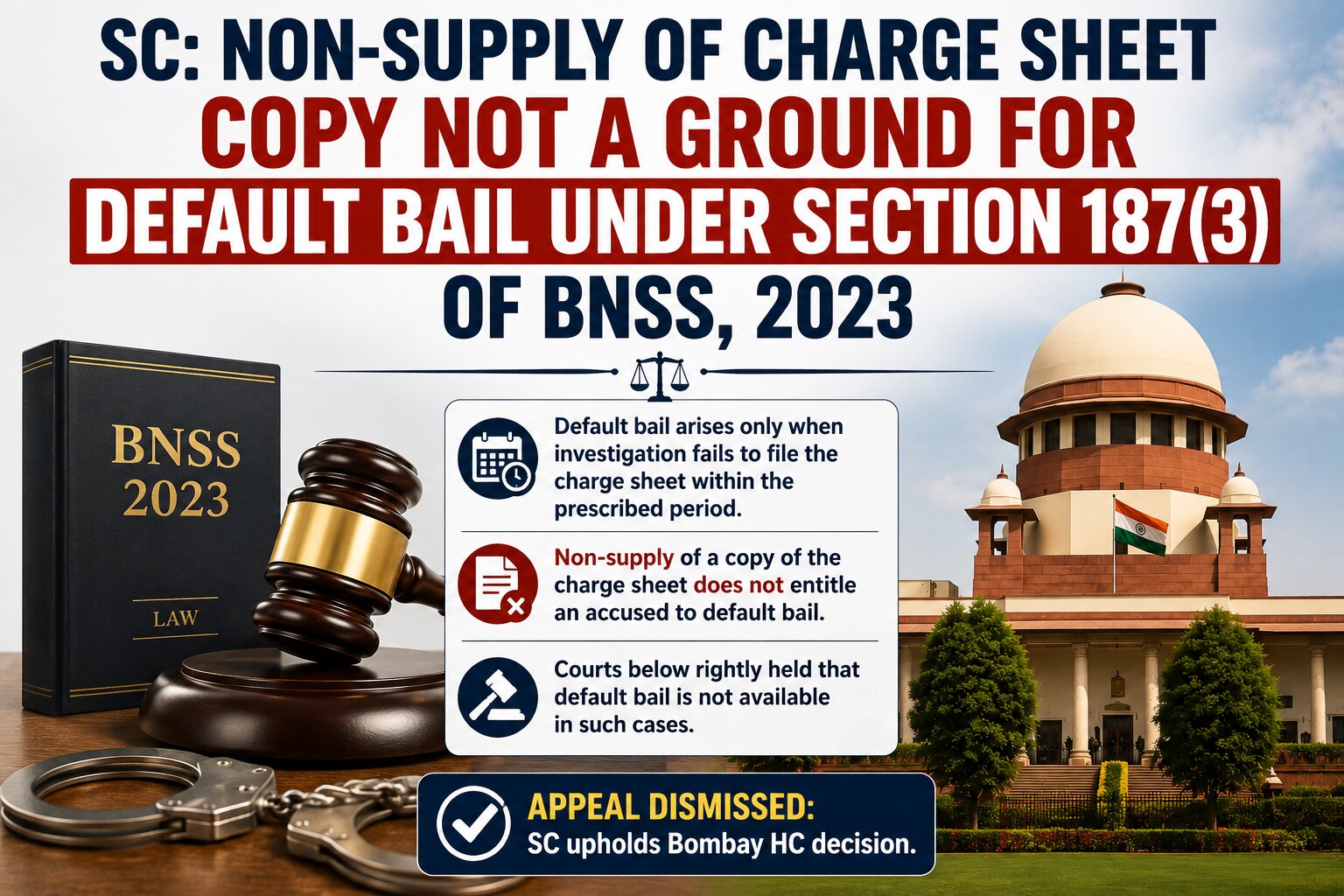
Non-supply of a copy of a charge sheet cannot, by itself, confer a right to default bail under Section 187(3) BNSS when the charge sheet has been filed within the prescribed statutory period.
Judgement Details
Court
Supreme Court of India
Date of Decision
5 August 2026
Judges
Justice Sanjay Karol and Justice Nongmeikapam Kotiswar Singh
Citation
Acts / Provisions
Facts of the Case
-
The appellant was arrested in connection with a CBI investigation into an alleged large-scale cyber fraud.
-
The alleged fraud involved approximately ₹3.81 crore.
-
The FIR invoked provisions of the Bharatiya Nyaya Sanhita, Prevention of Corruption Act and Information Technology Act.
-
The investigating agency filed the charge sheet within the prescribed statutory period.
-
However, the accused contended that a copy of the charge sheet had not been supplied to him.
-
Relying upon this non-supply, he sought default bail under Section 187(3) BNSS.
-
The Bombay High Court rejected the application.
-
The High Court held that default bail arises from failure to file the charge sheet within the prescribed period, and not merely from failure to supply a copy of an already-filed charge sheet.
-
The accused challenged the High Court's decision before the Supreme Court.
-
The Supreme Court examined whether non-supply of the charge sheet could independently trigger the right to default bail.
Issues
-
Whether non-supply of a copy of the charge sheet to an accused, despite the charge sheet having been filed within the prescribed period, constitutes a ground for default bail under Section 187(3) of the BNSS?
-
Whether the right to default bail under Section 187(3) BNSS arises when the investigating agency fails to furnish a copy of the charge sheet even though the charge sheet itself has been filed within the prescribed statutory period?
-
Whether the courts below were justified in rejecting the appellant's claim for default bail solely because the charge sheet had already been filed within the prescribed period?
Judgement
-
The Supreme Court dismissed the appeal.
-
The Court upheld the Bombay High Court's decision rejecting default bail.
-
The Court held that non-supply of a copy of the charge sheet cannot by itself constitute a ground for default bail.
-
The relevant consideration under Section 187(3) BNSS is whether the investigating agency failed to file the charge sheet within the prescribed statutory period.
-
In the present case, the charge sheet had been filed within the applicable period.
-
Therefore, the statutory basis for claiming default bail was absent.
-
The Supreme Court found the reasoning of the courts below to be justified.
-
The appeal was consequently dismissed.
Held
-
Default bail under Section 187(3) BNSS is linked to failure to file the charge sheet within the prescribed period.
-
Merely failing to supply a copy of an already-filed charge sheet does not create an independent right to default bail.
-
Where the charge sheet has been filed within the statutory period, the accused cannot claim default bail solely on the ground that a copy was not supplied.
-
The appellant's claim for default bail was therefore rejected.
Analysis
-
Core principle: The judgment distinguishes between the statutory requirement of filing the charge sheet within the prescribed period and the separate procedural obligation of supplying a copy to the accused.
-
Default bail: Default bail is a statutory safeguard against prolonged detention when the investigating agency fails to complete the investigation and file the required report within the prescribed period.
-
Trigger for the right: According to the Court, the relevant trigger is non-filing of the charge sheet within the statutory period, not merely non-supply of a copy after filing.
-
Filing versus supply: The judgment makes an important distinction between two different procedural events. Filing the charge sheet satisfies the condition relevant to default bail, whereas supplying a copy concerns the accused's access to the prosecution material.
-
No automatic default bail: The Court rejected the proposition that every procedural failure relating to the charge sheet automatically converts into a right to default bail.
-
Personal liberty: Although default bail is closely connected with the accused's personal liberty, the statutory conditions governing that right must still be satisfied.
-
Scope of Section 187(3): The Court interpreted the provision according to its statutory purpose: preventing detention beyond the permissible period where the investigation has not been completed and the required report has not been filed.
-
Practical significance: Investigating agencies must comply with procedural requirements concerning supply of documents, but failure to supply the charge sheet does not, by itself, confer a right to default bail where the charge sheet was timely filed.
-
Limited ruling: The judgment, based on the material provided, addresses only the default-bail consequence of non-supply. It does not mean that an accused has no legal entitlement to receive necessary prosecution documents at the appropriate stage.
-
Cyber-fraud context: The underlying case involved an alleged ₹3.81-crore cyber fraud, but the Supreme Court's ruling on the appeal concerned the specific question of default bail.