
Shardul Negi v. State of Uttarakhand and Another, 2026
The decision strongly cautions investigating agencies against routinely invoking Section 306 IPC in emotionally charged cases without satisfying the statutory requirements.
Judgement Details
Court
Uttarakhand High Court
Date of Decision
15 July 2026
Judges
Justice Alok Mahra
Citation
Acts / Provisions
Facts of the Case
-
The revisionist and the deceased were allegedly in a romantic relationship and intended to marry each other.
-
According to the prosecution, after some time, the revisionist refused to marry the deceased.
-
It was alleged that the refusal caused the deceased severe emotional distress and depression.
-
The deceased subsequently committed suicide by administering an overdose of Midazolam (Mezolam).
-
The deceased's father lodged an FIR alleging that the revisionist had abetted her suicide.
-
Upon completion of the investigation, the police filed a charge-sheet under Section 306 IPC.
-
The Additional District and Sessions Judge, Tehri Garhwal, framed a charge against the revisionist under Section 306 IPC by order dated 14 January 2021.
-
The revisionist challenged the order before the Uttarakhand High Court, contending that mere refusal to marry did not constitute abetment of suicide in law.
-
The complainant argued that at the stage of framing of charge, the Court was only required to determine whether a prima facie case existed and that the trial had already substantially progressed.
Issues
-
Whether mere refusal to marry, without any positive act of instigation, intentional aid, or active participation, constitutes abetment of suicide under Section 306 IPC?
-
Whether the material collected during investigation disclosed the essential ingredients of abetment under Section 107 IPC?
-
Whether the Trial Court was justified in framing a charge under Section 306 IPC against the revisionist?
-
Whether investigating agencies and Trial Courts should exercise greater caution before invoking and framing charges under Section 306 IPC?
Judgement
-
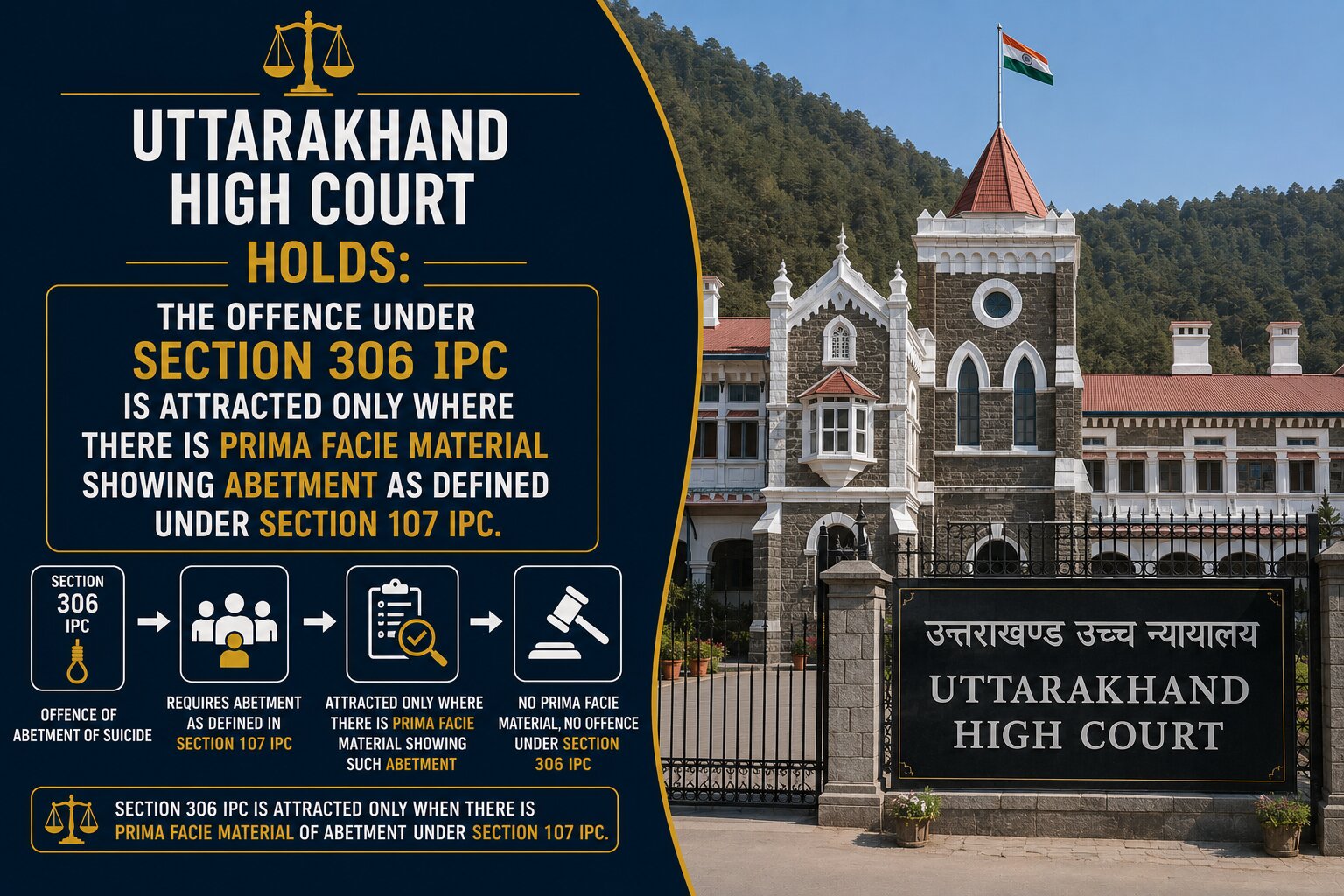
The High Court held that the offence under Section 306 IPC is attracted only where there is prima facie material showing abetment as defined under Section 107 IPC.
-
The Court observed that mere harassment, emotional distress, disappointment, or refusal to marry does not amount to abetment unless accompanied by a positive act of instigation, intentional aid, or active participation.
-
The Court found that the only allegation against the revisionist was that he had refused to marry the deceased.
-
The Court held that there was no material showing that the revisionist intentionally provoked, instigated, encouraged, or aided the deceased in committing suicide.
-
The Court observed that the witness statements recorded during investigation disclosed no overt act capable of constituting abetment in law.
-
The Court remarked that Section 306 IPC appears to be casually and too readily invoked by investigating agencies, despite repeated judicial pronouncements prescribing a higher threshold for its application.
-
The Court cautioned that criminal prosecution under Section 306 IPC should not be initiated merely to satisfy the emotional expectations of the deceased's family where the statutory ingredients are absent.
-
The Court further observed that Trial Courts should avoid adopting a "play it safe" approach by mechanically framing charges without examining whether the essential legal ingredients are prima facie established.
-
Holding that the prosecution case remained legally insufficient even if accepted at its highest, the Court set aside the order framing charge under Section 306 IPC.
-
Consequently, the revisionist was discharged from the criminal proceedings, and the criminal revision was allowed.
Held
-
Mere refusal to marry does not constitute abetment of suicide under Section 306 IPC.
-
To attract Section 306 IPC, there must be prima facie evidence of instigation, intentional aid, or active participation as contemplated under Section 107 IPC.
-
Emotional distress or disappointment alone is insufficient to establish criminal liability for abetment of suicide.
-
Trial Courts must exercise caution before framing charges under Section 306 IPC.
-
The charge under Section 306 IPC was quashed, and the revisionist was discharged.
Analysis
-
The judgment reiterates the settled principle that criminal liability for abetment of suicide requires a clear causal and intentional connection between the accused's conduct and the deceased's decision to commit suicide.
-
By relying on Sections 306 and 107 IPC, the Court reaffirmed that every instance of emotional trauma or failed personal relationship cannot be criminalised as abetment.
-
The Court's criticism of the "play it safe" syndrome serves as important guidance to Trial Courts that framing of charges must involve judicial application of mind rather than mechanical acceptance of the police report.
-
The judgment recognizes that interpersonal relationships often involve emotional conflicts, disappointment, or harsh exchanges, but these ordinary realities cannot automatically amount to criminal instigation.
-
By emphasizing practical evaluation of human conduct instead of isolated allegations or hyperbolic exchanges, the Court promotes a balanced and legally principled approach to prosecutions for abetment of suicide.
-
The ruling also strengthens procedural safeguards by preventing unnecessary criminal trials where the essential ingredients of the offence are absent from the very inception.
-
Overall, the judgment reinforces the high threshold consistently prescribed by the Supreme Court for prosecuting offences of abetment of suicide and seeks to curb misuse of Section 306 IPC.