
Shakir Jamil Ahmed Shaikh v. State of Maharashtra, 2026
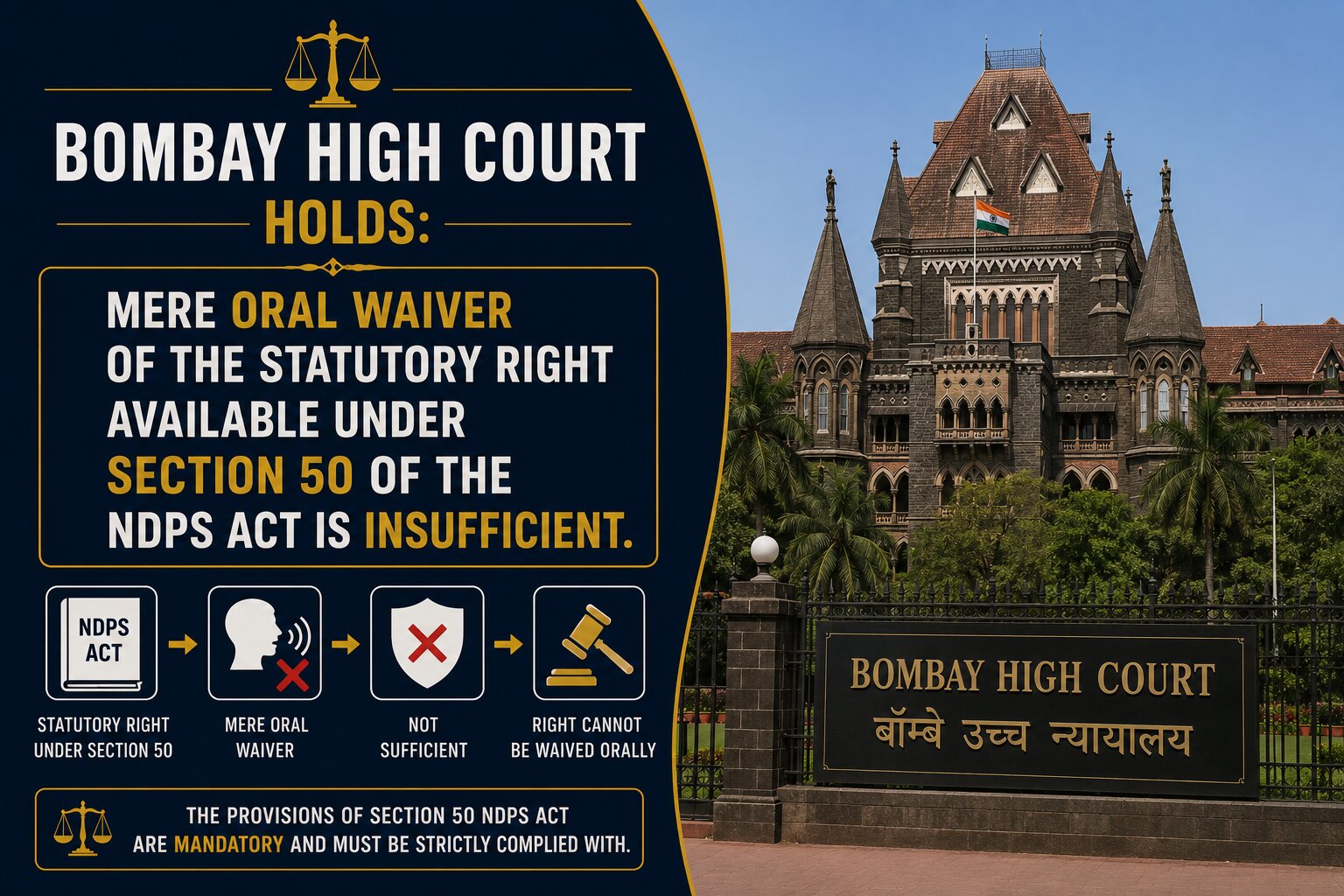
The judgment reinforces the mandatory nature of the procedural safeguards contained in Section 50 of the NDPS Act, recognizing them as an important protection against arbitrary searches.
Judgement Details
Court
Bombay High Court
Date of Decision
15 July 2026
Judges
Justice Shyam C. Chandak
Citation
Acts / Provisions
Facts of the Case
-
The applicant was arrested for offences punishable under Sections 8(c), 22(b), and 22(c) of the NDPS Act.
-
According to the prosecution, while police officers were on patrol duty, they noticed the applicant behaving suspiciously.
-
Before conducting the personal search, the police served the applicant with a written notice under Section 50 of the NDPS Act, informing him of his right to be searched before a Gazetted Officer or a Magistrate.
-
The prosecution alleged that the applicant orally declined the offer and stated that such an arrangement was "not necessary."
-
The personal search was thereafter conducted in the presence of panch witnesses.
-
During the search, the police allegedly recovered 100 grams of Mephedrone from the applicant's possession.
-
After completion of the investigation, a charge-sheet was filed.
-
The Trial Court rejected the applicant's bail application.
-
Before the High Court, the applicant contended that the mandatory requirements of Section 50 NDPS Act had not been complied with because his alleged waiver of the statutory right was never recorded in writing or signed by him.
-
The State argued that service of the written notice and the applicant's oral refusal constituted sufficient compliance with Section 50.
Issues
-
Whether an oral waiver of the right available under Section 50 of the NDPS Act is sufficient compliance with the statutory requirement?
-
Whether an accused's waiver of the right to be searched before a Gazetted Officer or a Magistrate must be recorded in writing and signed by the accused?
-
Whether the alleged non-compliance with Section 50 of the NDPS Act entitled the applicant to be released on bail?
Judgement
-
The Bombay High Court held that mere oral waiver of the statutory right available under Section 50 of the NDPS Act is insufficient.
-
The Court observed that although the applicant had been informed through a written notice of his right to be searched before a Gazetted Officer or a Magistrate, his alleged refusal was recorded only in the panchnama as an oral statement.
-
The Court noted that the alleged waiver was neither endorsed on the copy of the Section 50 notice nor separately reduced into writing bearing the applicant's signature.
-
The Court held that where an accused chooses not to exercise the valuable statutory right under Section 50, such waiver should be reduced into writing and duly signed by the accused.
-
The Court observed that the absence of a written waiver lent support to the applicant's contention that the mandatory safeguards prescribed under Section 50 had not been properly followed.
-
The Court also took into consideration that the applicant had remained in custody for more than three and a half years, no prosecution witness had yet been examined, and the applicant was already on bail in earlier criminal cases.
-
Considering the cumulative circumstances, the Court held that the applicant had made out a case for grant of bail.
-
Accordingly, the Court allowed the bail application and directed the applicant's release on bail subject to appropriate conditions.
Held
-
An oral waiver of the right under Section 50 of the NDPS Act is not sufficient.
-
Waiver of the statutory right to be searched before a Gazetted Officer or a Magistrate should be recorded in writing and signed by the accused.
-
Failure to properly record such waiver may indicate non-compliance with the mandatory safeguards under Section 50.
-
Considering the alleged procedural lapse, prolonged incarceration, and delay in trial, the applicant was granted bail.
Analysis
-
By insisting upon a written and signed waiver, the Court sought to eliminate disputes regarding whether the accused voluntarily relinquished the statutory right.
-
The decision strengthens procedural fairness by ensuring that relinquishment of valuable legal rights is evidenced by clear and reliable documentation rather than solely through oral assertions recorded by investigating officers.
-
The Court balanced the seriousness of offences under the NDPS Act with the equally important requirement of strict compliance with statutory safeguards governing search and seizure.
-
The judgment also recognizes that prolonged incarceration coupled with delayed trial is a relevant consideration while deciding applications for bail, even in prosecutions under the NDPS Act.
-
The ruling is likely to encourage investigating agencies to adopt more rigorous documentation practices while conducting searches under Section 50, thereby reducing future procedural challenges.
-
Overall, the decision affirms that compliance with procedural safeguards under special criminal statutes is indispensable for ensuring fairness in criminal investigations.