
Shahrukh v. State of U.P. and Connected Jail Appeal, 2026
A conviction based on circumstantial evidence requires a complete chain of circumstances pointing towards the guilt of the accused.
Judgement Details
Court
Allahabad High Court
Date of Decision
24 September 2026
Judges
Justice Siddhartha Varma and Justice Jai Krishna Upadhyay
Citation
Acts / Provisions
Facts of the Case
-
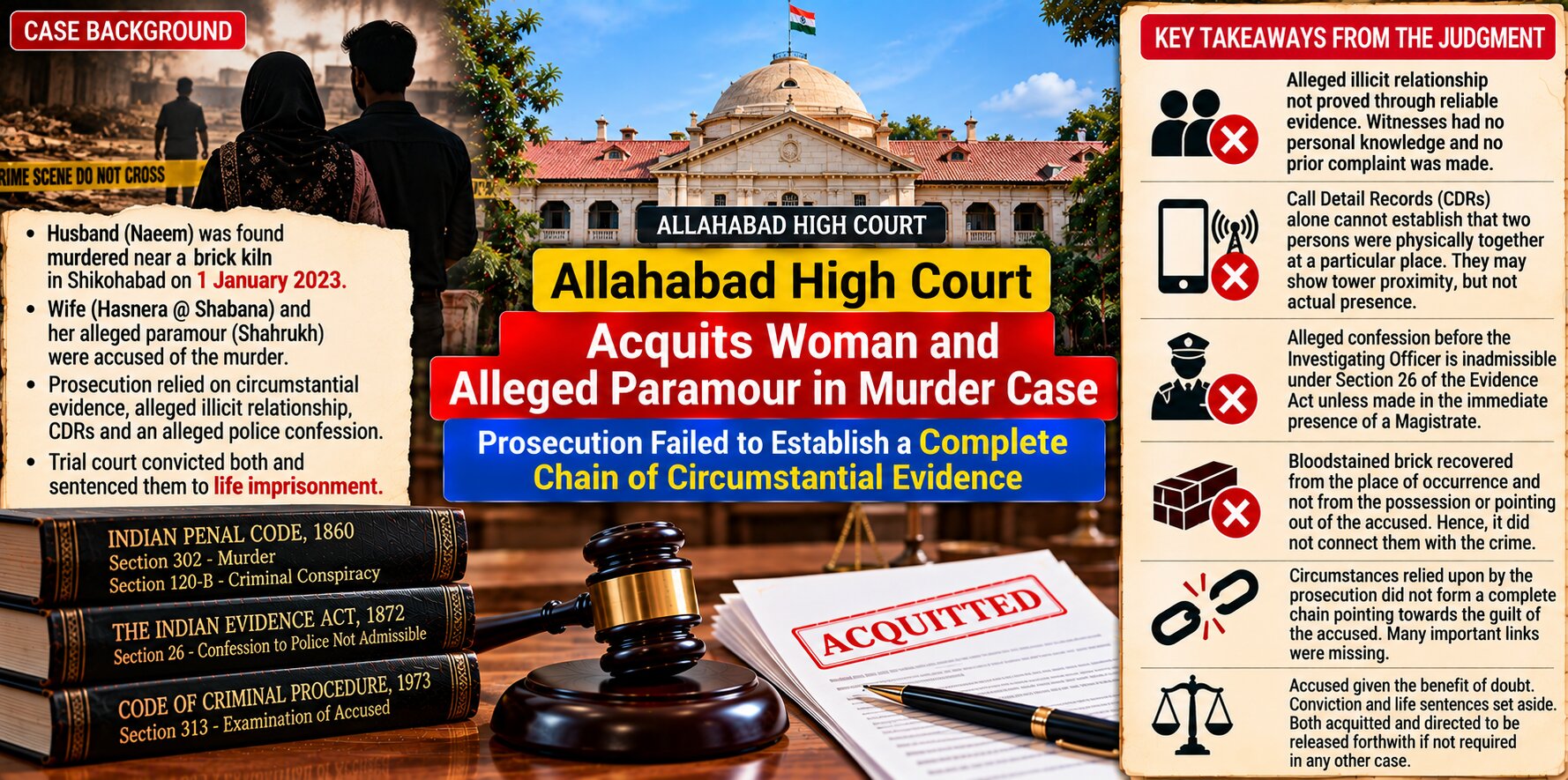
The case arose from the death of Naeem, who was found murdered near a brick kiln in the Shikohabad area on 1 January 2023.
-
Naeem had suffered severe injuries and the prosecution alleged that he had been murdered by his wife, Hasnera @ Shabana, and Shahrukh.
-
The prosecution alleged that Hasnera and Shahrukh were involved in an illicit relationship and had conspired to eliminate Naeem.
-
There was no eyewitness to the alleged murder and the prosecution case was therefore substantially based on circumstantial evidence.
-
The prosecution relied upon the alleged illicit relationship as the motive for the murder.
-
It also relied upon Call Detail Records (CDRs) to contend that Shahrukh and the deceased were in communication and were in proximity to each other around the relevant time.
-
The prosecution further relied upon alleged confessions said to have been made by the accused before the Investigating Officer.
-
A bloodstained brick, alleged to be the murder weapon, was recovered from the place of occurrence.
-
The prosecution sought to use these circumstances collectively to establish the involvement of the two accused.
-
The trial court convicted Hasnera @ Shabana and Shahrukh under Sections 302 and 120-B IPC and sentenced them to life imprisonment, along with a fine of ₹30,000 each, by judgment dated 14 November 2025.
-
The accused challenged their conviction before the Allahabad High Court.
-
The High Court examined whether the individual circumstances relied upon by the prosecution were legally proved and whether, taken together, they constituted a complete chain pointing towards the guilt of the accused.
-
The Court separately examined the alleged motive, CDR evidence, alleged police confession and recovery of the bloodstained brick.
Issues
-
Whether the prosecution established a complete and conclusive chain of circumstantial evidence connecting the appellants with the murder of Naeem?
-
Whether the alleged illicit relationship between Hasnera and Shahrukh was proved through reliable evidence so as to establish the prosecution's motive theory?
-
Whether the Call Detail Records were sufficient by themselves to establish that Shahrukh and the deceased were physically together at or near the place of occurrence?
-
Whether the alleged confession made by the accused before the Investigating Officer was legally admissible and could be relied upon against them?
-
Whether recovery of the bloodstained brick from the place of occurrence, rather than from the possession or pointing out of either accused, constituted a connecting circumstance against them?
-
Whether the circumstances relied upon by the prosecution excluded every reasonable hypothesis consistent with the innocence of the appellants?
-
Whether the appellants were entitled to the benefit of doubt where material links in the alleged chain of circumstantial evidence remained unproved?
Judgement
-
The Allahabad High Court allowed the appeals and set aside the conviction and sentence imposed by the trial court.
-
The Court held that the prosecution had failed to establish a complete chain of circumstantial evidence connecting Hasnera and Shahrukh with the murder of Naeem.
-
The alleged illicit relationship between Hasnera and Shahrukh, which constituted the principal motive relied upon by the prosecution, was not established through reliable evidence.
-
The witnesses who spoke about the alleged relationship did not possess personal knowledge of it and no independent witness was produced to substantiate the allegation.
-
The Court consequently found that the prosecution had failed to prove the alleged motive.
-
The High Court also rejected the prosecution's attempt to treat CDRs as conclusive evidence that Shahrukh and the deceased were physically together.
-
The Court explained that CDRs may indicate communication or that two mobile devices were operating within the coverage area of the same mobile tower, but such data does not necessarily establish that the users were physically together.
-
The Court observed that a person may leave a mobile phone at one location while travelling elsewhere, meaning that mobile-tower proximity cannot automatically establish the physical presence of its owner at a crime scene.
-
The Court held that CDRs could, in an appropriate case, serve as corroborative evidence, but could not by themselves establish that the accused and deceased were together at the relevant time.
-
The alleged confessions made before the Investigating Officer were also rejected as legally inadmissible.
-
Applying Section 26 of the Evidence Act, the Court held that a confession made by an accused while in police custody cannot be proved against the accused unless it is made in the immediate presence of a Magistrate.
-
The alleged confession therefore could not provide a valid incriminating link against either appellant.
-
The Court further found that the bloodstained brick was recovered from the place of occurrence and not pursuant to the possession or pointing out of either accused.
-
Consequently, the recovery did not provide the necessary evidentiary link connecting either appellant to the murder.
-
After examining all the circumstances cumulatively, the Court concluded that several important links in the prosecution's chain were missing.
-
The Court held that it would not be safe to sustain a murder conviction where the circumstances did not form a complete chain pointing towards the guilt of the accused.
-
The appellants were therefore given the benefit of doubt.
-
The trial court's judgment dated 14 November 2025 was set aside.
-
Hasnera @ Shabana and Shahrukh were acquitted, with directions that they be released forthwith if they were not required in any other case.
Held
-
Every important incriminating circumstance must be independently and firmly established.
-
The alleged illicit relationship between the accused, when unsupported by reliable first-hand evidence, could not establish the prosecution's motive theory.
-
CDRs alone cannot conclusively prove that two persons were physically together at a particular place.
-
CDR evidence may be used as corroborative material when supported by reliable eyewitness, scientific or recovery evidence, but it cannot ordinarily serve as the sole basis for concluding physical presence together.
-
The mere fact that two mobile phones were operating within the same tower's coverage area does not necessarily establish that their users were together.
-
A confession allegedly made by an accused while in police custody before the Investigating Officer cannot be relied upon contrary to the restriction contained in Section 26 of the Evidence Act.
-
Recovery of an alleged murder weapon from the place of occurrence, without a legally incriminating connection to the accused, does not automatically establish their involvement.
-
Where significant circumstances relied upon by the prosecution remain unproved or legally insufficient, the required chain of circumstantial evidence remains incomplete.
-
Where the evidence permits a reasonable hypothesis consistent with innocence, the accused are entitled to the benefit of doubt.
-
The High Court accordingly set aside the conviction and sentence and acquitted both appellants.
Analysis
-
The principal significance of the judgment lies in its reaffirmation of the strict standard applicable to circumstantial evidence in a murder prosecution.
-
Unlike a case supported by direct eyewitness testimony, a circumstantial-evidence case requires the prosecution to establish several individual facts and demonstrate that those facts collectively lead to one conclusion — the guilt of the accused.
-
The Court relied upon established principles, including those associated with Sharad Birdhichand Sarda v. State of Maharashtra, requiring the circumstances to be fully established, consistent only with guilt, conclusive in nature and collectively forming a complete chain.
-
The alleged illicit relationship was important because it was relied upon as the motive for the murder. However, the Court found that the witnesses relied upon for proving the relationship lacked personal knowledge.
-
The absence of reliable evidence establishing the relationship meant that the prosecution's motive theory remained substantially unsupported.
-
Importantly, motive is not invariably indispensable when other evidence conclusively establishes guilt. However, where the prosecution case is otherwise circumstantial and motive constitutes one of the principal links, failure to establish it may assume considerable significance.
-
The Court's treatment of CDR evidence is another important feature of the judgment.
-
A CDR can establish that calls were exchanged between particular numbers and, depending upon the data, may indicate the general geographical area covered by a mobile tower.
-
But tower coverage does not ordinarily identify the precise physical location of the handset, much less prove that two individuals were physically together at a particular place.
-
The Court therefore treated CDR evidence as potentially corroborative rather than conclusive.
-
This distinction is particularly important in criminal trials because converting circumstantial telecommunications data into proof of physical presence requires additional reliable evidence.
-
The Court also highlighted the possibility that the mobile phone and its user may be in different locations. Consequently, possession or location of a mobile device cannot automatically be equated with the physical presence of its owner.
-
On the alleged confession, the Court applied the statutory protection contained in Section 26 of the Evidence Act. A confession made while the accused is in police custody is subject to a strict evidentiary restriction unless made in the immediate presence of a Magistrate.
-
Therefore, an alleged confession made directly to the Investigating Officer could not be used as an independent incriminating circumstance against the accused.
-
The recovery evidence also failed to bridge the evidentiary gap. The bloodstained brick was found at the place of occurrence, rather than being recovered from the accused or pursuant to information supplied by them.
-
Thus, the prosecution could not use the recovery as a circumstance uniquely connecting the weapon with either appellant.
-
When the motive, CDR evidence, alleged confession and recovery are considered together, the prosecution's case contained multiple evidentiary gaps rather than a series of mutually reinforcing circumstances.
-
The High Court therefore applied the fundamental criminal-law principle that suspicion, however strong, cannot replace proof beyond reasonable doubt.
-
The judgment also demonstrates that individual pieces of evidence cannot necessarily be aggregated mechanically. Each circumstance must first possess sufficient evidentiary value before it can contribute to a complete chain.
-
The Court's approach does not mean that CDRs can never be used in a murder prosecution. Rather, they can be relevant as corroborative evidence where supported by stronger independent circumstances.
-
Similarly, the decision does not establish that motive must always be proved in every murder case. Its importance depends upon the nature of the prosecution evidence and the role assigned to motive in the particular case.
-
The acquittal therefore resulted from the cumulative failure of several prosecution links, rather than from any single evidentiary defect alone.
-
The decision reinforces the distinction between evidence that merely creates suspicion and evidence that establishes guilt beyond reasonable doubt.
-
Ultimately, because the circumstances did not form a complete chain excluding reasonable alternatives consistent with innocence, the High Court concluded that sustaining the life sentences would not be safe.
-
The appellants were accordingly entitled to the benefit of doubt and were acquitted.