
Shabana Khatoon v. Ranchi Municipal Corporation and Ors., 2026
A person who demonstrates a prima facie connection or interest in the disputed property may be permitted to intervene or be impleaded where his presence is relevant to the complete adjudication of the dispute.
Judgement Details
Court
Jharkhand High Court
Date of Decision
25 September 2026
Judges
Justice Sanjay Kumar Dwivedi
Citation
Acts / Provisions
Facts of the Case
-
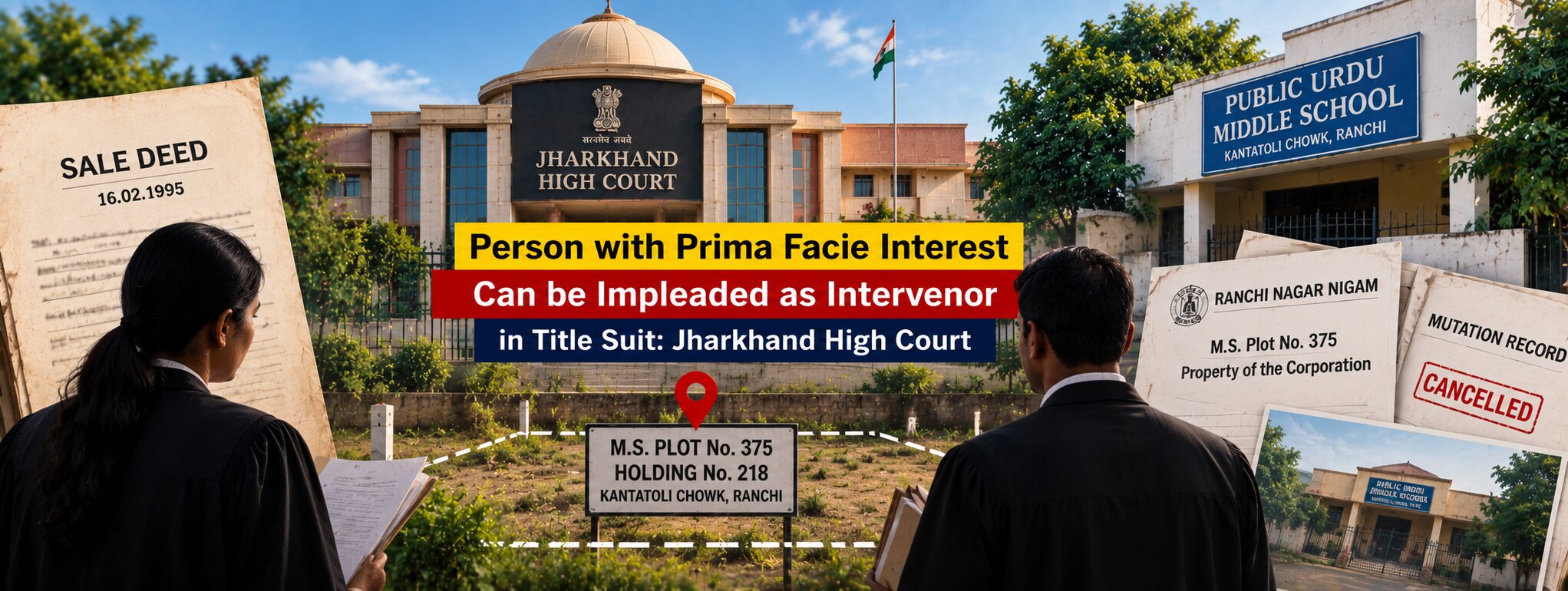
The petitioner instituted Title Suit No. 173 of 2011 seeking a declaration of her right, title and interest over the disputed property along with a permanent injunction against interference with her possession.
-
The disputed property was situated at M.S. Plot No. 375, Holding No. 218, Ward No. VI (Old), corresponding to Ward No. 23/13, Khasmahal Plot No. 2048, Tamtamtoli Road, Kantatoli Chowk, Ranchi.
-
The petitioner claimed ownership on the basis of a registered sale deed dated 16 February 1995, executed by Swapan Kumar Saha, and asserted that she had been in peaceful possession of the property.
-
During the pendency of the title suit, the President of Public Urdu Middle School, Kantatoli Chowk, Ranchi, sought intervention/impleadment on the ground that the school had an interest connected with the disputed property.
-
The Trial Court, by order dated 24 February 2014, allowed the intervention application.
-
The petitioner challenged the Trial Court's order before the Jharkhand High Court under Article 227 of the Constitution, contending that the intervenor had no right, title or interest in the disputed property.
-
The intervenor relied upon documents concerning the same M.S. Plot No. 375, including communications issued by Ranchi Nagar Nigam.
-
The municipal documents indicated that the plot was claimed as municipal property and that certain mutation entries concerning the property had been cancelled or otherwise disputed.
-
The material placed before the Trial Court also indicated that the Public Urdu Middle School was being run on a portion of the disputed property, thereby creating a competing factual claim concerning the same land.
-
The High Court found that there was uncertainty concerning the identity and exact portion of the disputed plot, as well as competing claims concerning ownership and possession.
-
The Court held that these matters could not appropriately be conclusively determined at the stage of deciding the intervention application and would have to be adjudicated after the parties produced evidence in the pending title suit.
Issues
-
Whether the Trial Court was justified in allowing the intervention/impleadment application concerning the disputed M.S. Plot No. 375?
-
Whether the intervenor had disclosed a sufficient prima facie interest in the disputed property to justify his presence in the title suit?
-
Whether the presence of the intervenor was necessary or proper for complete and effective adjudication of the competing claims concerning the disputed property?
-
Whether the High Court, while exercising supervisory jurisdiction under Article 227 of the Constitution, was justified in interfering with the Trial Court's order allowing intervention?
Judgement
-
The Jharkhand High Court dismissed the writ petition and upheld the Trial Court's order permitting intervention.
-
The Court observed that the intervenor had produced documents relating to the very same plot of land which was the subject matter of the title suit.
-
The documents created a genuine dispute concerning the ownership, possession and particular portion of M.S. Plot No. 375 involved in the litigation.
-
The Court considered the material indicating that the Public Urdu Middle School was functioning on a portion of the property and that municipal records also raised competing claims concerning the plot.
-
The Court held that these circumstances demonstrated that the intervenor's presence could assist the Trial Court in completely and effectively adjudicating the dispute.
-
Relying upon the principles laid down by the Supreme Court in Vidur Impex & Traders (P) Ltd. v. Tosh Apartments (P) Ltd., the Court recognized the distinction between a necessary party and a proper party.
-
The Court emphasized that the question of the parties' ultimate rights over the property was a matter for determination in the title suit on the basis of evidence and was not required to be finally decided while considering intervention.
-
The High Court found no illegality or jurisdictional error in the Trial Court's decision to allow intervention.
-
The parties were therefore left to establish their respective claims before the Trial Court through appropriate evidence.
Held
-
Where documents produced by an intervenor concern the same property involved in the title suit and disclose competing claims, the court may permit intervention to avoid fragmented litigation.
-
The existence of a disputed claim does not require the court to finally determine the intervenor's title at the stage of impleadment.
-
The ultimate question concerning ownership, possession and identification of the disputed portion can be decided by the Trial Court after evidence is led.
-
The Trial Court correctly exercised its discretion in allowing intervention, and the High Court found no ground to interfere under Article 227.
Analysis
-
Court's reasoning: The High Court focused on whether the intervenor's presence would assist in resolving the actual controversy. Since the documents related to the same plot and raised a competing claim, excluding the intervenor could potentially result in incomplete adjudication.
-
Necessary and proper parties: The judgment reinforces the principle that a person need not necessarily be someone against whom the plaintiff seeks direct relief to qualify as a proper party. If that person's presence enables the court to completely and effectively determine the controversy, impleadment can be justified.
-
Prima facie interest: At the intervention stage, the court does not conduct a detailed trial on title. The existence of relevant documents and a plausible connection with the disputed property can be sufficient to justify participation in the proceedings.
-
Avoidance of multiplicity of proceedings: Allowing intervention can prevent a situation where the intervenor is forced to institute separate litigation concerning the same property, while the original title suit proceeds without all materially interested parties.
-
Evidence-based adjudication: The Court correctly separated the question of impleadment from the question of final title. Whether the petitioner, municipality, school or another claimant ultimately possesses a legally enforceable right is a matter to be established through evidence in the title suit.
-
Article 227 jurisdiction: The High Court's supervisory jurisdiction is not intended to substitute its own factual assessment for that of the Trial Court in every interlocutory matter. Interference is warranted where there is jurisdictional error, illegality or serious procedural irregularity.
-
Impact on existing law: The decision applies the established Supreme Court principles in Vidur Impex concerning necessary and proper parties. It illustrates that the procedural power of impleadment may be exercised to ensure that all materially relevant claims concerning the same property are considered within the appropriate litigation.
-
Practical significance: In property disputes involving overlapping sale deeds, municipal records, mutation entries, possession claims or competing institutional claims, the court may allow a person with a credible connection to the property to participate so that the dispute can be resolved comprehensively rather than through multiple proceedings.