
Seemabai v. Basantilal, 2026
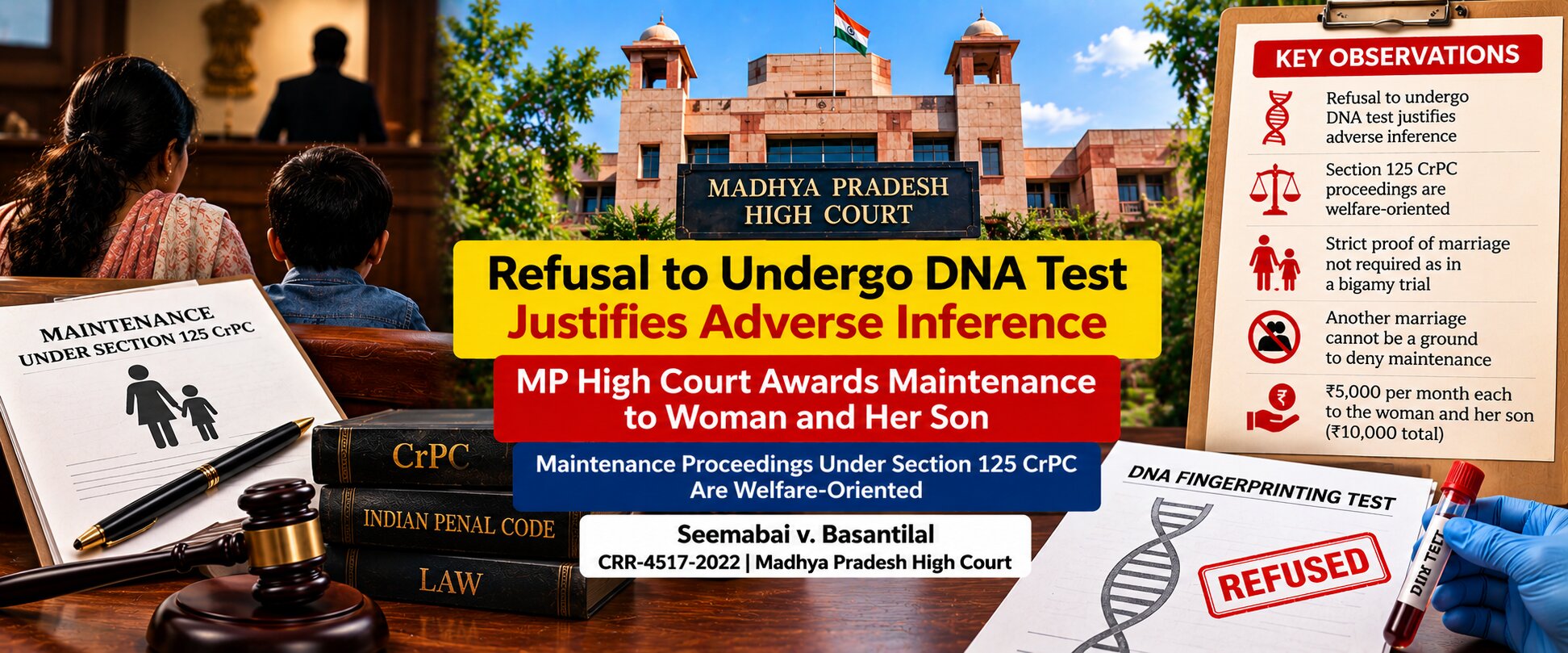
The Court emphasized that proceedings under Section 125 CrPC are welfare-oriented and are intended to prevent destitution and vagrancy.
Judgement Details
Court
Madhya Pradesh High Court
Date of Decision
1 September 2026
Judges
Justice Gajendra Singh
Citation
Acts / Provisions
Facts of the Case
-
Seemabai and her minor son filed proceedings under Section 125 CrPC in 2014 seeking maintenance from Basantilal.
-
Seemabai claimed that she had married Basantilal approximately 14 years earlier according to Hindu rites and customs and that Revision Petitioner No. 2 was born from their relationship.
-
According to the petitioners, they were subsequently driven out of the matrimonial home and were left without adequate financial support.
-
Seemabai alleged that Basantilal was employed as a government teacher and also had substantial income from agricultural property.
-
Basantilal denied having married Seemabai. He claimed that he was already legally married to another woman, Krishnabai, with whom he had two children.
-
Basantilal asserted that Seemabai had merely worked as a domestic worker in his house for a monthly salary of ₹1,000.
-
He further alleged that Seemabai had left his house after committing theft and had initiated the maintenance proceedings to harass and blackmail him.
-
The Gram Nyayalaya rejected the maintenance application, finding that the petitioners had failed to establish the marital relationship and the paternity of the child.
-
The appellate court affirmed the decision.
-
During the revision proceedings before the High Court, the petitioners sought permission for a DNA fingerprinting test to establish the paternity of Revision Petitioner No. 2.
-
The respondent opposed the DNA test and refused to undergo it.
-
By order dated 14 March 2024, the High Court had declined to compel the respondent to undergo the test but specifically directed that his refusal could be considered while finally deciding the revision.
-
The High Court noted that Basantilal admitted that Seemabai was his relative and had lived in his house for a considerable period.
-
The Court also noticed inconsistencies in his stand concerning the child. While initially denying knowledge of Revision Petitioner No. 2, he subsequently admitted that the child was Seemabai's child.
-
Witnesses produced by the petitioners consistently stated that Seemabai and Basantilal had married according to Hindu customs and that the child was born from their relationship.
Issues
-
Whether the respondent's refusal to undergo DNA fingerprinting, despite disputing the paternity of the child, could justify drawing an adverse inference against him?
-
Whether the evidence on record was sufficient to establish the marital relationship between Revision Petitioner No. 1 and the respondent for the purposes of Section 125 CrPC?
-
Whether the respondent's assertion that he was already married to another woman could, by itself, defeat the petitioners' claim for maintenance under Section 125 CrPC?
-
Whether the findings of the Gram Nyayalaya and the appellate court refusing maintenance were sustainable in the circumstances of the case?
Judgement
-
The Madhya Pradesh High Court allowed the revision petition filed by Seemabai and her son.
-
The Court drew an adverse inference against the respondent because he opposed the DNA fingerprinting test despite the dispute regarding the child's paternity.
-
The Court considered the respondent's refusal particularly relevant because the DNA test had been sought specifically to determine whether Revision Petitioner No. 2 was his biological child.
-
The Court also considered the respondent's own statements concerning Seemabai's presence in his household and his later acknowledgment that the child was Seemabai's child.
-
The consistent testimony of the petitioners' witnesses regarding the marriage according to Hindu customs was also taken into consideration.
-
The Court held that the standard applicable in maintenance proceedings is not identical to the strict proof required in a criminal prosecution for an offence such as bigamy under Section 494 IPC.
-
The fact that Basantilal claimed to have another legally wedded wife, Krishnabai, and two children from that marriage was held not, by itself, sufficient to deny maintenance to the petitioners in the circumstances of the case.
-
The High Court consequently set aside the orders of the Gram Nyayalaya and the appellate court.
-
Basantilal was directed to pay ₹5,000 per month to Seemabai and ₹5,000 per month to her son, making the total maintenance ₹10,000 per month.
Held
-
Refusal to undergo a DNA test can, in appropriate circumstances, justify an adverse inference, particularly where paternity is specifically disputed and the person refusing the test is in the best position to provide evidence capable of resolving the dispute.
-
Proceedings under Section 125 CrPC are welfare-oriented and should not be approached with the same degree of technicality applicable to a prosecution for bigamy.
-
The existence or assertion of another marriage cannot automatically defeat a maintenance claim where the surrounding evidence supports the claimant's case.
-
The Court may consider the entire evidentiary circumstances, including admissions, conduct, witness testimony and refusal to undergo relevant scientific examination.
-
The petitioners were entitled to maintenance of ₹5,000 each per month.
Analysis
-
Adverse inference from DNA-test refusal: The significant aspect of the decision is the Court's treatment of the respondent's refusal to undergo DNA fingerprinting. The Court did not treat the refusal as an independent and automatic proof of paternity; rather, it considered the refusal along with the other evidence available on record.
-
Importance of surrounding circumstances: The Court took into account that Seemabai had admittedly stayed in the respondent's house for a considerable period, that the respondent acknowledged her relationship with him to some extent, and that his statements concerning the child were not entirely consistent.
-
Welfare character of Section 125 CrPC: Section 125 CrPC is designed to provide a speedy and practical remedy against destitution. The Court therefore emphasized that maintenance proceedings should not be defeated merely because the relationship cannot be established with the same strictness demanded in a criminal prosecution for bigamy.
-
Marriage and maintenance are distinct questions: The Court's reasoning demonstrates that the question whether a woman is entitled to maintenance under Section 125 CrPC must be examined in the context and purpose of the maintenance proceeding. A respondent cannot simply rely on the assertion of another marriage and thereby automatically defeat the claim.
-
Paternity dispute: The DNA issue was particularly important because the respondent disputed the child's paternity. His refusal to participate in the proposed scientific examination became an evidentiary circumstance against him when viewed together with the other material.
-
Admissions can be significant: The respondent's acknowledgment concerning Seemabai's presence in his household and his subsequent acknowledgment concerning the child weakened the categorical defence that he had no relationship with the petitioners.
-
Evidence must be considered cumulatively: The judgment illustrates that maintenance proceedings may require the court to examine oral testimony, admissions, conduct and surrounding circumstances collectively rather than isolating one piece of evidence.
-
Nature of the relief: The ultimate object was to prevent the woman and child from being left without financial support. The Court therefore restored the maintenance claim and fixed ₹5,000 per month for each petitioner.