
Securities and Exchange Board of India v. Yogesh Babulal Mehta & Ors., 2026
A public authority is not generally required to create, collect, compile or collate fresh information for an RTI applicant.
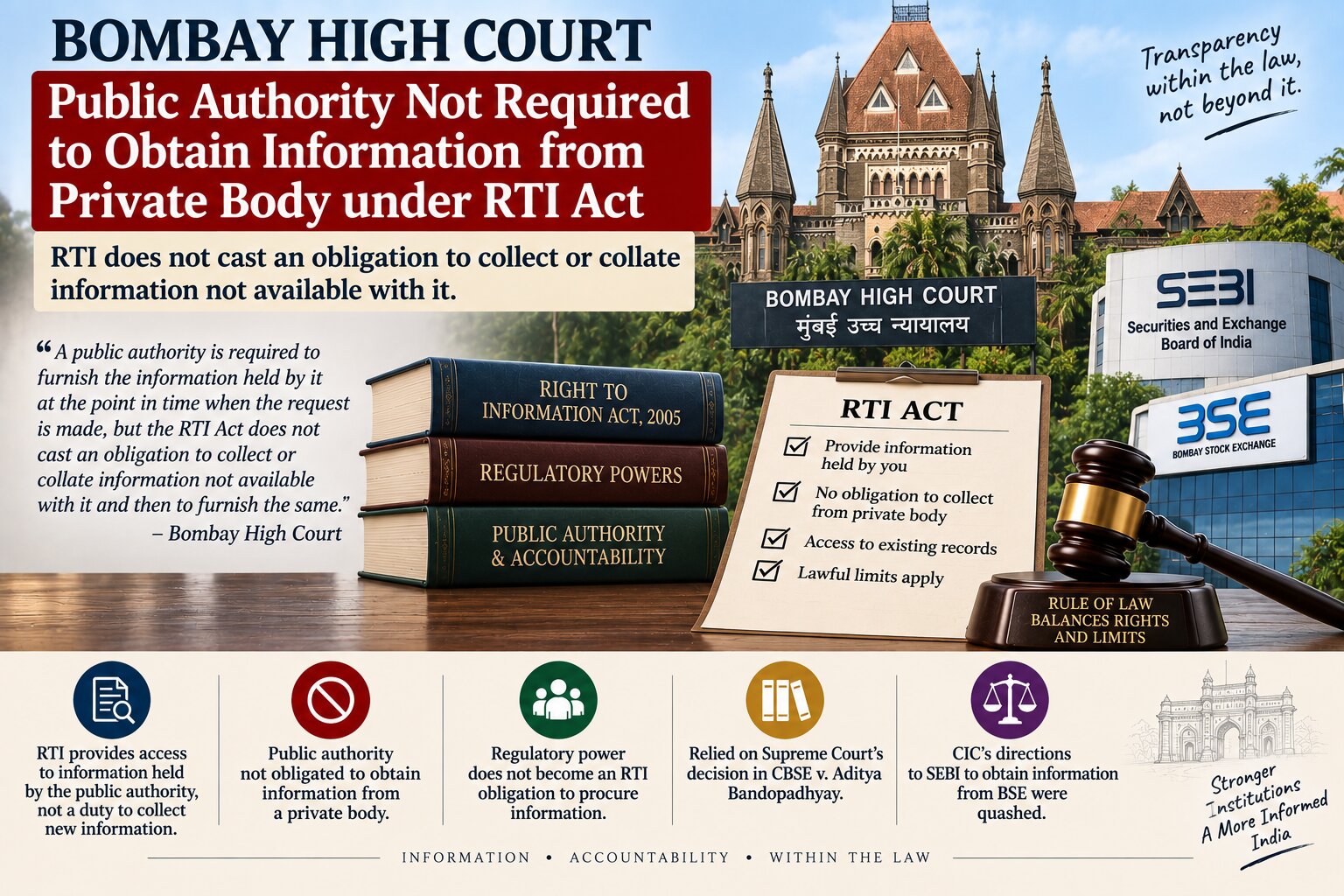
Judgement Details
Court
Bombay High Court
Date of Decision
11 August 2026
Judges
Justice Manish Pitale and Justice Shreeram V. Shirsat
Citation
Acts / Provisions
Facts of the Case
-
A batch of writ petitions was filed by SEBI and BSE challenging orders of the Central Information Commission.
-
The CIC had directed SEBI to obtain information from BSE and furnish it to RTI applicants.
-
SEBI argued that its obligation under the RTI Act was to provide information held by or under its control, subject to statutory exemptions.
-
It contended that its regulatory power to obtain information from BSE could not be converted into an obligation to collect information specifically for an RTI applicant.
-
The dispute primarily concerned the interpretation of Section 2(f) of the RTI Act.
-
The High Court considered the Supreme Court's ruling in CBSE v. Aditya Bandopadhyay and the subsequent Constitution Bench decision in CPIO v. Subhash Chandra Agarwal.
Issues
-
Whether a public authority is required under the RTI Act to collect or obtain information from a private body merely to satisfy an RTI applicant?
-
Whether information relating to a private body accessible by a public authority under Section 2(f) requires the public authority to actively obtain such information from that private body?
-
Whether a public authority is required to collect or collate information not available with it at the time of an RTI request?
-
Whether SEBI's regulatory power to obtain information from BSE could be treated as an obligation under the RTI Act to furnish that information to RTI applicants?
-
Whether the CIC was justified in directing SEBI to obtain information from BSE and furnish it to the applicants?
Judgement
-
The Bombay High Court allowed the writ petitions filed by SEBI and BSE.
-
The Court held that the RTI Act does not ordinarily require a public authority to collect information from a private body merely because the authority has statutory powers to obtain that information.
-
Information required to be furnished under the RTI Act is information held by or under the control of the public authority when the request is made.
-
The Court rejected the CIC's interpretation that SEBI's regulatory authority to obtain information from BSE created an RTI obligation to procure such information.
-
The CIC orders directing SEBI to obtain information from BSE were quashed and set aside.
Held
-
The RTI Act provides access to existing and available information.
-
Section 2(f) does not impose an unlimited duty upon a public authority to obtain information from a private body.
-
Information relating to a private body can fall within Section 2(f) where it is accessible by the public authority under law, but applicable statutory conditions and restrictions continue to operate.
-
A regulatory power to demand information from a private entity does not automatically become an RTI obligation to exercise that power whenever an applicant seeks the information.
-
The RTI Act does not require a public authority to furnish information that would require drawing inferences or making assumptions, nor does it require the authority to generate advice or opinions that are not already available on record.
-
Section 22 RTI Act does not give a public authority an unrestricted power to overcome statutory restrictions governing access to information held by private bodies.
-
The CIC's directions requiring SEBI to obtain information from BSE were therefore unsustainable.
Analysis
-
The judgment draws a crucial distinction between accessing information already held and requiring a public authority to undertake a fresh information-gathering exercise.
-
The expression “information relating to any private body” in Section 2(f) has a broad scope, but it does not mean that every piece of information which a regulator could potentially obtain must automatically be procured for an RTI applicant.
-
The Court correctly separated SEBI's regulatory function from its obligations under the RTI Act. SEBI may possess statutory powers to demand information from BSE for regulatory purposes, but those powers cannot automatically be transformed into a service obligation for individual RTI applicants.
-
The ruling reinforces the Supreme Court's principle in CBSE v. Aditya Bandopadhyay that the RTI Act is primarily concerned with providing access to information that exists and is held by or under the control of the public authority.
-
The judgment also prevents RTI proceedings from being converted into a mechanism for compelling public authorities to investigate, gather or generate information that they do not possess.
-
At the same time, the judgment does not mean that information held by private bodies is always outside the RTI framework. Where the law gives a public authority lawful access to such information and the information is within the statutory concept of accessible information, the relevant provisions of the RTI Act continue to apply.
-
The decision therefore establishes a balanced interpretation: RTI provides access to information; it does not ordinarily impose a duty on public authorities to create or procure information on demand.
-
The CIC's approach was particularly problematic because it effectively converted SEBI's regulatory power into a mandatory information-collection obligation, which the High Court found inconsistent with the settled Supreme Court position.