
Securities and Exchange Board of India v. Yogesh Babulal Mehta & Connected Matters, 2026
A public authority is required to provide information held by or under its control when a valid RTI request is made, subject to the exemptions and procedural safeguards contained in the RTI Act.
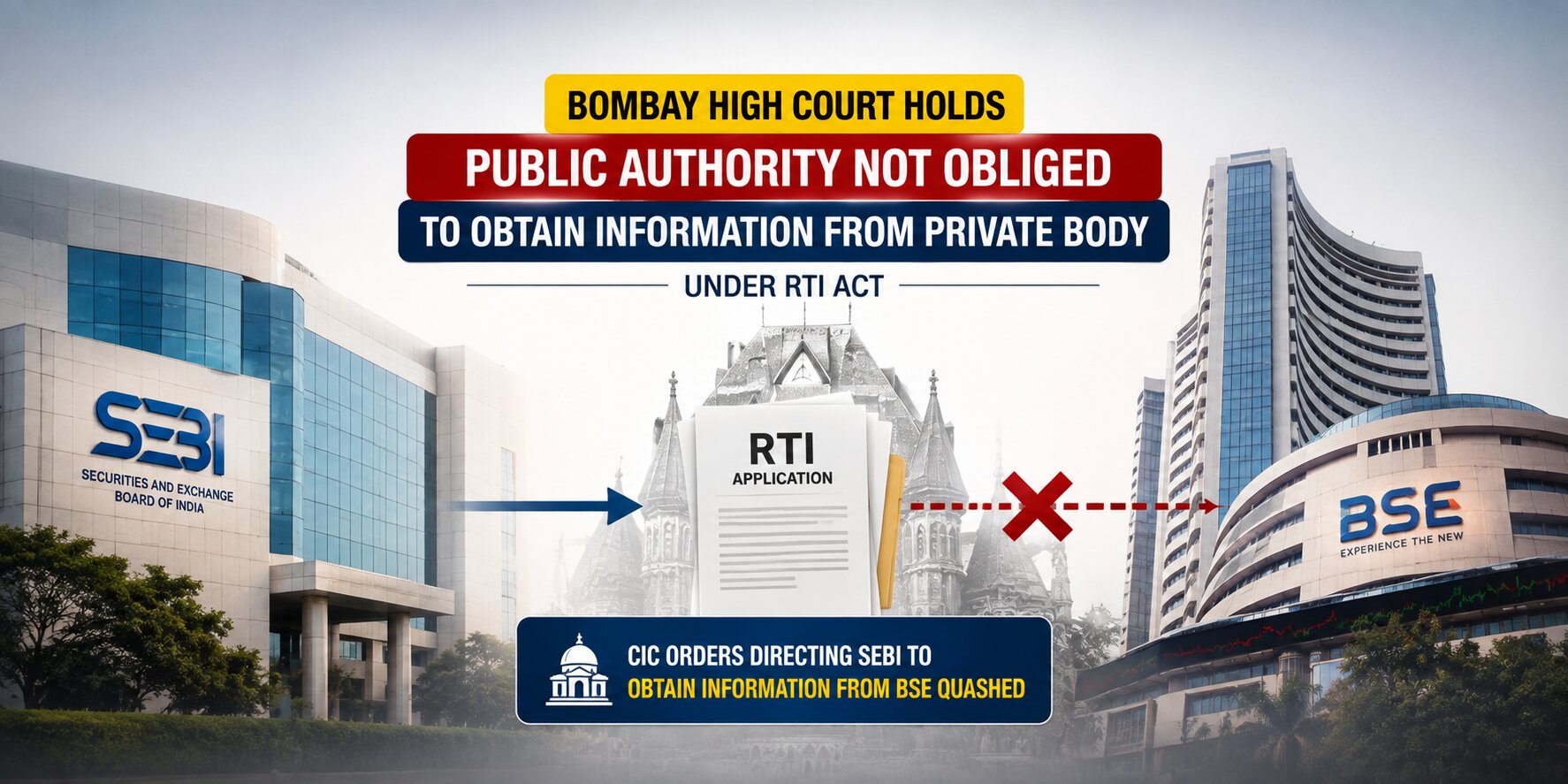
Judgement Details
Court
Bombay High Court
Date of Decision
25 August 2026
Judges
Justice Manish Pitale and Justice Shreeram V. Shirsat
Citation
Acts / Provisions
Facts of the Case
-
The dispute arose from several applications made under the Right to Information Act, 2005 seeking information from the Securities and Exchange Board of India (SEBI).
-
SEBI was approached in its capacity as a regulatory authority.
-
Some of the information sought by the RTI applicants was not actually available in the records of SEBI.
-
The information was instead available with, or was required to be obtained from, the Bombay Stock Exchange (BSE).
-
SEBI possessed statutory regulatory powers under its governing legislation to call upon entities such as BSE to provide information for regulatory purposes.
-
The RTI applicants nevertheless sought such information from SEBI under the RTI Act.
-
The Central Information Commission (CIC) considered the scope of Section 2(f) of the RTI Act and concluded that SEBI's obligation extended beyond information already available with it.
-
The CIC directed SEBI to obtain information from BSE and provide the information to the RTI applicants.
-
According to the CIC's interpretation, SEBI was required not only to disclose information already held by it but also to collect relevant information from third parties such as BSE.
-
SEBI challenged the CIC's orders before the Bombay High Court.
-
BSE also filed connected writ petitions challenging the directions that effectively required information to be obtained from it through SEBI.
-
The nine writ petitions were tagged together because they raised a common question of law.
-
The impugned CIC orders were stayed during the pendency of the writ proceedings.
-
The original RTI applicants were served with notice in the High Court proceedings but did not appear to contest the petitions.
-
SEBI argued that its obligation under the RTI Act was to provide information held by or under its control at the time the RTI application was made.
-
SEBI accepted that information relating to a private body could fall within Section 2(f) where such information was accessible to SEBI under another law.
-
However, SEBI argued that this did not mean that it was required to exercise its regulatory powers and collect fresh information from a third party merely because an RTI applicant wanted that information.
-
SEBI contended that its power to demand information from BSE existed for the purpose of regulatory supervision, not for conducting information-gathering exercises on behalf of RTI applicants.
-
BSE supported SEBI's position and raised substantially similar arguments.
-
The petitioners relied upon Sections 2(f), 2(h), 2(j), 6, 8, 11 and 18 of the RTI Act.
-
They also relied upon the Supreme Court decisions in CBSE v. Aditya Bandopadhyay and CPIO v. Subhash Chandra Agarwal.
-
It was argued that these decisions had already clarified that the RTI Act does not require a public authority to collect or collate information that is not available with it.
-
The CIC had adopted a broader interpretation of Section 2(f).
-
According to the impugned CIC orders, SEBI's statutory ability to obtain information from BSE meant that the information could be regarded as information accessible to SEBI.
-
On this basis, the CIC directed SEBI to obtain the required information from BSE and furnish it to the RTI applicants.
-
The High Court therefore had to determine whether the expression “information relating to any private body which can be accessed by a public authority” creates an obligation upon the public authority to actively obtain such information whenever requested under the RTI Act.
Issues
-
Whether a public authority is required under the Right to Information Act, 2005 to obtain information from a private body merely because the public authority possesses statutory powers to call for such information?
-
Whether Section 2(f) of the RTI Act requires a public authority to collect or obtain information from a third party when such information was not actually held by the public authority at the time of the RTI request?
-
Whether the expression “information relating to any private body” in Section 2(f) can be interpreted to impose an obligation upon a public authority to actively procure information from a private body?
-
Whether a regulatory power vested in a public authority to obtain information from a private body under its governing statute can be treated as a statutory duty under the RTI Act to obtain that information for an applicant?
-
Whether the RTI Act requires a public authority to collect, compile or collate non-available information merely because the information is sought by an RTI applicant?
-
Whether the information sought by the applicants could be treated as information “held by or under the control of” SEBI when SEBI did not possess the information but could potentially obtain it from BSE in exercise of its regulatory powers?
-
Whether the Central Information Commission was justified in directing SEBI to obtain information from BSE and furnish it to the RTI applicants?
-
Whether the CIC orders directing SEBI to obtain information from third parties were sustainable in light of the Supreme Court's judgment in CBSE v. Aditya Bandopadhyay?
-
Whether the subsequent clarification by the Constitution Bench in CPIO v. Subhash Chandra Agarwal confirmed that the RTI Act does not require a public authority to collect information that is not already available with it?
-
Whether the impugned CIC orders were liable to be quashed and set aside for being contrary to the settled position of law?
Judgement
-
The Bombay High Court allowed the writ petitions filed by SEBI and BSE.
-
The Court held that a public authority is not under an obligation under the RTI Act to obtain information from a private body merely because it possesses statutory powers to obtain such information.
-
The Court examined Section 2(f) and acknowledged that the provision has a wide scope.
-
However, the Court emphasized that Section 2(f) is subject to the other provisions of the RTI Act, including Sections 8 and 11.
-
The Court held that the information required to be furnished under the RTI Act is information held by the public authority at the time the request is made.
-
The Court rejected the proposition that a regulatory authority such as SEBI must automatically exercise its statutory powers against a third party to obtain information for an RTI applicant.
-
The Court distinguished between a power to access information for regulatory purposes and an obligation to obtain information for the purposes of an RTI request.
-
The Court relied heavily upon the Supreme Court's decision in CBSE v. Aditya Bandopadhyay.
-
The Supreme Court had held that the RTI Act provides access to information that is available and existing, and does not require a public authority to collect or collate information that is not part of its records.
-
The Bombay High Court observed that this principle directly applied to the dispute involving SEBI and BSE.
-
The Court also relied upon the Constitution Bench decision in CPIO v. Subhash Chandra Agarwal, which approved the relevant observations from CBSE v. Aditya Bandopadhyay.
-
The Court explained that the phrase in Section 2(f) concerning information relating to a private body must be understood in the context of information that is accessible to the public authority under another law.
-
The existence of a statutory mechanism enabling SEBI to call for information from BSE did not, by itself, create an obligation to exercise that mechanism every time an RTI application was filed.
-
The Court also noted that the CIC itself had subsequently passed orders recognizing the correct legal position and had declined to direct SEBI to obtain information from third parties.
-
Therefore, the earlier reasoning adopted by the CIC was found to be inconsistent with the law clarified by the Supreme Court.
-
The Court held that the impugned CIC orders could not be sustained.
-
Accordingly, the impugned CIC orders were quashed and set aside.
-
The writ petitions were allowed and the Rule was made absolute.
Held
-
The RTI Act does not ordinarily require a public authority to collect information from a private body merely because the authority has statutory powers to obtain such information.
-
The expression “information relating to any private body” in Section 2(f) does not mean that a public authority must undertake a fresh information-gathering exercise for every RTI applicant.
-
A public authority's regulatory power to obtain information from a third party cannot automatically be converted into an RTI obligation to obtain that information.
-
The RTI Act does not require a public authority to collect, compile or collate information that is not available with it.
-
The information must be held by or under the control of the public authority for the right to information to operate in the manner contemplated by the Act.
-
The Supreme Court's interpretation in CBSE v. Aditya Bandopadhyay remains applicable and was subsequently approved by the Constitution Bench in CPIO v. Subhash Chandra Agarwal.
-
Section 22 of the RTI Act does not transform a public authority's regulatory power into an unlimited power to obtain third-party information for RTI applicants.
-
The CIC therefore erred in directing SEBI to obtain information from BSE.
-
The CIC's impugned orders were consequently quashed and set aside.
Analysis
-
Meaning of “information”: Section 2(f) deliberately gives “information” a broad meaning. It includes records, documents, e-mails, reports, data and other forms of material. However, the breadth of the definition does not eliminate the requirement that the information must be accessible to or held by the relevant public authority within the statutory framework.
-
Existing information versus fresh collection: The most important distinction in the judgment is between information already available and information that would have to be freshly obtained. The RTI Act facilitates access to the former; it does not generally require a public authority to create or procure the latter.
-
Section 2(f) and private bodies: Section 2(f) specifically includes information relating to a private body that can be accessed by a public authority under another law. The Supreme Court's interpretation, as applied by the Bombay High Court, means that this provision recognizes information that the public authority is legally capable of accessing. It does not necessarily impose a duty to access that information afresh for every RTI applicant.
-
Power versus obligation: SEBI's ability to demand information from BSE arose from its regulatory powers. The Court correctly distinguished that power from an obligation under the RTI Act. A power granted for regulatory supervision cannot automatically be treated as a mandatory procedure for responding to RTI applications.
-
Role of Section 22: Section 22 gives the RTI Act overriding effect where there is an inconsistency with another law. However, the Court relied upon the Supreme Court's explanation that Section 22 does not erase statutory conditions governing a public authority's own access to private-body information. It does not give the public authority an unrestricted power to obtain information that it otherwise cannot access.
-
Third-party information: Section 11 provides a mechanism where information relating to or supplied by a third party is already within the RTI process and disclosure is being considered. Section 11 does not itself create a general obligation requiring a public authority to first obtain every piece of information from a third party.
-
CBSE v. Aditya Bandopadhyay: This Supreme Court judgment was central to the High Court's reasoning. It established that the RTI Act provides access to available and existing information and does not require public authorities to collect or collate information that is not available in their records.
-
CPIO v. Subhash Chandra Agarwal: The Constitution Bench subsequently approved the relevant reasoning in Aditya Bandopadhyay. The Bombay High Court therefore treated the legal position as settled rather than as an open question.
-
Regulatory authorities: The judgment has particular importance for regulators such as SEBI. Regulatory authorities routinely possess statutory powers to call for information from regulated entities. If every RTI application could compel the regulator to exercise those powers, the RTI mechanism could effectively convert regulatory powers into an extensive information-collection service.
-
Administrative burden: The Court's interpretation avoids placing an unlimited administrative burden on public authorities. Authorities are required to process and disclose information within the RTI framework but are not generally required to conduct fresh investigations merely because an applicant seeks information.
-
RTI applicants: The judgment does not eliminate the right of citizens to obtain information concerning private bodies where such information is already held by or under the control of a public authority and is otherwise disclosable under the Act.
-
Important limitation: The decision should not be misunderstood as saying that information concerning a private body can never be obtained through an RTI application. Where a public authority lawfully possesses or controls the information, the RTI Act may require its disclosure, subject to applicable exemptions.
-
No creation of information: A public authority is also not generally required to prepare a new analysis, compilation, inference or opinion merely because an applicant wants such material. The RTI mechanism is primarily concerned with access to existing information.
-
CIC's inconsistent position: The Court noted that the CIC itself had subsequently recognized the Supreme Court's clarification and had declined to issue similar directions requiring SEBI to obtain information from third parties. This further demonstrated that the impugned orders could not continue to stand.
-
Judicial discipline: The judgment demonstrates the importance of following binding Supreme Court precedent. Once the Supreme Court had clarified the scope of Section 2(f), the CIC could not continue adopting an interpretation inconsistent with that authoritative position.
-
Impact on transparency: The decision does not weaken the fundamental objective of the RTI Act. Instead, it clarifies the statutory boundaries of transparency. The right to information is extensive but is not unlimited.
-
Balance between transparency and administration: The Supreme Court's reasoning, adopted by the High Court, recognizes the need to balance transparency and accountability against efficient administration, limited public resources and legitimate confidentiality interests.
-
Practical significance: An RTI applicant seeking information from a regulator should generally identify information that the regulator already holds or controls. A request cannot ordinarily be used to compel the regulator to approach another organization and undertake a fresh information-gathering exercise.
-
Overall legal principle: The judgment establishes a clear distinction between accessing existing information and creating or procuring information. The RTI Act primarily guarantees the former and does not generally impose the latter obligation.
-
The Bombay High Court's decision clarifies the limits of a public authority's obligation under the RTI Act.
-
A public authority must disclose information that is held by or under its control, subject to statutory exemptions.
-
However, the authority is not required to obtain information from a private body merely because it has a separate statutory power to demand that information.
-
The judgment therefore prevents the RTI Act from being used to compel regulators such as SEBI to conduct fresh information-gathering exercises on behalf of applicants.
-
The CIC orders directing SEBI to obtain information from BSE were quashed, and the connected writ petitions were allowed.