
Savari Eswaramma v. Parigala Anjinamma & Others, 2026
A writ court cannot adversely affect the rights of third-party purchasers without impleading them and giving them an opportunity of hearing.
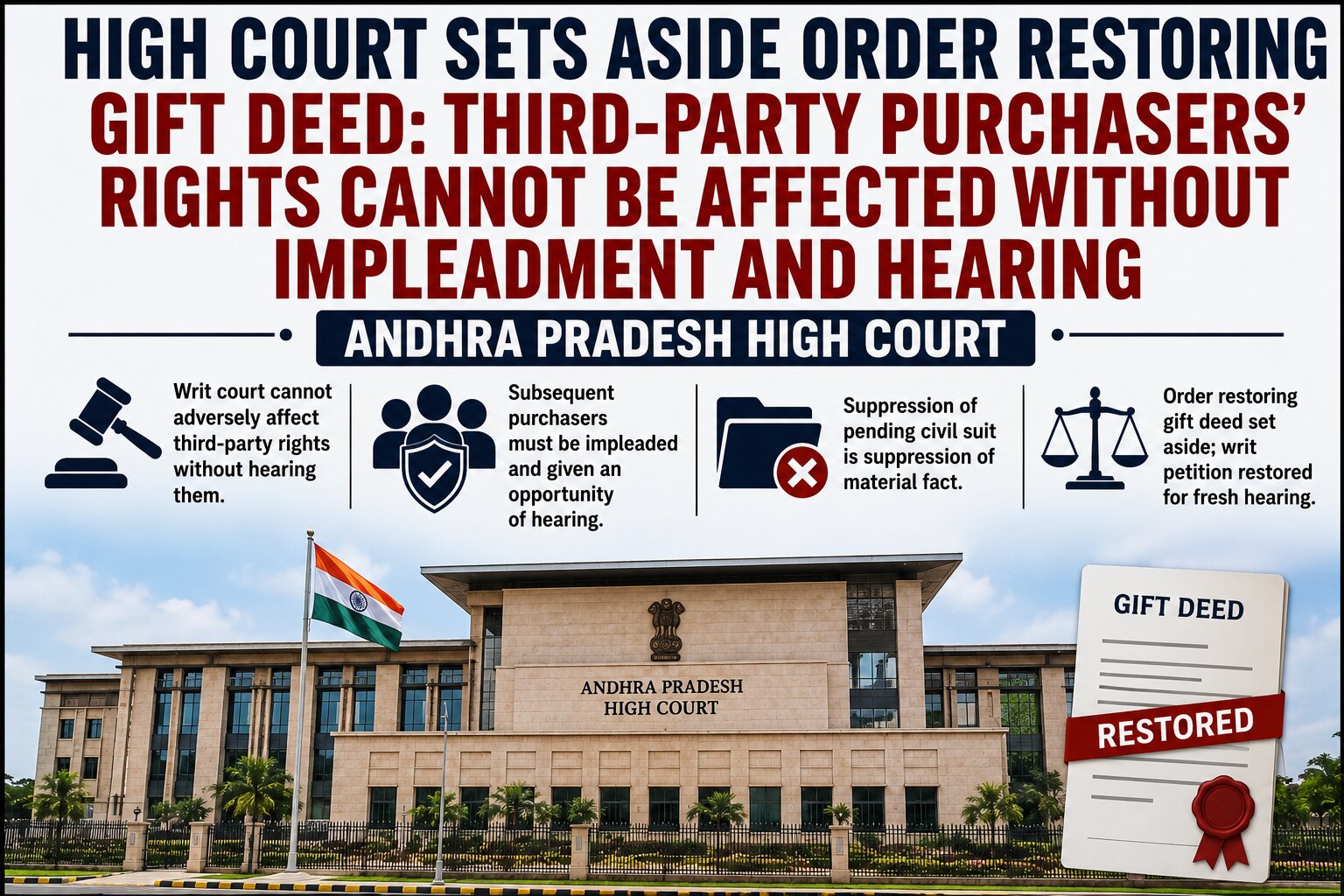
Judgement Details
Court
Andhra Pradesh High Court
Date of Decision
20 August 2026
Judges
Justice Ravi Nath Tilhari and Justice Purushottam Kumar Chintalapudi
Citation
Acts / Provisions
Facts of the Case
-
The dispute arose between a mother and daughter concerning immovable property.
-
The mother had executed a registered gift deed in favour of her daughter.
-
Subsequently, the mother executed a separate registered cancellation deed cancelling the gift.
-
The daughter challenged the cancellation before the Andhra Pradesh High Court.
-
The Single Judge held that unilateral cancellation of the registered gift deed violated Rule 26(i)(k) of the Andhra Pradesh Registration Rules, 1960.
-
The Single Judge directed the Joint Sub-Registrar to cancel the cancellation deed and restore the original gift deed.
-
The mother challenged the Single Judge's decision before the Division Bench.
-
The mother contended that there were genuine grounds for cancellation of the gift.
-
The daughter argued that a completed gift could not be unilaterally revoked in the absence of a valid ground under Section 126 of the Transfer of Property Act.
-
During the proceedings, it emerged that after cancellation of the gift, the mother had executed subsequent title documents in favour of third-party purchasers.
-
The daughter had also instituted a civil suit against the mother and those subsequent purchasers concerning the same property.
-
The civil suit was pending when the writ petition was decided by the Single Judge.
-
The subsequent purchasers, whose property rights could be directly affected by restoration of the gift deed, were not impleaded in the writ proceedings.
-
The Division Bench therefore examined whether the Single Judge could have passed an order affecting the rights of those purchasers without giving them an opportunity of hearing.
Issues
-
Whether a writ court can pass an order adversely affecting the rights of subsequent purchasers of property without impleading them and providing them an opportunity of hearing?
-
Whether the Single Judge was justified in directing restoration of a registered gift deed when subsequent purchasers claiming rights through the donor were not parties to the writ proceedings?
-
Whether suppression of the pendency of a civil suit concerning the same property constitutes suppression of a material fact warranting interference with the writ court's order?
-
Whether an order restoring a registered gift deed can indirectly prejudice the rights of subsequent purchasers whose title is already the subject matter of pending civil litigation?
-
Whether the dispute concerning cancellation and revocation of the gift deed should be determined without considering the rights and interests of subsequent transferees?
-
Whether the Single Judge's order could be sustained when persons directly affected by the order had been denied an opportunity of hearing?
Judgement
-
The Division Bench allowed the writ appeal filed by the mother.
-
It set aside the Single Judge's order directing restoration of the original gift deed.
-
The Court found that subsequent purchasers had acquired rights through the mother after the cancellation of the gift deed.
-
Those purchasers were not impleaded in the writ petition.
-
The Court held that the purchasers had therefore been denied an opportunity to present their case.
-
The Bench also noted that a civil suit concerning the property was already pending between the daughter, mother and subsequent purchasers.
-
The pendency of that civil litigation had not been disclosed before the Single Judge.
-
The Court observed that restoration of the original gift deed could adversely affect the rights of the subsequent purchasers.
-
Such an order could potentially influence the outcome of the pending civil suit without the purchasers being heard.
-
The Division Bench held that such a procedure could not be permitted.
-
The Court emphasized the importance of natural justice and audi alteram partem, particularly where a judicial order directly affects the rights of persons who are not parties to the proceedings.
-
The Court also disapproved of the suppression of material facts concerning the pending civil suit.
-
The writ petition was restored for fresh consideration.
-
The subsequent purchasers were directed to be impleaded as parties.
-
The Division Bench did not finally decide the rival claims concerning the validity of the cancellation of the gift deed.
-
The parties were therefore left to have the substantive dispute reconsidered after all affected persons were brought before the Court.
Held
-
Persons whose proprietary rights may be directly affected by an order must ordinarily be before the Court.
-
Suppression of a pending civil suit concerning the same property is a material omission that can affect the validity of proceedings.
-
A writ proceeding cannot be used to obtain an order behind the back of persons whose rights would be prejudiced by that order.
-
Restoration of a gift deed may have consequential effects upon subsequent purchasers and therefore cannot be considered in isolation from their rights.
-
The High Court should not permit its order to become an instrument for indirectly deciding the rights of parties to a pending civil suit without hearing them.
-
The Single Judge's order was therefore set aside.
-
The writ petition was restored for fresh adjudication after impleadment of the subsequent purchasers.
-
The Division Bench did not adjudicate the ultimate validity of the gift cancellation on merits.
Analysis
-
Natural justice: The central principle is that a person whose rights may be adversely affected by a judicial order must ordinarily be given notice and an opportunity to be heard.
-
Third-party purchasers: The subsequent purchasers were not merely formal parties. Their proprietary interests could be directly affected if the original gift deed was restored.
-
Writ jurisdiction: Although writ courts possess broad powers, those powers cannot ordinarily be exercised in a manner that prejudices non-parties without hearing them.
-
Suppression of material facts: The pendency of the civil suit was highly relevant because the same property and the same competing claims were already before the Civil Court.
-
Abuse of process: The Court strongly disapproved of a litigant obtaining an order while withholding material information and then using that order against persons who were not heard.
-
Gift deed dispute: The Bench deliberately avoided deciding whether the cancellation of the gift deed was legally valid. That issue requires consideration after all affected parties are properly before the Court.
-
Section 126, Transfer of Property Act: The daughter's argument concerning revocation of a gift under Section 126 raises a substantive property-law question, but the Division Bench considered it inappropriate to conclusively determine that issue while affected purchasers remained outside the proceedings.
-
Pending civil suit: The existence of a pending civil suit does not necessarily prevent writ jurisdiction, but the High Court must be cautious when its order could effectively determine issues already pending before the Civil Court.
-
Avoiding conflicting decisions: Allowing a writ order to effectively establish title against subsequent purchasers could create serious complications in the pending civil proceedings.
-
Audi alteram partem: The case reinforces the basic rule that no person should suffer an adverse judicial consequence without being given an opportunity to present their case.
-
Property litigation: In disputes involving successive transfers of property, courts must identify all persons whose rights may be affected before passing substantive orders.
-
Judicial restraint: The Division Bench adopted a procedural solution rather than deciding the substantive title dispute itself. This preserves the rights of all parties and allows the matter to be decided on a complete factual and legal record.
-
Broader significance: The ruling serves as a reminder that parties approaching constitutional courts must make full and candid disclosure of material facts, particularly where parallel civil proceedings concerning the same subject matter are pending.