
Satish Gupta v. Praveen Kumar Singhal, 2026
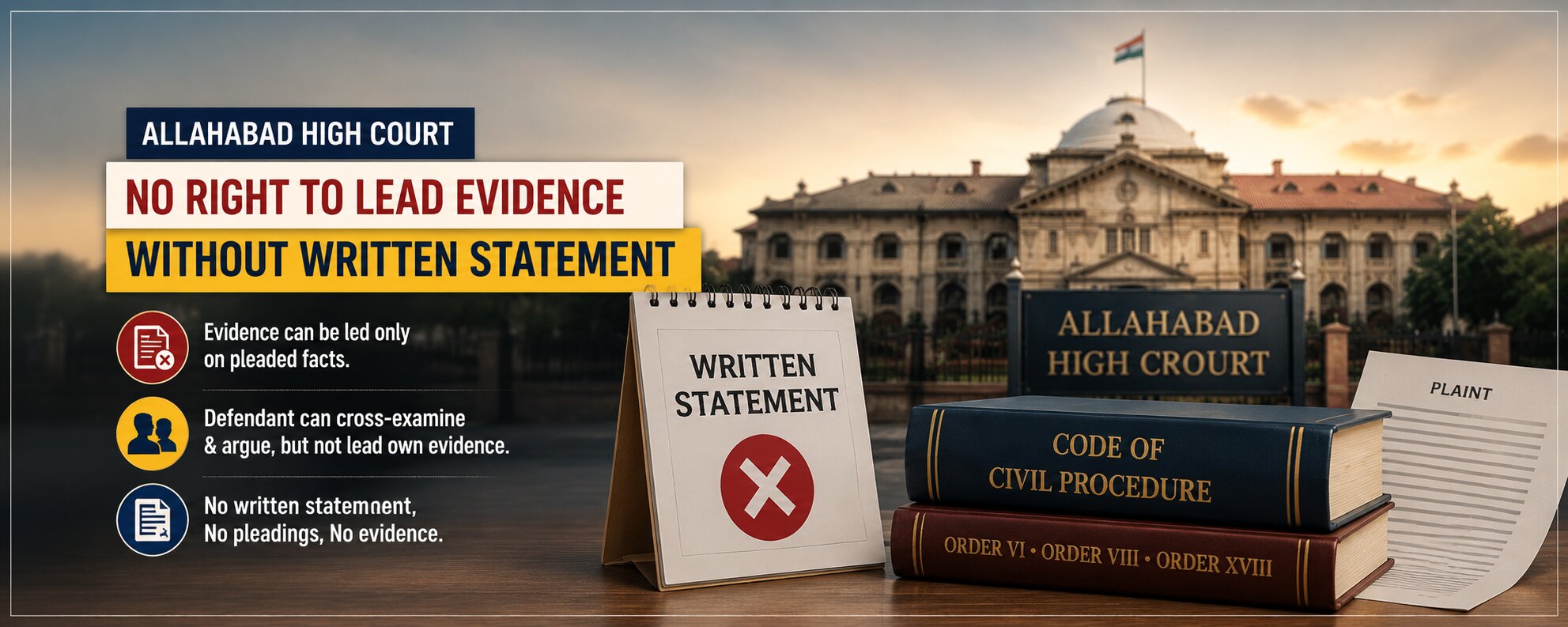
A defendant whose right to file a written statement has been closed cannot lead independent evidence.
Judgement Details
Court
Allahabad High Court
Date of Decision
20 July 2026
Judges
Justice Manish Kumar Nigam
Citation
Acts / Provisions
Facts of the Case
-
The plaintiff instituted a suit for specific performance of an agreement to sell dated 20.04.2017 before the Additional District Judge, Ghaziabad.
-
The defendant entered appearance but failed to file a written statement within the period prescribed under Order VIII Rule 1 CPC.
-
The Trial Court granted an additional opportunity, but the defendant still failed to file the written statement.
-
Consequently, the defendant's right to file the written statement was closed.
-
Despite this, the defendant's counsel participated in the proceedings and cross-examined the plaintiff's witnesses.
-
Thereafter, the defendant filed an affidavit under Order XVIII Rule 4 CPC along with a list of witnesses to adduce his own evidence.
-
The plaintiff objected, contending that in the absence of a written statement, the defendant had no right to lead independent evidence.
-
The Trial Court accepted the objection, returned the defendant's evidence affidavit and closed his right to adduce evidence.
-
The defendant challenged the Trial Court's order before the Allahabad High Court under Article 227 of the Constitution.
Issues
-
Whether a defendant whose right to file a written statement has been closed can lead independent evidence in support of his defence?
-
Whether evidence can be adduced in the absence of pleadings contained in a written statement?
-
Whether a defendant who has forfeited the right to file a written statement can still participate in the trial by cross-examining the plaintiff's witnesses?
-
Whether the Trial Court was justified in refusing to accept the defendant's affidavit of evidence under Order XVIII Rule 4 CPC?
-
Whether the Trial Court's order warranted interference under Article 227 of the Constitution?
Judgement
-
The Allahabad High Court dismissed the petition.
-
The Court held that evidence can be led only in support of pleaded facts.
-
It observed that where no written statement has been filed, there are no pleadings on behalf of the defendant.
-
Consequently, the defendant cannot lead independent evidence, as there are no pleaded facts requiring proof.
-
The Court clarified that the defendant is not completely shut out from participating in the proceedings.
-
It held that such a defendant may cross-examine the plaintiff's witnesses and advance legal arguments based on the plaint and the evidence produced by the plaintiff.
-
However, the defendant cannot introduce his own factual case through oral or documentary evidence.
-
The Court emphasized that the object of pleadings is to narrow the controversy and define the issues for trial.
-
It relied upon Modula India v. Kamakshya Singh Deo, wherein the Supreme Court held that a defendant whose defence has been struck off may cross-examine witnesses and argue but cannot lead evidence.
-
The Court also relied upon Kaushik Narsinhbhai Patel v. S.J.R. Prime Corporation Pvt. Ltd., where the Supreme Court held that a party forfeiting the right to file a written statement cannot indirectly introduce its defence through evidence.
-
The Court upheld the Trial Court's order refusing to permit the defendant to lead evidence.
Held
-
Evidence cannot exist without pleadings, and in the absence of a written statement there are no pleadings supporting the defendant's evidence.
-
Such a defendant may still cross-examine the plaintiff's witnesses and address legal arguments.
-
The Trial Court rightly rejected the defendant's affidavit of evidence.
-
The petition under Article 227 was dismissed.
Analysis
-
The judgment reinforces the fundamental civil law principle that pleadings form the foundation of evidence.
-
The Court reiterated that material facts must first be pleaded before evidence can be adduced to prove them.
-
By refusing to permit evidence without a written statement, the Court preserved the procedural discipline contemplated by the Code of Civil Procedure.
-
The ruling prevents defendants from circumventing the consequences of failing to file a written statement by introducing their defence through evidence.
-
At the same time, the Court balanced procedural fairness by allowing such defendants to cross-examine witnesses and make legal submissions.
-
The judgment faithfully follows the Supreme Court's decisions in Modula India and Kaushik Narsinhbhai Patel, ensuring consistency in civil procedure.
-
The decision emphasizes that the object of pleadings is to identify the real controversy, reduce unnecessary evidence and ensure an efficient trial.
-
The ruling will serve as an important precedent in civil litigation concerning the consequences of default in filing written statements.