
Sarwan Singh @ Samma Singh & Others v. Sukhraj Kaur & Ors., 2026
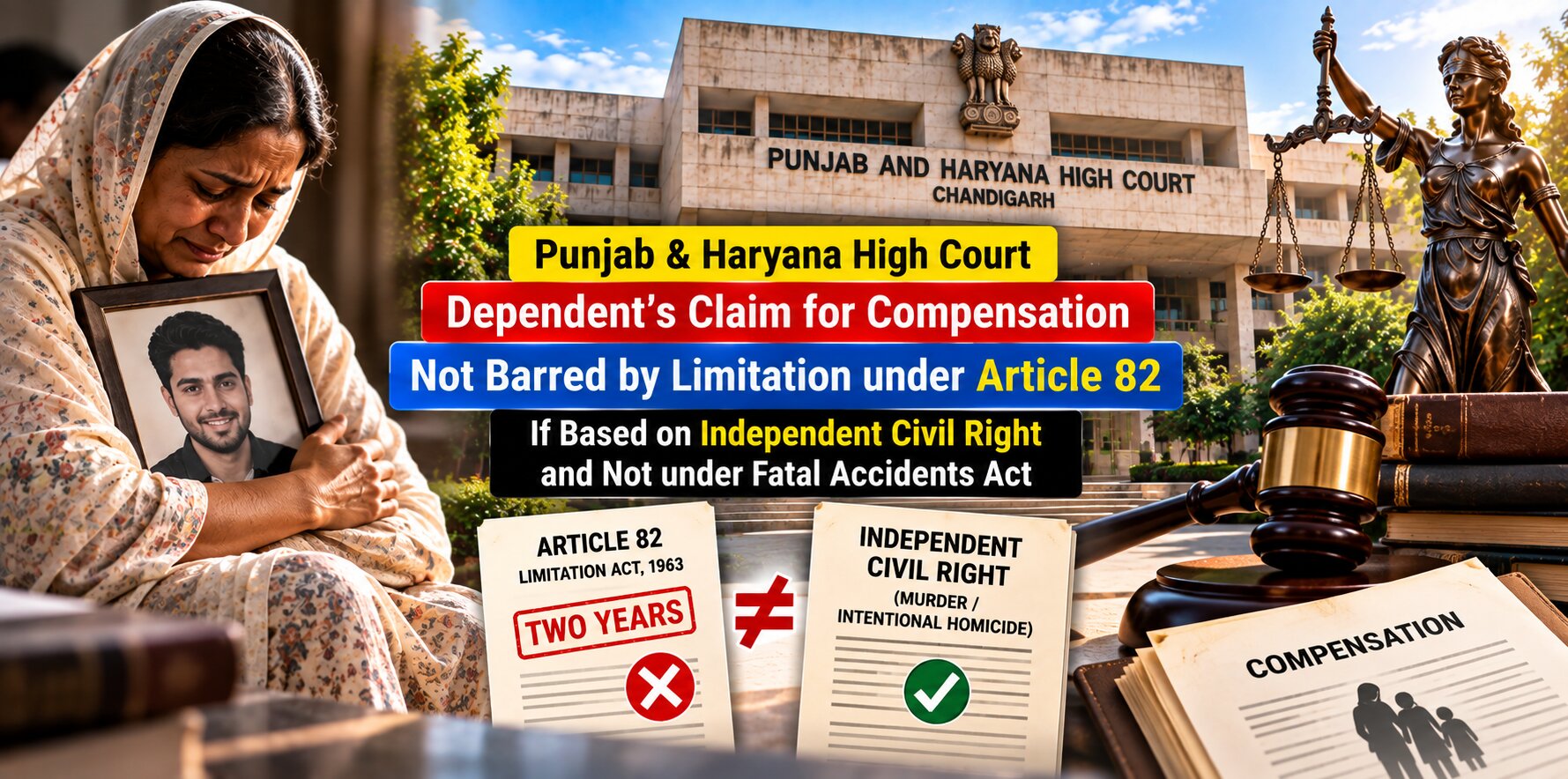
The Court held that Article 82 of the Limitation Act, 1963 does not automatically govern every claim for compensation arising from a person's death.
Judgement Details
Court
Punjab and Haryana High Court
Date of Decision
4 September 2026
Judges
Justice Nidhi Gupta
Citation
Acts / Provisions
Facts of the Case
-
The respondent-plaintiff, Sukhraj Kaur, was the mother of the deceased.
-
The dispute arose out of the death of her son, which she alleged had been caused by the defendants.
-
According to the plaintiff's case, her son had been wrongfully/murderously killed by the defendants.
-
The plaintiff claimed compensation for the loss and injury suffered by her as a result of the death of her son.
-
The plaintiff instituted a civil suit seeking monetary compensation from the defendants.
-
The defendants contested the claim and, among other grounds, challenged the maintainability of the suit on the ground of limitation.
-
The defendants relied upon Article 82 of the Limitation Act, 1963.
-
They argued that a suit seeking compensation for causing death was required to be instituted within two years from the date of death.
-
The deceased died in December 2012.
-
The civil suit was instituted in May 2016, more than two years after the death.
-
On this basis, the defendants argued that the plaintiff's claim was barred by limitation.
-
The trial court did not accept the defendants' limitation objection in its entirety and partly decreed the suit.
-
The trial court awarded the plaintiff ₹18 lakh with interest as compensation.
-
The defendants challenged the judgment before the first appellate court.
-
The Additional District Judge upheld the finding regarding liability but reduced the compensation to ₹11.28 lakh.
-
The defendants thereafter approached the Punjab and Haryana High Court in second appeal.
-
Before the High Court, the principal contention was that the suit ought to have been dismissed as time-barred under Article 82.
-
The appellants argued that because the death had occurred in December 2012 and the suit had been instituted only in May 2016, the statutory two-year limitation period had expired.
-
The plaintiff maintained that her claim was not one brought under the Fatal Accidents Act, 1855, but arose from her own independent civil right to claim damages for the loss suffered because of the wrongful death of her son.
Issues
-
Whether the plaintiff's suit seeking compensation for the death of her son was governed by Article 82 of the Limitation Act, 1963?
-
Whether Article 82 of the Limitation Act applies only to claims falling within the scope of the Fatal Accidents Act, 1855?
-
Whether a claim arising from an intentional killing or murder constitutes an independent civil cause of action distinct from a claim under the Fatal Accidents Act?
-
Whether the plaintiff's independent right to claim damages for the loss suffered from the death of her son was subject to the two-year limitation period prescribed under Article 82?
-
Whether the concurrent findings of the trial court and first appellate court suffered from any perversity, illegality or error of law warranting interference in second appeal?
-
Whether any substantial question of law arose for consideration by the High Court in the second appeal?
Judgement
-
The Punjab and Haryana High Court dismissed the second appeal filed by the defendants.
-
The Court examined the applicability of Article 82 of the Limitation Act, 1963 to the plaintiff's claim.
-
The defendants argued that the claim was barred because the suit had been filed more than two years after the death.
-
The Court rejected this argument after examining the nature of the plaintiff's cause of action.
-
The Court held that Article 82 is applicable to cases falling within the Fatal Accidents Act, 1855.
-
The Court distinguished claims arising from accidental or wrongful death caused by “neglect or default” from claims arising out of intentional homicide or murder.
-
The Court observed that intentional murder constitutes a distinct cause of action.
-
In cases involving murder or intentional homicide, the claim of a dependent may arise from the independent injury suffered by the dependent, rather than being merely a statutory claim under the Fatal Accidents Act.
-
The Court therefore held that the plaintiff's claim did not fall within the two-year limitation contemplated by Article 82.
-
The Court emphasized that the cause of action available to a dependent is distinct from any cause of action that may have belonged to the deceased.
-
The injury suffered by the plaintiff arose from the wrongful act allegedly committed against her son and the consequent loss suffered by her.
-
The Court consequently rejected the appellants' contention that the suit was barred solely because it was filed more than two years after the death.
-
The Court also examined the concurrent findings recorded by the courts below.
-
It found that the appellants had failed to demonstrate any perversity, illegality or material error in those findings.
-
The High Court held that no substantial question of law arose for consideration in the second appeal.
-
The compensation modified by the first appellate court to ₹11.28 lakh was therefore allowed to stand.
-
The second appeal was accordingly dismissed.
Held
-
The Court held that Article 82 applies to claims falling within the statutory framework of the Fatal Accidents Act, 1855.
-
The Court distinguished accidental or wrongful death caused by neglect or default from intentional homicide.
-
The Court held that a claim arising from murder or intentional homicide may constitute an independent civil cause of action under general civil/common law.
-
The Court held that such an independent claim is not subject to the two-year limitation period under Article 82 merely because it seeks compensation for death.
-
The Court held that the dependent's cause of action arises from the injury suffered by the dependent because of the wrongful act, which is distinct from any cause of action belonging to the deceased.
-
The Court found no perversity or illegality in the concurrent findings of the courts below.
-
The Court held that no substantial question of law arose in the second appeal.
-
The compensation of ₹11.28 lakh, as modified by the first appellate court, was therefore affirmed.
Analysis
-
Nature of the cause of action: The central issue was not simply whether the plaintiff sought compensation for a death, but what legal source gave rise to her claim. The Court distinguished a statutory Fatal Accidents Act claim from an independent civil claim arising from intentional killing.
-
Article 82 is not universally applicable to death claims: The judgment clarifies that Article 82 should not be mechanically applied merely because a suit seeks compensation following death. Its applicability depends upon the nature and legal basis of the claim.
-
Fatal Accidents Act distinction: The Court emphasized that the Fatal Accidents Act deals with death caused by a wrongful act, neglect or default. The Court treated intentional murder as a materially different category of wrongdoing.
-
Independent right of the dependent: An important principle is that the dependent's claim may arise from an injury personally suffered by that dependent. The dependent's cause of action is therefore not necessarily identical to the cause of action that may have been available to the deceased.
-
Murder and intentional homicide: The Court treated intentional killing as a separate basis of civil liability. Consequently, the limitation applicable to a statutory Fatal Accidents Act claim could not automatically be imposed upon an independent claim based on intentional homicide.
-
Limitation must follow the legal nature of the claim: The judgment demonstrates that determining limitation requires identification of the precise cause of action and statutory provision governing it rather than simply looking at the relief claimed.
-
Independent civil/common-law remedy: Where the claim is founded on an independent civil right, the limitation applicable to that right must be determined according to the appropriate legal framework. Article 82 cannot be applied without first establishing that the claim falls within its scope.
-
Concurrent findings: Both subordinate courts had found liability against the defendants. Although the first appellate court reduced the quantum from ₹18 lakh to ₹11.28 lakh, it maintained the finding of liability.
-
Limited scope of second appeal: The High Court emphasized that a second appeal is not an opportunity to reopen factual findings unless a substantial question of law is involved. The appellants failed to identify a legal error sufficient to invoke that jurisdiction.
-
Compensation quantum: The High Court did not disturb the modified compensation of ₹11.28 lakh awarded by the first appellate court.
-
Practical significance: The judgment is relevant to civil claims arising from deaths where the claimant asserts an independent right rather than proceeding under the Fatal Accidents Act. It demonstrates why the exact legal foundation of the claim is critical when determining limitation.
-
Important qualification: The ruling should not be understood to mean that every compensation claim following murder is automatically free from limitation. The applicable limitation period must depend upon the precise cause of action, statutory framework and nature of the civil claim.
-
Core legal principle: The central proposition is that Article 82's two-year limitation period cannot be invoked merely because a civil suit seeks compensation for death; the provision must be applicable to the particular cause of action, and an independent claim arising from intentional homicide may fall outside its scope.