
Sarkar Syed Habibullah Sha Kahdari Arif Rabbani Hazarat Dargha v. Tamil Nadu Waqf Board & Others, 2026
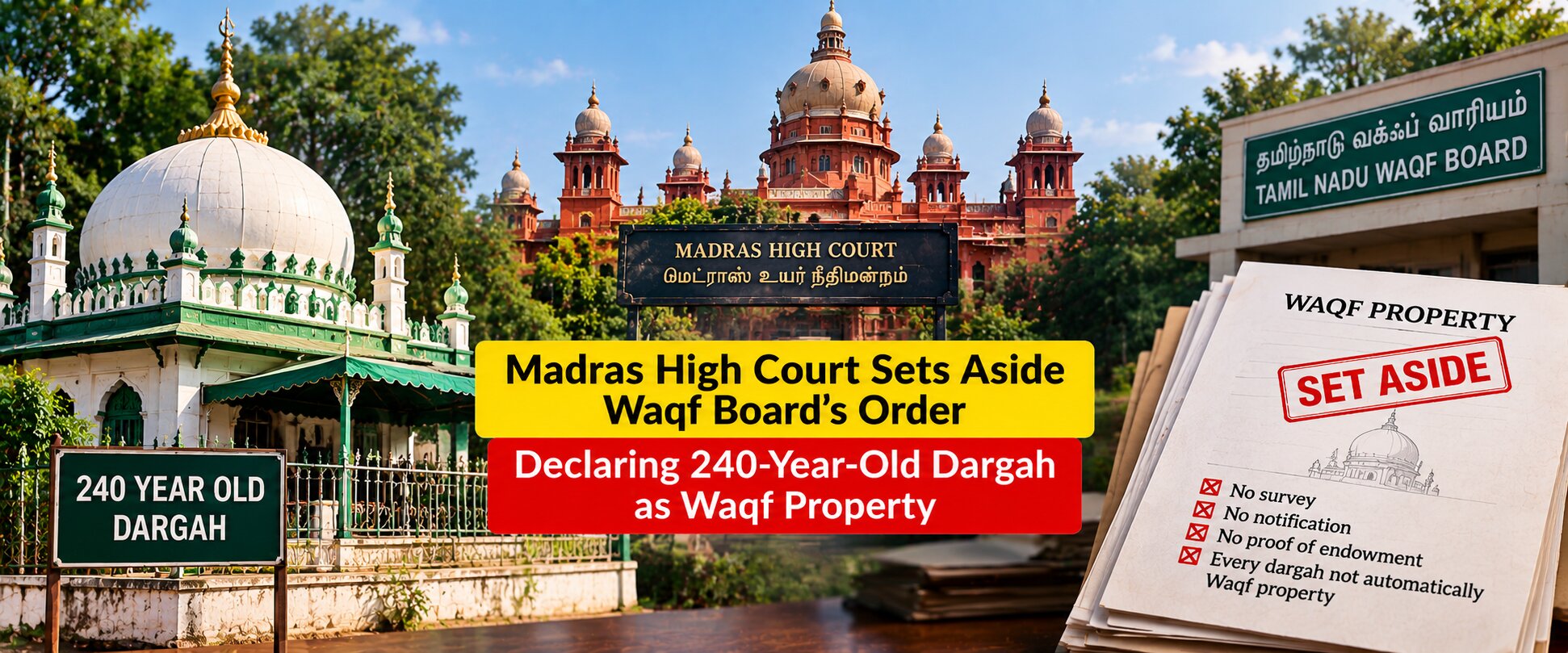
Every Dargah is not automatically Waqf property.
Judgement Details
Court
Madras High Court
Date of Decision
2 September 2026
Judges
Justice K. Govindarajan Thilakavadi
Citation
Acts / Provisions
Facts of the Case
-
The dispute concerned the Sarkar Syed Habibullah Sha Kahdari Arif Rabbani Hazarat Dargah, which was claimed to be approximately 240 years old.
-
The appellant claimed to have been serving as the Mutawalli of the Dargah and stated that his family had maintained it from its own earnings.
-
The Tamil Nadu Waqf Board appointed another person as Mutawalli and treated the property on which the Dargah stood as Waqf property.
-
The appellant challenged the action of the Waqf Board before the Tamil Nadu Waqf Tribunal.
-
The appellant contended that the land belonged to the Public Works Department (PWD) and that he had obtained an NOC from the department for obtaining an electricity connection in his name.
-
He argued that the Waqf Board had declared the property to be Waqf without following the procedure prescribed under the Waqf Act.
-
The Waqf Board argued that the appellant was not entitled to claim hereditary Mutawalliship and that the property had historically been associated with religious purposes.
-
The Board further contended that once property was intended for a religious or charitable purpose, it could constitute Waqf property and fall under the Board's supervisory jurisdiction.
-
The PWD maintained that the land belonged to the department and that the Dargah could not, merely because of its existence, be treated as Waqf property.
-
The private respondent relied upon a registered Trust Deed concerning the Dargah and claimed control over its affairs.
-
The High Court examined the documents concerning ownership and the alleged Waqf status of the property.
-
The Court noted that the records showed the property as belonging to the Public Works Department, which had leased the land to Bharat Scouts and Guides.
-
The Court further found that the documents relied upon by the Waqf Board did not establish that the property had been included in the statutory list of auqaf.
-
Although the Board stated that a survey of the property was in progress, the Court considered the statutory requirement of conducting the survey before treating the property as Waqf.
Issues
-
Whether the existence of a Dargah or grave by itself is sufficient to establish the property on which it stands as Waqf property?
-
Whether the Waqf Board can assume jurisdiction over a Dargah without establishing the existence of a valid Waqf or permanent dedication of the property?
-
Whether the statutory survey and notification procedure under the Waqf Act is required before property can be declared or treated as Waqf property?
-
Whether long religious use of a Dargah, without sufficient evidence of dedication or Waqf by user, is sufficient to establish the underlying land as Waqf property?
-
Whether the Waqf Board was justified in appointing another person as Mutawalli when the Waqf character of the property itself had not been established?
-
Whether the order of the Tamil Nadu Waqf Tribunal upholding the Waqf Board's action was sustainable in law?
Judgement
-
The Madras High Court allowed the appeal filed by the appellant.
-
The Court set aside the order of the Tamil Nadu Waqf Tribunal and the consequential action of the Waqf Board.
-
The Court held that the mere existence of a grave or Dargah does not automatically make the property Waqf property.
-
A legally recognised Waqf requires an appropriate legal foundation, including permanent dedication of property for a pious, religious or charitable purpose recognised under Muslim law.
-
The Court recognised that Waqf may, in appropriate circumstances, be established through long and uninterrupted religious use, but the necessary factual and legal requirements must nevertheless be proved.
-
In the present case, the respondents failed to establish that the disputed land had been permanently dedicated as Waqf.
-
The Court found that the existence of the Dargah and its religious use did not, by themselves, establish the Waqf character of the underlying land.
-
The Court also considered the statutory procedure relating to the survey and identification of Waqf properties.
-
The fact that the Board stated that the survey was still in progress could not substitute for the statutory procedure required to establish the property's Waqf status.
-
The Court found that the Waqf Board had failed to establish that the disputed property was legally Waqf property.
-
Consequently, the Board could not assume automatic supervisory jurisdiction merely because the property contained a Muslim religious shrine.
-
The order of the Tribunal was therefore set aside.
Held
-
The mere existence of a grave, tomb or Dargah does not establish Waqf status.
-
There must be evidence of a legally recognised Waqf or permanent dedication.
-
Mere religious use of property is not by itself sufficient to establish ownership of the underlying land as Waqf.
-
Waqf by user, where relied upon, must be established on the facts and in accordance with the applicable legal principles.
-
The Waqf Board cannot assume jurisdiction merely because a property is associated with a Muslim religious institution.
-
The statutory procedure concerning the survey and identification of Waqf properties must be followed.
-
The Board must establish the Waqf character of the property before exercising consequential powers over it.
-
Appointment of a Mutawalli cannot independently establish that the underlying property is Waqf.
-
In the present case, the Waqf Board failed to establish that the disputed land belonged to a Waqf.
Analysis
-
Religious institution versus Waqf property: The judgment draws an important distinction between the existence of a religious shrine and the legal status of the property on which it stands.
-
Proof of dedication: The Court emphasised that Waqf status requires a legally sufficient foundation. A Dargah's historical existence alone does not establish permanent dedication of the land.
-
Waqf by user: The Court acknowledged the concept but did not treat religious use as automatically sufficient. The necessary factual circumstances must be established.
-
Government land: The fact that the records showed the land as belonging to the Public Works Department was significant because the Board had to establish how that land had legally acquired the character of Waqf.
-
Statutory procedure: The Court stressed the importance of the survey and statutory identification process under the Waqf Act before treating property as Waqf.
-
Limits on Waqf Board jurisdiction: The Board's supervisory authority cannot be assumed merely from the religious character of a place. The underlying property must first be shown to fall within the statutory concept of Waqf.
-
Mutawalli appointment: The power to appoint or recognise a Mutawalli is consequential to the existence of a Waqf. It cannot itself create Waqf status where the underlying property has not been established as Waqf.
-
Fact-specific ruling: The judgment does not hold that Dargahs can never be Waqf properties. Where valid dedication or legally established Waqf by user is proved, a different conclusion may follow.