
Saresh Chandra Jatav v. MP Road Transport Corporation, 2026
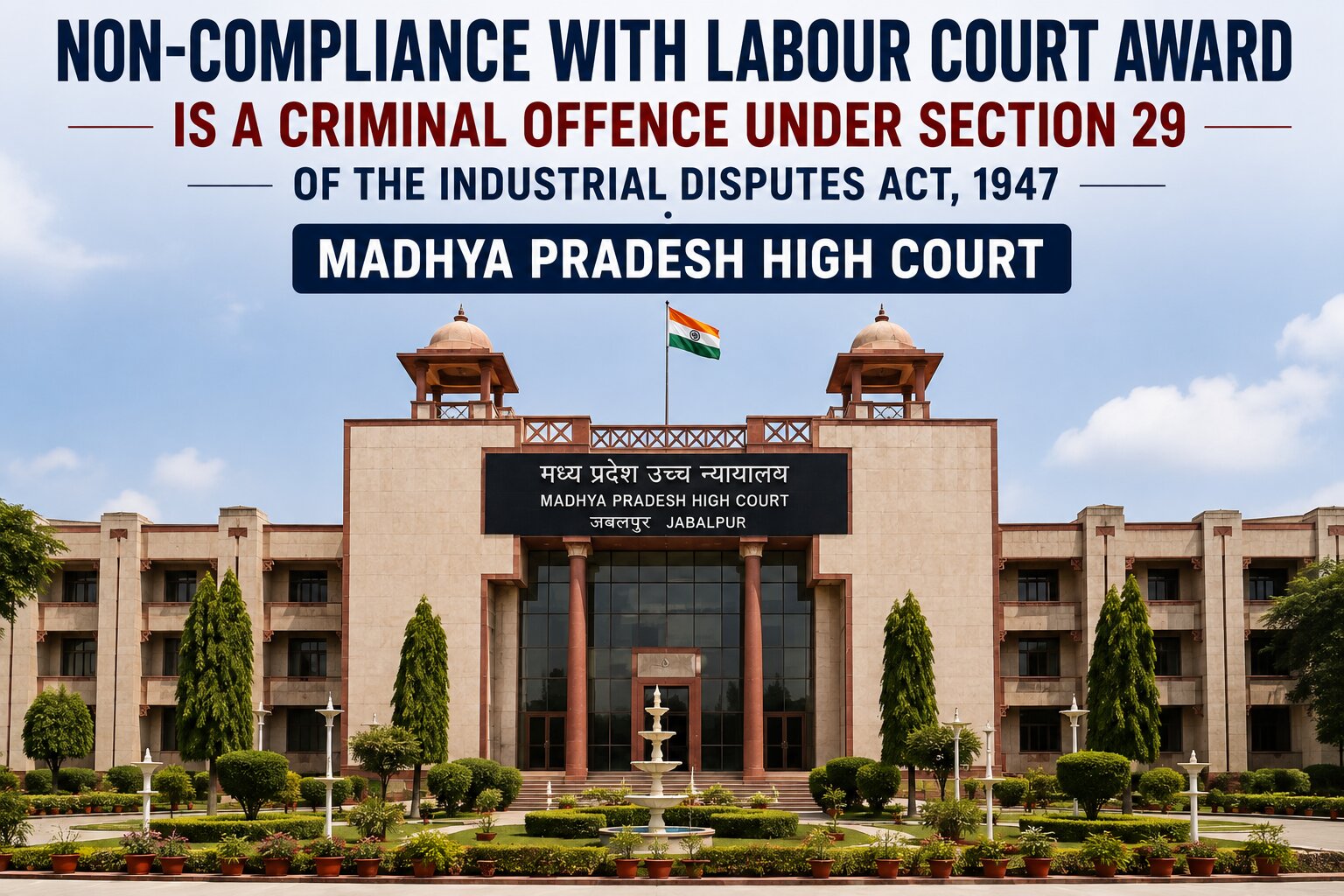
Non-compliance with a Labour Court award within the time expressly prescribed by the award can constitute a criminal offence under Section 29 of the Industrial Disputes Act, 1947.
Judgement Details
Court
Madhya Pradesh High Court
Date of Decision
20 August 2026
Judges
Justice Vivek Jain
Citation
Acts / Provisions
Facts of the Case
-
The petitioner, a workman, had been dismissed from service by the Madhya Pradesh Road Transport Corporation.
-
The workman raised an industrial dispute through the appropriate statutory process.
-
The dispute was ultimately referred to the Labour Court for adjudication.
-
The Labour Court found that the termination of the workman was bad in law.
-
In paragraph 22 of its award, the Labour Court directed the employer to reinstate the workman within one month, without payment of back wages.
-
The Road Transport Corporation challenged the Labour Court's award before the High Court in 2016.
-
The challenge to the award was ultimately dismissed in July 2024.
-
Despite the Labour Court's direction requiring reinstatement within one month, the workman was actually reinstated only on 27 July 2018.
-
The delay in compliance was approximately three years and four months.
-
The workman consequently raised the issue of wages payable for the period during which the employer failed to comply with the reinstatement direction.
-
The relevant period for which wages were sought extended from the date following the expiry of the one-month compliance period until the actual reinstatement.
-
The Executing Court, however, closed the execution proceedings.
-
The Executing Court reasoned that the Labour Court's award had directed reinstatement without back wages and did not expressly grant wages for the delayed period.
-
The workman challenged the Executing Court's order before the Madhya Pradesh High Court.
-
The Corporation argued that an executing court could not go beyond the terms of the award and therefore could not grant wages that had not expressly been awarded.
-
The High Court examined the special character of industrial adjudication, the consequences of breach of a Labour Court award and the Executing Court's jurisdiction to give complete effect to the adjudication.
-
The Court also considered the criminal consequences of deliberately failing to comply with a Labour Court award within the time stipulated by the Labour Court.
Issues
-
Whether failure to comply with a Labour Court award within the time period expressly prescribed in the award constitutes a criminal offence under Section 29 of the Industrial Disputes Act, 1947?
-
Whether the Executing Court was justified in closing the execution proceedings merely because the employer had eventually reinstated the workman, albeit after a delay of approximately three years and four months?
-
Whether the Executing Court could take into account the employer's delayed compliance while determining the consequences flowing from the Labour Court's award?
-
Whether the Executing Court had jurisdiction to grant wages for the period during which the employer failed to comply with the Labour Court's direction to reinstate the workman?
-
Whether the Executing Court was required to give effect to the complete adjudication made by the Labour Court rather than treating the award as an ordinary civil decree capable of only mechanical execution?
-
Whether the workman was required to institute fresh litigation to recover the consequences arising from the employer's prolonged and unjustified non-compliance with the Labour Court's award?
-
Whether the Managing Directors or responsible officers of the Madhya Pradesh Road Transport Corporation could be proceeded against under Section 29 for breach of the Labour Court's award?
Judgement
-
The Madhya Pradesh High Court allowed the revision petition filed by the workman.
-
The Court set aside the order of the Executing Court which had closed the execution proceedings.
-
The Court noted that the Labour Court's award expressly prescribed a one-month period for compliance with the reinstatement direction.
-
The employer did not comply with that direction within the prescribed period.
-
Instead, reinstatement was effected only on 27 July 2018, approximately three years and four months after the period stipulated in the award.
-
The Court held that such breach of the Labour Court's award constituted a criminal offence under Section 29 of the Industrial Disputes Act.
-
The Court observed that the Executing Court should not have simply closed the execution proceedings after noting that reinstatement had eventually taken place.
-
The High Court emphasized that proceedings before a Labour Court are concerned not merely with resolving an individual lawsuit but with achieving industrial peace and harmony.
-
The Court held that the jurisdiction of a Labour Court and the corresponding execution of its award must be understood in light of this broader statutory objective.
-
The Court rejected the approach that the Executing Court was confined to the mechanical execution of an ordinary civil decree.
-
The Executing Court was entitled to deal with the execution proceedings in a manner that gave effect to the complete adjudication of the industrial dispute.
-
The Court held that the workman could not reasonably be required to institute fresh litigation merely because the employer had delayed compliance for several years.
-
The High Court directed the employer to pay wages to the workman from 5 April 2015 to 26 July 2018.
-
The payment was directed to be made within 30 days from the order.
-
The Court further directed that if the employer failed to comply with the wage direction within the stipulated period, the Executing Court should take cognizance against the Managing Directors of MPRTC under Section 29.
-
The Court therefore treated the prolonged non-compliance not merely as an execution irregularity but as conduct carrying criminal consequences under the Industrial Disputes Act.
Held
-
An employer cannot avoid the consequences of delayed compliance merely because it eventually implements the Labour Court's award several years later.
-
The Executing Court cannot mechanically close execution proceedings merely because the principal direction has eventually been complied with.
-
The Executing Court may take into account the delay and consequences of non-compliance while ensuring that the Labour Court's adjudication is fully implemented.
-
Industrial adjudication is directed not merely towards resolving an individual dispute but towards maintaining industrial peace and harmony.
-
The execution of a Labour Court award cannot always be treated in the same manner as the mechanical execution of an ordinary civil decree.
-
The workman should not ordinarily be forced into fresh litigation where the employer has, without sufficient justification, failed to comply with the award for several years.
-
The Court directed payment of wages for the delayed reinstatement period from 5 April 2015 to 26 July 2018.
-
The Managing Directors of MPRTC could face proceedings under Section 29 if the wage direction was not complied with within the prescribed period.
-
The Executing Court's order was therefore set aside.
Analysis
-
Criminal consequence of breach: The most significant aspect of the judgment is the Court's recognition that breach of a Labour Court award is not merely an executable civil obligation. Section 29 creates a separate statutory criminal consequence for breach of an award or settlement.
-
Time-bound compliance: The Labour Court had specifically directed reinstatement within one month. The Court treated that time limit as an integral part of the award rather than as a merely directory administrative instruction.
-
Three-year delay: The employer's delay of approximately three years and four months was considered substantial and unjustified. The fact that reinstatement eventually occurred did not erase the earlier breach.
-
Distinction from ordinary civil decree: The Court emphasized that an industrial award operates within a statutory framework designed to resolve industrial disputes and promote industrial peace. Its execution therefore cannot be reduced to the same mechanical approach applicable to an ordinary civil decree.
-
Industrial peace and harmony: The Court highlighted the broader objective of labour law. Labour adjudication seeks not merely to determine who wins a particular dispute but to restore an appropriate industrial relationship and prevent prolonged disruption.
-
Executing Court's role: The Executing Court was required to ensure that the substance of the Labour Court's adjudication was actually implemented. Closing the proceedings merely because reinstatement eventually occurred failed to account for the consequences of the prolonged non-compliance.
-
Wages for delayed reinstatement: Although the original award directed reinstatement without back wages, the High Court considered the employer's failure to comply with the award within the stipulated period and directed payment of wages for the period of unlawful delay.
-
Avoidance of multiplicity of litigation: The Court rejected an approach that would force the workman to initiate another round of proceedings merely to obtain relief arising directly from the employer's breach of the Labour Court's award.
-
Accountability of responsible officers: The direction concerning the Managing Directors demonstrates that Section 29 can have consequences for responsible officers where the statutory requirements for prosecution are satisfied.
-
Section 29 versus execution: The judgment illustrates that execution and criminal enforcement can operate alongside each other. The fact that an award is executable does not eliminate the separate statutory consequences of its breach.
-
Employer's challenge to award: The Corporation's challenge to the Labour Court award did not justify indefinite non-compliance. Once the award remained operative and the prescribed compliance period had expired, the employer was expected to comply with it.
-
Impact on labour law: The decision strengthens the enforceability of Labour Court awards and emphasizes that employers cannot treat time-bound directions as optional. Prolonged non-compliance can expose responsible officers to criminal proceedings.
-
Practical significance for workmen: The ruling provides an important remedy where reinstatement is ordered but the employer delays compliance for a substantial period. The workman may seek effective execution rather than being compelled to begin an entirely new proceeding for every consequence of the breach.
-
Limit of the ruling: The decision does not mean that every delay in complying with every Labour Court award automatically results in criminal liability in every circumstance. The precise terms of the award, the nature of the breach and the statutory requirements of Section 29 remain relevant.