
Sardari Lal v. Bishan Dass & Others, 2026
Mere proof of attestation under Section 63 of the Indian Succession Act is insufficient where suspicious circumstances surround the execution of a Will.
Judgement Details
Court
Supreme Court of India
Date of Decision
6 July 2026
Judges
Justice Manoj Misra and Justice K.V. Viswanathan
Citation
Acts / Provisions
Facts of the Case
-
The dispute concerned ownership of the properties of Chhajju Ram, who had died after his wife, Bhambo Devi, claimed that he died intestate.
-
Bhambo Devi instituted a civil suit claiming ownership and possession of the suit properties as the sole Class I heir under the law of succession.
-
The defendants resisted the suit by relying upon a registered Will dated 6 November 1974, allegedly executed by Chhajju Ram.
-
According to the defendants, the testator had bequeathed his entire movable and immovable property to them because they had looked after him during his lifetime.
-
The Trial Court, after examining the evidence, found several suspicious circumstances surrounding the execution of the Will and rejected it.
-
The First Appellate Court affirmed the Trial Court's findings and also held that the Will had not been satisfactorily proved.
-
The Himachal Pradesh High Court, however, reversed these concurrent findings in second appeal, holding that since an attesting witness had proved the execution of the registered Will, its genuineness stood established.
-
Aggrieved by the High Court's judgment, the legal representative of Bhambo Devi approached the Supreme Court.
Issues
-
Whether mere examination of an attesting witness is sufficient to prove a Will where suspicious circumstances surround its execution?
-
Whether the propounder of a Will bears an additional burden of dispelling suspicious circumstances surrounding the document?
-
Whether the High Court was justified in reversing the concurrent findings of the Trial Court and First Appellate Court upholding the invalidity of the Will?
Judgement
-
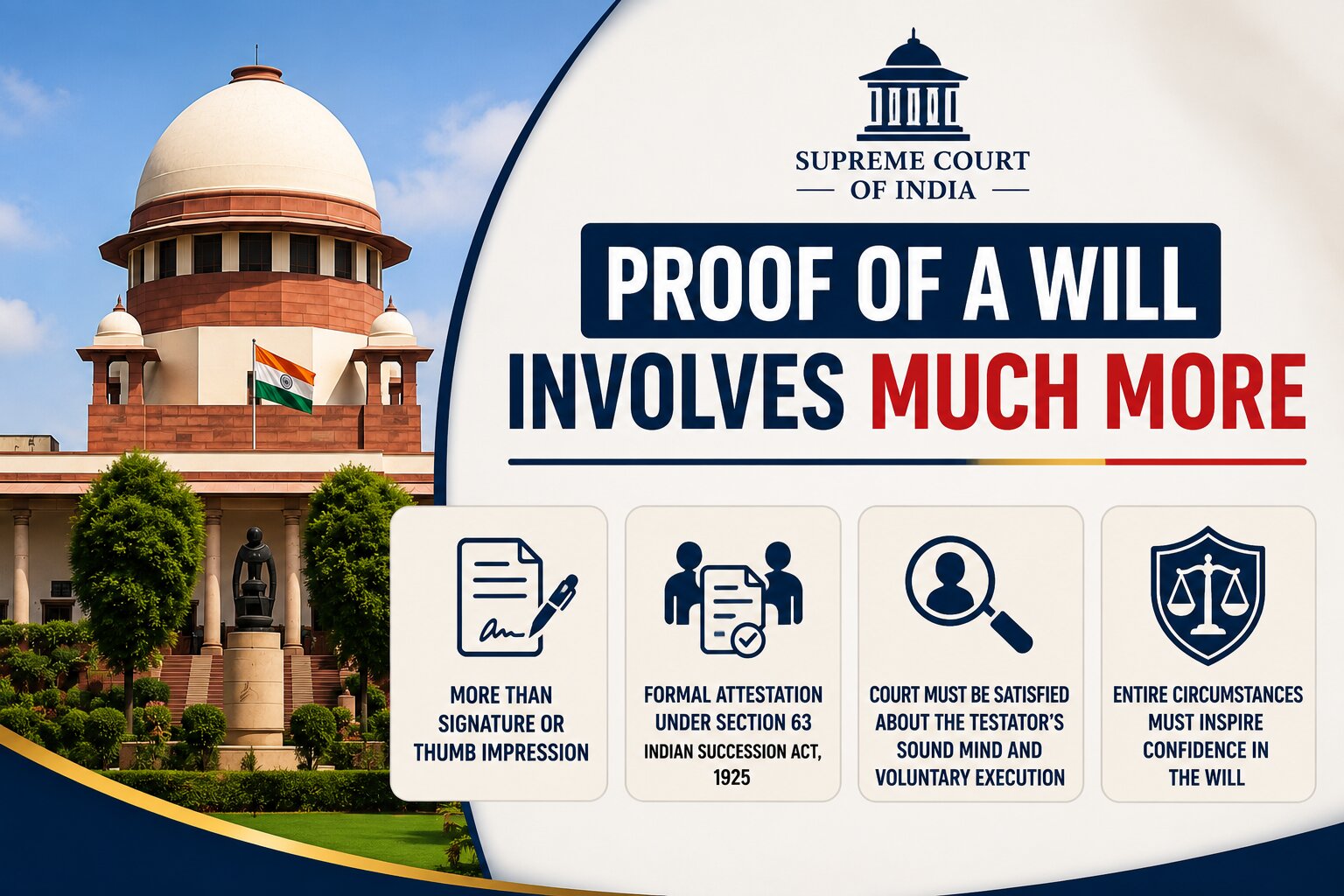
The Supreme Court held that proof of a Will involves much more than establishing the signature or thumb impression of the testator and proving formal attestation under Section 63 of the Indian Succession Act, 1925.
-
The Court observed that the propounder must satisfy the judicial conscience that the testator executed the Will voluntarily, with full understanding of its contents and consequences.
-
The Court reiterated that where suspicious circumstances exist, the burden lies upon the propounder to remove those suspicions before the Court can accept the Will as genuine.
-
The Court clarified that suspicious circumstances may include:
-
doubtful or shaky execution;
-
impaired mental capacity of the testator;
-
unnatural or unfair disposition of property;
-
unjust exclusion of natural heirs;
-
active participation of the beneficiary in execution of the Will; and
-
any other circumstance casting genuine doubt upon the testator's free will.
-
-
Examining the present case, the Court found several suspicious circumstances that remained unexplained.
-
The Court noted that the Will completely excluded the testator's wife, who was his sole Class I heir, while conferring the entire estate upon persons who were neither close relatives nor proven nephews of the deceased.
-
The Court further observed that although the beneficiaries claimed to be the nephews of the testator, no evidence established such relationship.
-
The Court also noticed material alterations on the reverse side of the registered Will where the name "Laxmi Kant" appearing in the registration endorsement had been struck off and replaced by "Chhajju" at several places.
-
Importantly, these alterations did not bear the initials or authentication of the Sub-Registrar, thereby creating serious doubt regarding the authenticity of the document.
-
The Supreme Court held that mere examination of an attesting witness could not cure these suspicious circumstances.
-
Accordingly, the Court set aside the judgment of the Himachal Pradesh High Court and restored the concurrent judgments of the Trial Court and the First Appellate Court declaring the widow to be the owner of the suit property.
Held
- The propounder bears the burden of removing all legitimate suspicious circumstances and satisfying the judicial conscience regarding the genuineness of the Will.
-
Registration of a Will does not by itself establish its authenticity.
-
The High Court erred in treating proof of attestation as conclusive despite unexplained suspicious circumstances.
-
The disputed Will was discarded, and the widow's title to the suit property was restored.
Analysis
-
The judgment reaffirms the well-settled principle that proof of a Will is not a mere technical exercise in proving signatures or attestation, but requires the Court to be satisfied that the document truly represents the free and informed testamentary intention of the testator.
-
The Court emphasized the distinction between formal proof of execution and substantive proof of genuineness, particularly where suspicious circumstances are apparent.
-
By holding that registration alone does not dispel suspicion, the Supreme Court reiterated that a registered Will enjoys no irrebuttable presumption of validity.
-
The decision also reinforces the principle that unnatural exclusion of close legal heirs, though not by itself fatal, becomes significant when coupled with other suspicious features requiring satisfactory explanation.
-
The Court's treatment of unexplained alterations in the registration endorsement highlights the importance of preserving the integrity and authenticity of testamentary documents.
-
The judgment serves as an important reminder that the propounder must establish not only compliance with statutory formalities but also the voluntary, informed, and independent intention of the testator.
-
Overall, the ruling strengthens judicial safeguards against fraudulent or doubtful testamentary instruments while preserving genuine testamentary freedom through careful judicial scrutiny.