
Sanu Varghese v. Shoukkathali, 2026
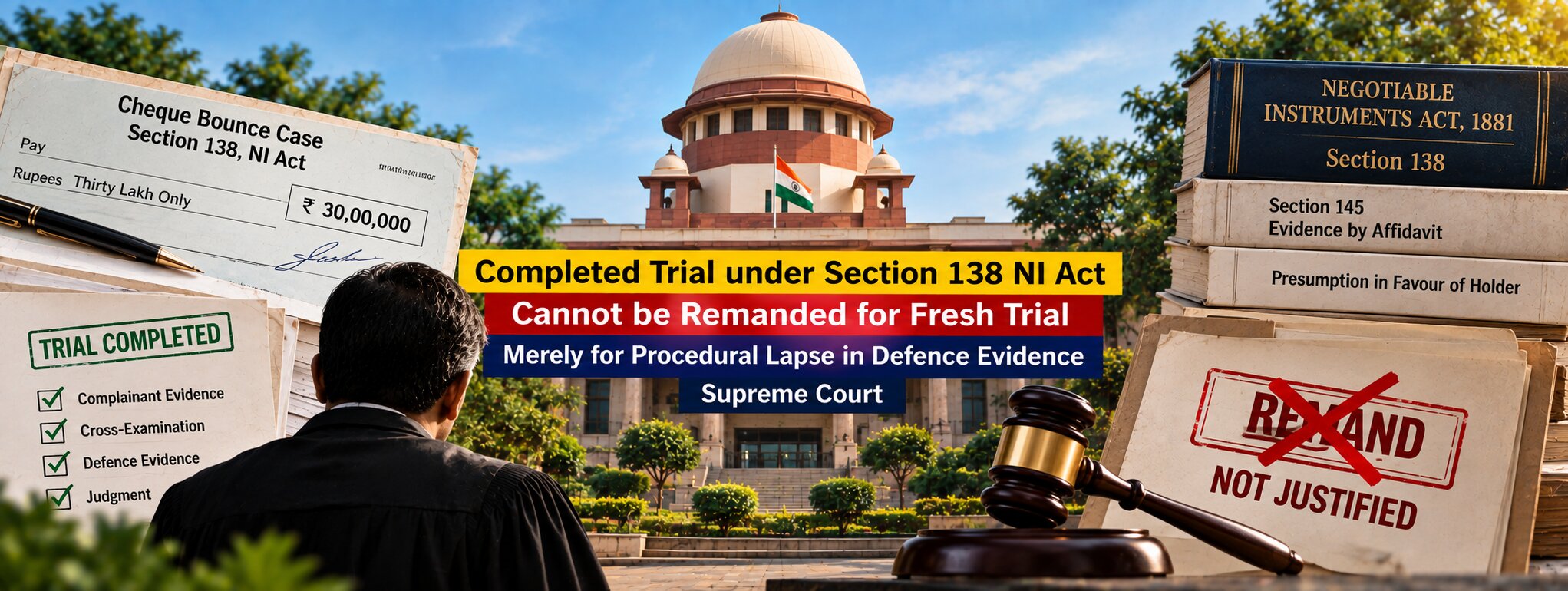
A procedural defect does not automatically justify setting aside an otherwise completed trial and ordering a retrial.
Judgement Details
Court
Supreme Court of India
Date of Decision
25 September 2026
Judges
Justice J.B. Pardiwala and Justice K. Vinod Chandran
Citation
Acts / Provisions
Facts of the Case
-
The appellant, Sanu Varghese, was the complainant in proceedings initiated against the respondent, Shoukkathali, under Section 138 of the Negotiable Instruments Act, 1881.
-
The dispute arose out of a cheque-bounce transaction involving a cheque for ₹30 lakh.
-
The accused admitted the signature on the cheque, but contended that he had originally issued a signed blank cheque as security in connection with a loan transaction of ₹10 lakh.
-
According to the accused, although the cheque had been issued as security for ₹10 lakh, it was subsequently presented for an amount of ₹30 lakh.
-
The accused further disputed the complainant's version concerning the alleged payment and issuance of the cheque.
-
In particular, the accused contended that the complainant was not present at the relevant place on the dates on which the alleged payment of ₹20 lakh and issuance of the cheque were said to have taken place.
-
However, the accused did not produce substantive evidence establishing the complainant's alleged absence from the relevant place.
-
The Trial Court specifically observed that the accused could have obtained and produced the complainant's Call Data Records (CDRs) if he wanted to substantiate the contention that the complainant was elsewhere.
-
The accused was examined as DW-1 during the trial and advanced his defence before the Magistrate.
-
Importantly, the accused did not allege before the Trial Court that he had suffered prejudice because of the manner in which his defence evidence had been recorded.
-
He also did not raise such a plea of prejudice before the First Appellate Court.
-
Despite the completion of the proceedings, the Kerala High Court, while exercising revisional jurisdiction, ordered that the matter be remanded for a fresh trial from the stage of defence evidence.
-
The High Court relied upon the Supreme Court's decision in M/s Mandvi Cooperative Bank Ltd. v. Nimesh B. Thakore, particularly its interpretation of Section 145 of the NI Act.
-
The complainant challenged this remand order before the Supreme Court, contending that a completed criminal trial should not be reopened merely on a procedural objection when the accused had never demonstrated that the alleged procedural irregularity had caused him any prejudice.
-
The Supreme Court therefore had to determine whether the High Court was justified in ordering a fresh trial when no prejudice had been demonstrated by the accused before the Trial Court or the First Appellate Court.
Issues
-
Whether a completed trial under Section 138 of the Negotiable Instruments Act can be remanded for a fresh trial merely on the ground of an alleged procedural irregularity concerning defence evidence?
-
Whether the principles laid down in M/s Mandvi Cooperative Bank Ltd. v. Nimesh B. Thakore require a fresh trial in every case where the procedure concerning the accused's evidence was not followed in the prescribed manner?
-
Whether a remand can be ordered when the accused has not alleged or demonstrated any prejudice before the Trial Court or the First Appellate Court?
-
Whether the admission of the signature on the cheque and the failure to rebut the statutory presumption under the Negotiable Instruments Act affect the justification for ordering a fresh trial?
-
Whether the Kerala High Court was justified in setting aside the completed proceedings and directing a fresh trial from the stage of defence evidence?
Judgement
-
The Supreme Court allowed the appeal and set aside the Kerala High Court's order directing a fresh trial from the stage of defence evidence.
-
The Court examined the earlier decision in M/s Mandvi Cooperative Bank Ltd. v. Nimesh B. Thakore, which interpreted Section 145 of the NI Act.
-
The Court explained that Section 145 permits the complainant's examination-in-chief to be given by affidavit and also provides a mechanism for requiring the person who has given evidence by affidavit to appear for examination when the statutory conditions are satisfied.
-
The Supreme Court noted that Mandvi Cooperative Bank had also distinguished the nature of the complainant's evidence from the evidence that may be required from the accused in rebutting the statutory presumptions applicable to a dishonoured cheque.
-
However, the Court emphasized that the principle in Mandvi Cooperative Bank cannot be mechanically applied to order a fresh trial in a completed criminal proceeding without examining whether the accused actually suffered prejudice.
-
In the present case, the accused had already participated in the proceedings and had been examined as DW-1.
-
The accused had raised the defence that the cheque was originally issued as security for a ₹10 lakh loan and that the complainant had subsequently presented it for ₹30 lakh.
-
The accused had also alleged that the complainant was not present at the relevant location when the alleged transactions occurred.
-
Nevertheless, the accused failed to produce substantive material establishing the complainant's absence, despite the Trial Court observing that Call Data Records could have been obtained for that purpose.
-
The Supreme Court placed significant emphasis on the fact that the accused had never alleged prejudice before the Trial Court or the First Appellate Court.
-
The Court also noted that the accused had admitted the signature on the cheque and had failed to rebut the statutory presumption operating in favour of the complainant.
-
The Supreme Court concluded that the absence of demonstrated prejudice was particularly significant because the High Court's remand effectively reopened a completed trial.
-
The Court observed that the plea concerning the procedural defect was raised before the High Court without any corresponding demonstration that the accused had actually been prejudiced during the original proceedings.
-
The Court therefore held that the High Court had erroneously accepted the procedural objection and ordered a fresh trial.
-
The High Court's remand order was accordingly set aside.
-
The criminal revision petition was restored to the file of the High Court so that the remaining contentions could be considered on their own merits.
-
The Supreme Court also clarified that if the accused had subsequently been examined in person after the High Court's remand, the evidence led during that subsequent stage would have to be eschewed, while the evidence from the original trial would remain relevant.
Held
-
A completed Section 138 NI Act trial should not ordinarily be remanded for a fresh trial merely because of a procedural irregularity concerning defence evidence when no actual prejudice to the accused has been demonstrated.
-
The principles in M/s Mandvi Cooperative Bank Ltd. v. Nimesh B. Thakore must be applied with regard to the circumstances of the particular criminal case and, importantly, the prejudice actually suffered by the accused.
-
The accused must demonstrate that the alleged procedural irregularity caused prejudice affecting the fairness of the trial.
-
The absence of any plea of prejudice before the Trial Court and the First Appellate Court was a significant circumstance against ordering a fresh trial.
-
The accused's admission of the cheque signature attracted the statutory presumption under the NI Act, which remained unrebutted on the material considered by the Court.
-
The accused's unsupported assertion concerning the complainant's absence from the relevant place was insufficient, particularly when the Trial Court had indicated that objective evidence such as Call Data Records could have been produced.
-
The Kerala High Court's remand order was therefore set aside.
-
The criminal revision was restored before the High Court for consideration on merits, without disturbing the original trial merely on the basis of the procedural objection.
Analysis
-
Prejudice is central to procedural irregularity: The most important principle emerging from the judgment is that a procedural defect in a criminal trial should not automatically result in a retrial. The court must examine whether the defect actually caused prejudice to the accused.
-
Retrial is not a routine remedy: Ordering a fresh trial after proceedings have already been completed has significant consequences. It prolongs litigation and effectively requires the parties to repeat proceedings that have already taken place. The Supreme Court therefore required a concrete justification before such a course could be adopted.
-
Mandvi Cooperative Bank properly contextualized: The Supreme Court did not disregard the earlier Mandvi Cooperative Bank ruling. Instead, it clarified that the principle concerning the manner in which evidence can be given under Section 145 must be applied in the context of the particular case and the actual prejudice caused.
-
Difference between procedural error and miscarriage of justice: The judgment reinforces the distinction between an irregularity in procedure and an irregularity that results in an unfair trial. Not every procedural departure necessarily invalidates the proceedings.
-
Conduct of the accused: The accused had participated in the trial, was examined as DW-1, and presented his defence. His failure to raise any grievance concerning prejudice before the Trial Court or First Appellate Court was therefore important in determining whether a fresh trial was justified.
-
Statutory presumption under NI Act: Once the signature on the cheque was admitted, the statutory presumption in favour of the cheque holder operated. The accused was required to rebut the presumption through a legally acceptable defence. The Court noted that this presumption had not been rebutted.
-
Bare assertions are insufficient: The accused claimed that the complainant was not present at the relevant location. However, no substantive evidence was produced to establish this. The Trial Court had specifically pointed out that CDRs could have been used to substantiate the allegation.
-
Importance for Section 138 proceedings: The decision is significant for cheque-bounce litigation because Section 138 cases are intended to follow a comparatively streamlined procedure. Reopening completed trials on purely technical grounds, without demonstrated prejudice, can unnecessarily prolong such proceedings.
-
High Court's revisional jurisdiction: The decision also illustrates that while a High Court possesses revisional powers to correct procedural illegality, those powers must be exercised with consideration of the consequences of disturbing a completed trial.
-
Impact on future cases: The judgment indicates that a party seeking remand on the basis of a procedural irregularity should specifically demonstrate how the irregularity affected the fairness of the trial and caused prejudice. A technical objection raised for the first time at a later stage may not, by itself, justify a retrial.
-
Final scope of the Supreme Court's decision: The Supreme Court did not decide the underlying cheque-bounce dispute finally. It only rejected the basis on which the High Court had ordered a fresh trial and restored the criminal revision for adjudication on its merits.