
Santosh Tiwari v. State, 2026
The judgment reiterates the settled principle that the sole testimony of the prosecutrix, if found credible and trustworthy, is sufficient to sustain a conviction for rape without independent corroboration.
Judgement Details
Court
Delhi High Court
Date of Decision
14 July 2026
Judges
Justice Vimal Kumar Yadav
Citation
Acts / Provisions
Facts of the Case
-
The appellant, a temple priest, was convicted by the Trial Court on 30 January 2013 for raping a woman with mild intellectual disability.
-
According to the prosecution, the incident occurred on 4 February 2010 when the victim visited the temple with her cousin.
-
The appellant allegedly asked the victim to cook food for him and thereafter took her to a room situated in the residential portion of the temple.
-
It was alleged that the appellant forcibly raped the victim inside the temple premises.
-
The victim disclosed the incident to her mother on the very same day.
-
However, the victim's family did not immediately lodge a police complaint due to their religious faith, fear of social stigma, concern for family honour, and the appellant's promise that he would permanently leave the temple.
-
The appellant later returned to the locality, whereupon the victim's brother noticed him, resulting in an altercation and eventual police intervention.
-
An FIR was lodged approximately 40 days after the incident.
-
During the trial, medical evidence established that the victim had an IQ of about 60, indicating mild intellectual disability.
-
The Trial Court convicted the appellant for rape, following which he challenged the conviction before the Delhi High Court.
Issues
-
Whether the delay of approximately forty days in lodging the FIR rendered the prosecution case unreliable?
-
Whether the absence of conclusive medical or forensic evidence was sufficient to discredit the prosecution's case?
-
Whether the testimony of a woman with mild intellectual disability could form the sole basis for sustaining a conviction for rape?
-
Whether the alleged occurrence of rape inside a temple during daytime rendered the prosecution version improbable?
-
Whether the conviction of the appellant for the offence of rape warranted interference by the High Court?
Judgement
-
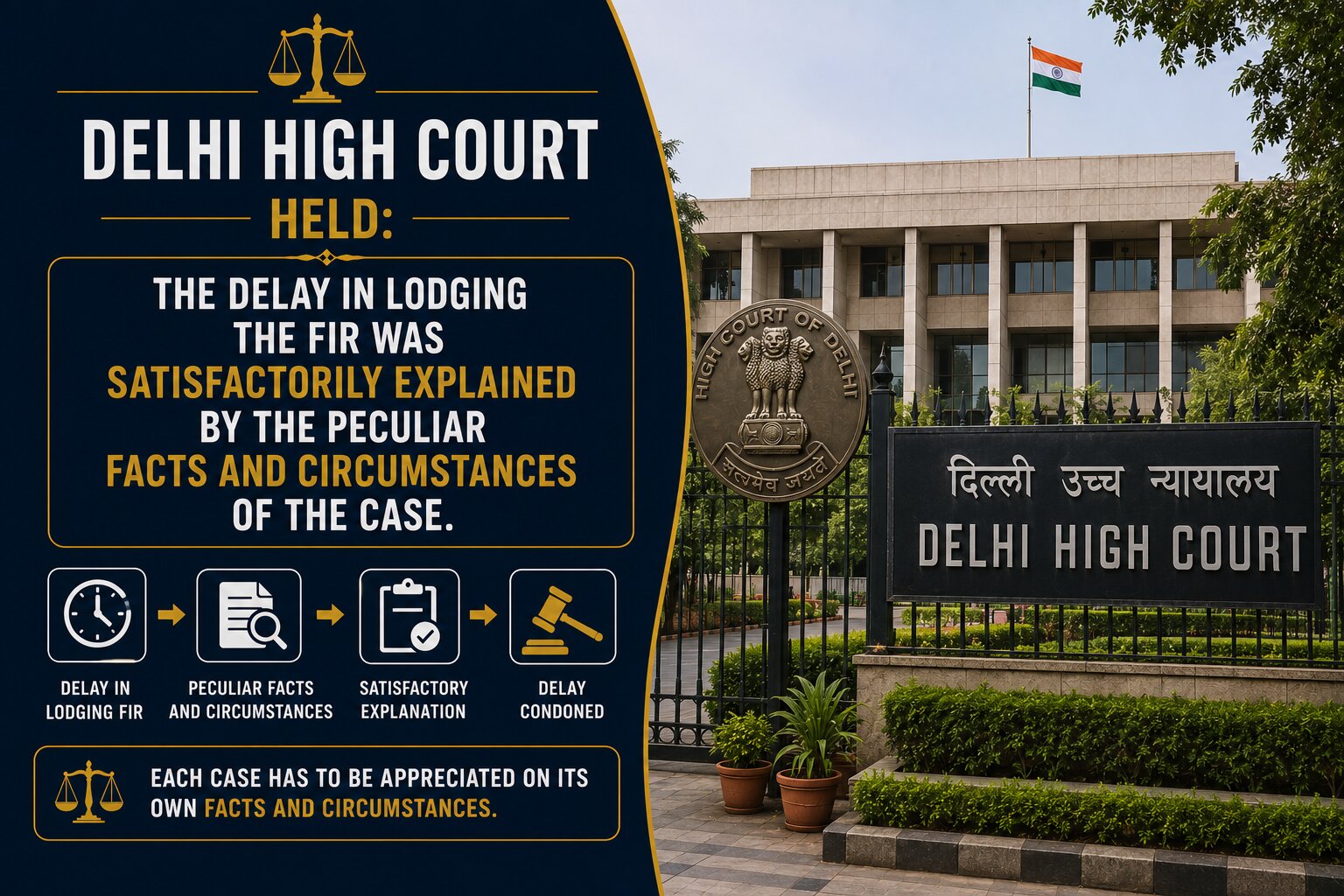
The High Court held that the delay in lodging the FIR was satisfactorily explained by the peculiar facts and circumstances of the case.
-
The Court observed that the victim's family initially refrained from approaching the police because the offence had been committed by a temple priest, they wished to avoid social stigma, and they believed the appellant's assurance that he would permanently leave the temple.
-
The Court held that the delay had not prejudiced the appellant and, if at all, had weakened the prosecution by reducing the availability of stronger medical and forensic evidence.
-
The Court noted that although forensic evidence was inconclusive, the medical examination revealed a healed hymenal tear consistent with the prosecution's timeline.
-
The Court found the prosecutrix's testimony to be truthful, reliable, and of sterling quality, sufficient to sustain the conviction.
-
The Court observed that persons with mild intellectual disability are generally simple, gullible, and less capable of fabricating complex allegations, thereby lending credibility to the victim's testimony.
-
The Court rejected the argument that the offence could not have occurred inside a temple during daytime, observing that temple premises are ordinarily deserted during afternoon hours and that the victim's account was consistent with the physical layout of the premises.
-
The Court further held that minor inconsistencies in the testimony of a witness with intellectual disability cannot be treated as fatal to the prosecution case.
-
Condemning the appellant's conduct, the Court observed that his actions not only violated the victim's dignity but also desecrated the sanctity of the temple and betrayed the trust associated with the office of a priest.
-
Consequently, the High Court dismissed the appeal and affirmed the conviction.
Held
-
Delay in lodging the FIR was adequately explained and did not undermine the prosecution case.
-
The absence of conclusive forensic evidence was not fatal where credible ocular evidence existed.
-
The trustworthy testimony of the prosecutrix was sufficient to sustain the conviction.
-
Minor discrepancies in the evidence of a person with mild intellectual disability do not discredit otherwise reliable testimony.
-
The conviction of the appellant under Section 376 IPC was upheld, and the appeal was dismissed.
Analysis
- The Court adopted a sensitive approach while appreciating the testimony of a woman with mild intellectual disability, recognizing that such witnesses should not be disbelieved merely because of minor inconsistencies arising from their cognitive limitations.
-
The decision reinforces that delay in lodging an FIR in sexual offence cases is not necessarily fatal, particularly where social stigma, religious sensitivities, family honour, and emotional trauma reasonably explain the delay.
-
The Court emphasized that inconclusive forensic evidence does not automatically negate the prosecution case when other reliable evidence establishes guilt beyond reasonable doubt.
-
By condemning the abuse of religious authority, the judgment underscores that positions of spiritual trust impose greater moral responsibility and that exploitation under the guise of such authority constitutes a grave aggravating circumstance.
-
The ruling also highlights the judiciary's commitment to protecting the dignity, bodily integrity, and autonomy of vulnerable victims, including persons with intellectual disabilities.
-
Overall, the judgment strengthens victim-centric jurisprudence while balancing evidentiary principles with sensitivity toward the realities faced by survivors of sexual violence.