
Santosh Kumar v. State of U.P. & 2 Others, 2026
A woman whose first marriage was subsisting when she entered into a subsequent relationship cannot claim the status of a legally wedded wife under Section 125 CrPC.
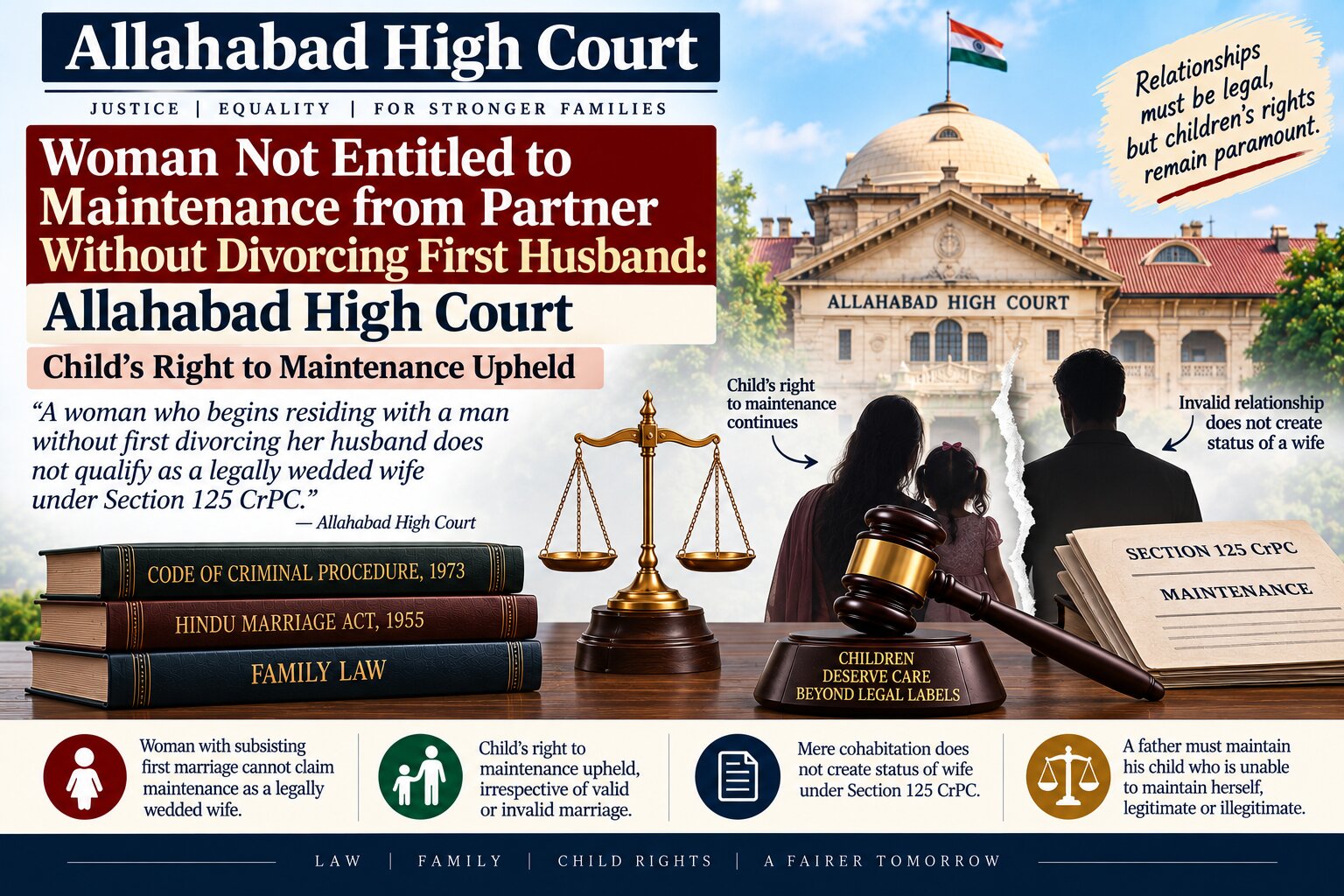
Judgement Details
Court
Allahabad High Court
Date of Decision
11 August 2026
Judges
Justice Achal Sachdev
Citation
Acts / Provisions
Facts of the Case
-
The Family Court, Chitrakoot directed the revisionist to pay ₹2,000 per month to the woman and ₹1,000 per month to their minor daughter until she attained majority.
-
The woman claimed that she had married the revisionist in 2006 and thereafter lived with him as his wife.
-
She alleged that the revisionist subsequently subjected her and their daughter to physical harassment and stopped providing maintenance.
-
During cross-examination, she admitted that she had previously married another man and had two children from that marriage.
-
She also admitted that she had started living with the revisionist while her first husband was alive.
-
She further admitted that her marriage with the revisionist had not been solemnised according to Hindu rites and rituals.
-
The revisionist challenged the maintenance order before the Allahabad High Court.
-
A DNA report established that the revisionist was the biological father of the minor daughter.
Issues
-
Whether a woman who enters into a relationship with another man without obtaining divorce from her first husband can claim maintenance as a legally wedded wife under Section 125 CrPC?
-
Whether a woman whose subsequent marriage is legally invalid is entitled to maintenance under Section 125 CrPC?
-
Whether a minor child is entitled to maintenance from her biological father despite the invalidity of the parents' relationship?
-
Whether the Family Court was justified in granting maintenance to both the woman and the minor daughter?
Judgement
-
The High Court partly allowed the criminal revision.
-
The Court set aside the maintenance awarded to the woman.
-
It held that the woman did not qualify as the “legally wedded wife” of the revisionist.
-
The Court noted that her first marriage was subsisting when she began living with the revisionist.
-
The subsequent relationship therefore could not confer upon her the status of a legally wedded wife.
-
However, the Court upheld the maintenance awarded to the minor daughter.
-
The DNA evidence established the biological relationship between the revisionist and the child.
-
The Court emphasized that a father is responsible for maintaining his child who is unable to maintain herself, irrespective of whether the child is born from a valid or invalid marital relationship.
-
Accordingly, the woman's maintenance was set aside, while the daughter's maintenance was maintained.
Held
-
Mere cohabitation and representation as husband and wife do not establish a valid marriage where the statutory requirements of marriage are absent.
-
The woman was therefore not entitled to maintenance in the capacity of a wife under Section 125 CrPC.
-
The invalidity of the parents' relationship does not affect the child's right to maintenance.
-
A biological father has a legal obligation to maintain his minor child who is unable to maintain herself.
-
The daughter's maintenance was therefore upheld.
-
The revision was partly allowed.
Analysis
-
The judgment makes an important distinction between the maintenance claim of a woman and the independent maintenance rights of a child.
-
For claiming maintenance as a wife under Section 125 CrPC, the woman must establish the requisite legal marital relationship.
-
In the present case, the woman's first marriage was still subsisting when she began living with the revisionist.
-
Her own admissions during cross-examination also showed that the subsequent relationship had not been solemnised according to the required Hindu rites and rituals.
-
The Court therefore refused to recognize her as the revisionist's legally wedded wife for the purpose of Section 125 CrPC.
-
The decision demonstrates that long-term cohabitation alone cannot automatically create the legal status of a wife where the underlying marriage is legally invalid.
-
However, the Court treated the child's position differently. The daughter's right to maintenance was not made dependent upon the validity of her parents' marriage.
-
The DNA evidence established the revisionist's biological relationship with the child, thereby supporting the child's claim for maintenance.
-
Section 125(1)(b) CrPC specifically protects children who are unable to maintain themselves, including children whose parents' marital relationship may not have been legally valid.
-
This approach prevents a child from suffering financially because of circumstances relating to the parents' relationship.
-
The judgment therefore separates marital status from parental responsibility.
-
While the woman could not establish entitlement as a legally wedded wife, the father could not escape his obligation towards his minor daughter.
-
The ruling also highlights the importance of admissions made during cross-examination, particularly where those admissions directly affect the validity of a claimed marriage.
-
At the same time, the Court did not disturb the child's maintenance merely because the mother's claim failed.
-
The decision reflects the protective purpose of Section 125 CrPC, particularly in ensuring that minor children are not left without financial support.
-
The key legal principle is that failure to establish a valid marriage may defeat a woman's claim as a wife, but it does not defeat a minor child's independent right to maintenance from her biological father.