
Santosh Kumar v. Sangeeta Rani, 2026
Res judicata-like principles do not operate with the same rigidity against interlocutory procedural orders as they do against final adjudications.
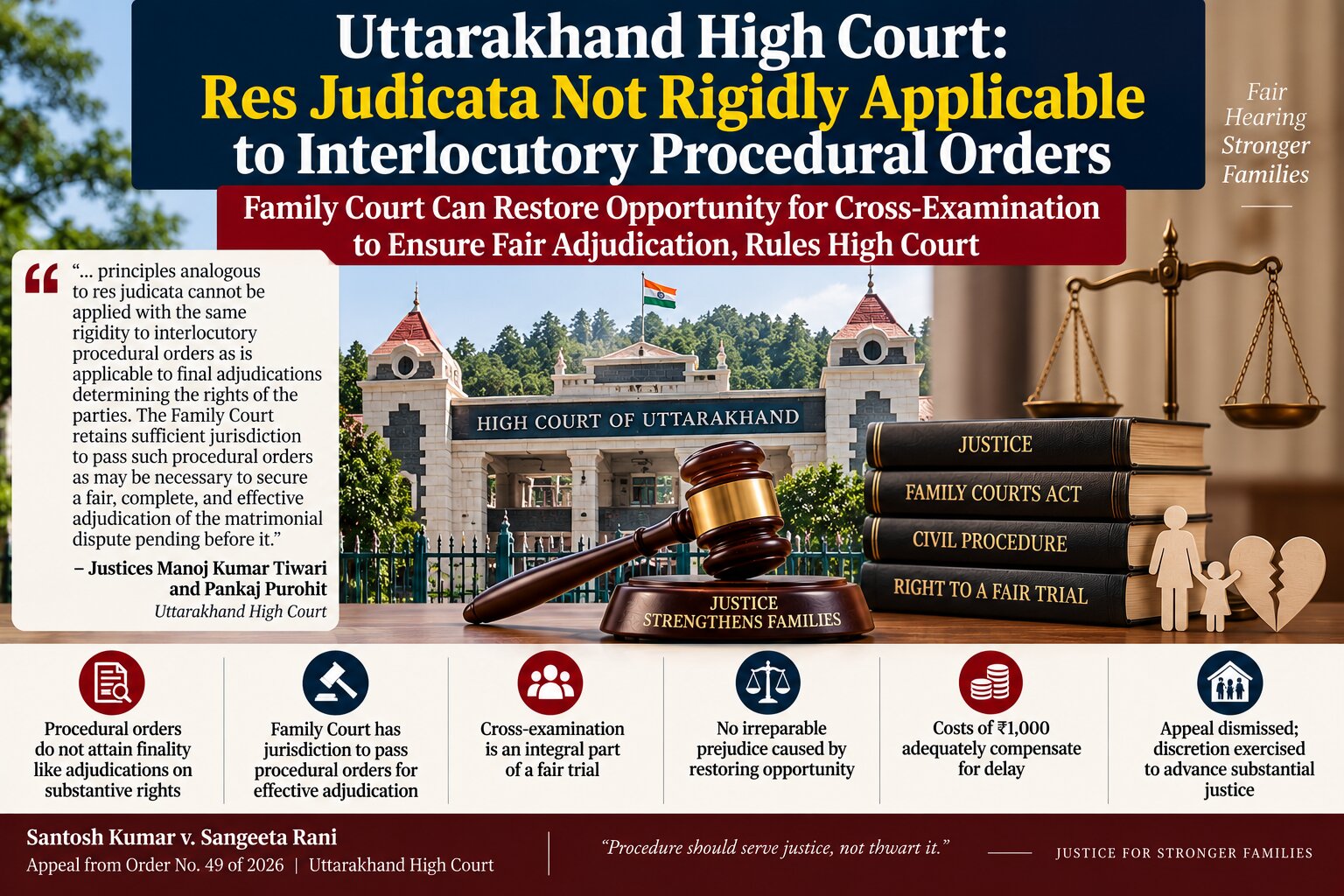
Judgement Details
Court
High Court of Uttarakhand
Date of Decision
4 September 2026
Judges
Justice Manoj Kumar Tiwari and Justice Pankaj Purohit
Citation
Acts / Provisions
Facts of the Case
1. Court Name
2. Date of Decision
Not specified in the case material provided
3. Legal Provisions Involved
-
— principles concerning procedural orders and fair adjudication.
-
Principles analogous to res judicata — considered in relation to interlocutory procedural orders.
-
Principles of natural justice and fair hearing — particularly the right to effectively test evidence through cross-examination.
-
Family Courts Act, 1984 — framework governing adjudication of matrimonial disputes by Family Courts.
4. Case Title
Case: Appeal from Order No. 49 of 2026
5. Brief Facts
-
The parties were involved in a pending matrimonial dispute before the Family Court.
-
During the divorce proceedings, the wife's opportunity to cross-examine the opposing side's evidence was closed on 6 August 2024.
-
The opportunity was closed after the wife failed to avail herself of several opportunities granted by the Family Court.
-
The wife subsequently moved an application seeking restoration of her opportunity for cross-examination.
-
The Family Court rejected that application on 27 August 2024.
-
The matrimonial proceedings thereafter continued and eventually reached the stage of final hearing.
-
The wife later filed another application seeking restoration of her opportunity to cross-examine.
-
The Family Court allowed the subsequent application and restored the opportunity, subject to payment of ₹1,000 as costs.
-
The husband challenged the Family Court's order before the Uttarakhand High Court.
-
The husband contended that the wife's earlier application for restoration had already been rejected and therefore the Family Court should not have entertained another application seeking substantially the same relief.
-
The High Court considered whether principles analogous to res judicata prevented the Family Court from restoring the opportunity for cross-examination.
-
The Court examined the nature of the impugned order and found it to be procedural and discretionary, rather than an adjudication finally determining the substantive rights of the parties.
-
The Court emphasised that cross-examination is an important component of a fair trial because it enables a party to test the evidence led by the opposite side.
-
The High Court concluded that the Family Court retained jurisdiction to pass procedural orders necessary for a fair and effective determination of the matrimonial dispute.
-
The Court found that granting another opportunity would not cause any irreversible or irreparable prejudice to the husband.
-
The inconvenience caused by the additional opportunity and possible delay was considered adequately addressed through the imposition of costs.
-
The High Court therefore dismissed the husband's appeal.
Issues
-
Whether principles analogous to res judicata can be applied with the same rigidity to interlocutory procedural orders as they are applied to final adjudications determining substantive rights?
-
Whether a Family Court has jurisdiction to restore an opportunity for cross-examination after an earlier application seeking such restoration had been rejected?
-
Whether restoration of an opportunity for cross-examination is permissible where such restoration is necessary to ensure a fair and effective adjudication of the matrimonial dispute?
-
Whether granting an additional opportunity for cross-examination caused any irreversible or irreparable prejudice to the husband?
-
Whether the Family Court properly exercised its discretionary jurisdiction by restoring the wife's opportunity subject to payment of costs?
Judgement
-
The Uttarakhand High Court dismissed the husband's appeal and upheld the Family Court's order.
-
The Court held that the impugned order was essentially procedural and discretionary in nature.
-
It did not finally determine any substantive right of either party.
-
The Court held that principles analogous to res judicata cannot be applied with the same rigidity to interlocutory procedural orders as they are applied to final adjudications.
-
The Family Court retains sufficient jurisdiction to pass procedural orders necessary for a fair, complete and effective adjudication of a matrimonial dispute.
-
The Court recognised cross-examination as an integral component of a fair trial.
-
An effective opportunity to test the evidence of the opposite party is an important element of a just adjudicatory process.
-
The Court acknowledged that the husband's objection based on the earlier rejection of the wife's application had some force and deserved consideration.
-
However, the Court held that this procedural history did not prevent the Family Court from subsequently restoring the opportunity when necessary to advance substantial justice.
-
The Court found that granting the additional opportunity would not cause the husband any irreversible or irreparable prejudice.
-
The inconvenience caused by delay was adequately addressed through the imposition of ₹1,000 costs.
-
The Court concluded that refusing the opportunity could potentially result in an unfair hearing and adversely affect adjudication on the merits.
-
The Family Court had therefore properly exercised its discretion in favour of substantial justice and effective adjudication.
Held
-
A Family Court retains jurisdiction to modify or restore procedural opportunities when necessary for a fair and complete adjudication.
-
Cross-examination is an essential component of a fair trial.
-
A party should ordinarily have an effective opportunity to test the evidence led by the opposing party.
-
An earlier rejection of an application for restoration does not necessarily prevent a Family Court from subsequently restoring the procedural opportunity where circumstances warrant it.
-
Procedural discretion may be exercised to advance substantial justice.
-
Where restoration of cross-examination causes no irreversible prejudice, appropriate costs can compensate for inconvenience or delay.
-
The Family Court's discretion will be upheld where it is exercised to ensure a fair and effective determination of the matrimonial dispute.
Analysis
-
The principal significance of the judgment lies in its distinction between final adjudications and interlocutory procedural orders. The doctrine of res judicata is designed to prevent repeated litigation of matters that have already been conclusively determined, but procedural orders operate in a different context.
-
The High Court recognised that matrimonial proceedings frequently require procedural flexibility. A Family Court must retain sufficient control over its proceedings to ensure that the dispute is ultimately decided on the basis of a fair opportunity to both parties.
-
Cross-examination was central to the Court's reasoning. Evidence given by one party must ordinarily be capable of being tested by the opposing party, and denial of that opportunity can affect the reliability and fairness of the adjudicatory process.
-
The Court did not ignore the wife's earlier failure to utilise the opportunities granted by the Family Court. Instead, it considered whether restoring the opportunity at a later stage would cause substantial prejudice to the husband.
-
The Court found that any inconvenience resulting from delay could be addressed through costs, whereas permanently denying cross-examination could have more serious consequences for the fairness of the proceedings.
-
The judgment therefore reflects a distinction between procedural inconvenience and prejudice affecting the fairness of adjudication.
-
The Court's approach also recognises that procedural rules are intended to facilitate adjudication rather than become an obstacle to determining the dispute on its merits.
-
The decision does not mean that parties can repeatedly seek reopening of procedural stages as a matter of right. The Family Court's power remains discretionary and must be exercised to advance fair and effective adjudication.
-
The circumstances of each case remain relevant, including the reason for the earlier default, the stage of proceedings, the nature of the evidence and the prejudice likely to be caused to the opposite party.
-
The imposition of ₹1,000 costs demonstrates the Court's attempt to balance the wife's need for an effective opportunity with the husband's interest in avoiding unnecessary delay.
-
The judgment consequently reinforces the principle that procedural finality is not absolute where a procedural order can be revisited to prevent an unfair adjudication.
-
In matrimonial litigation, where the ultimate objective is determination of the parties' substantive rights after a fair hearing, Family Courts retain procedural flexibility to correct or modify interlocutory orders when circumstances justify doing so.