
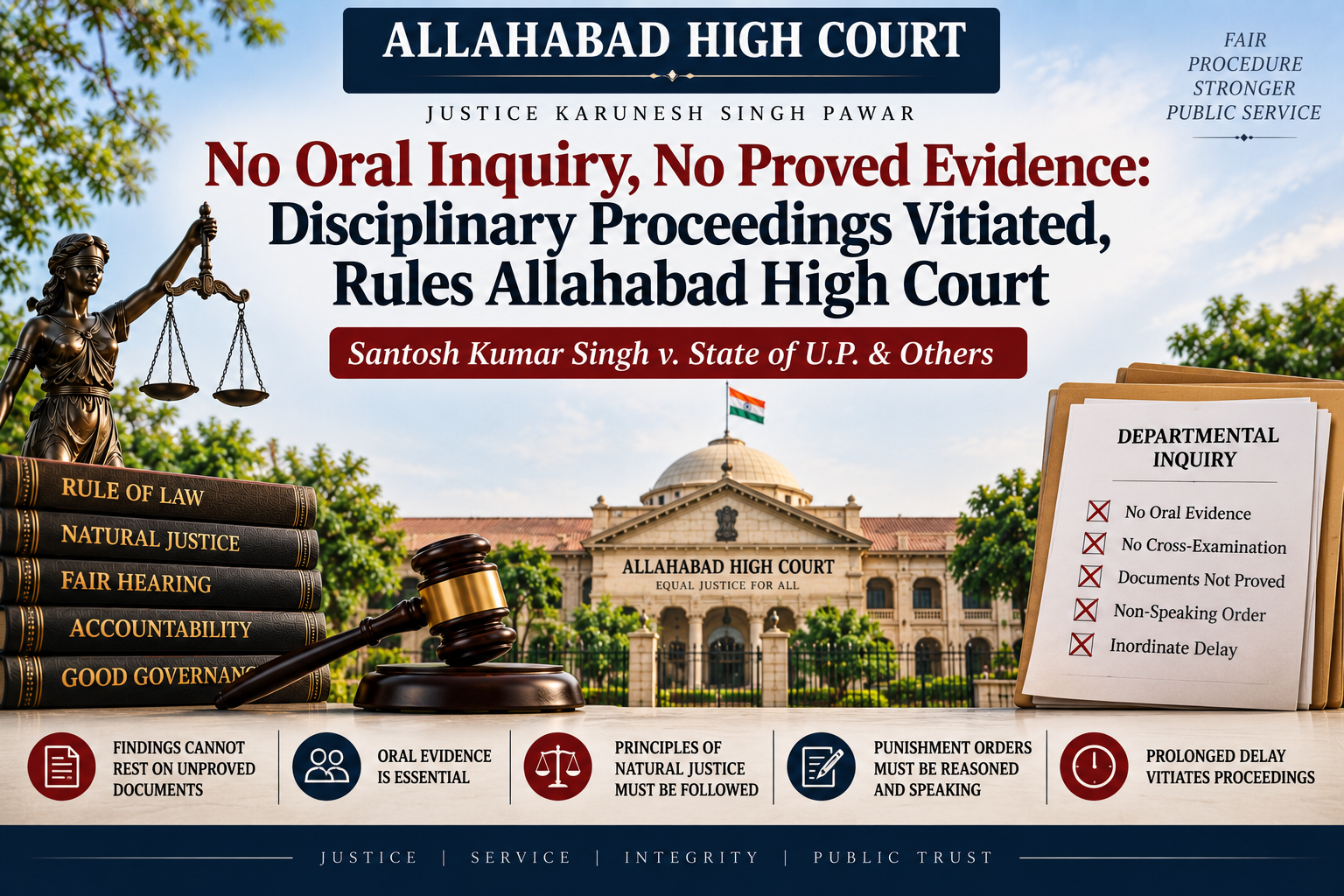
Santosh Kumar Singh v. State of U.P. through Addl. Chief Secy./Prin. Secy., Appointment and Personnel Department, Lucknow & Others, 2026
Oral evidence is essential in disciplinary proceedings where the employee disputes the charges.
Judgement Details
Court
Allahabad High Court
Date of Decision
11 August 2026
Judges
Justice Karunesh Singh Pawar
Citation
Acts / Provisions
Facts of the Case
-
The petitioner, who was posted as Sub-Divisional Magistrate, Mohanlalganj, Lucknow, faced disciplinary proceedings concerning alleged irregularities in allotment of a housing site in Village Bhasanda.
-
Proceedings were initiated under Rule 7 of the Uttar Pradesh Government Servant (Discipline and Appeal) Rules, 1999.
-
A charge-sheet containing two charges was served upon the petitioner in May 2019.
-
The Inquiry Officer ultimately found one charge proved in November 2020.
-
No oral inquiry was conducted and no witness was examined by the department to prove the documents relied upon against the petitioner.
-
The State Government subsequently imposed the punishment of permanent withholding of one annual increment along with censure on 10 September 2025.
-
The petitioner's representation against the punishment was rejected on 9 December 2025.
-
The petitioner challenged both orders before the Allahabad High Court.
-
The Board of Revenue had also opined that the petitioner had exercised due vigilance, had taken corrective action after discovering the irregularities and had acted without mala fide intention.
Issues
-
Whether disciplinary proceedings under Rule 7 can be sustained when no oral inquiry is conducted and no departmental witness is examined to prove the documents relied upon against the employee?
-
Whether documentary evidence relied upon in a departmental inquiry can form the basis of a finding of guilt when such documents have not been proved through oral evidence?
-
Whether failure to provide an effective opportunity of cross-examination and defence violates the principles of natural justice?
-
Whether a non-speaking punishment order that fails to consider the employee's specific defence and relevant material can be sustained in law?
-
Whether an inordinate and unexplained delay in concluding disciplinary proceedings can render the punishment order unsustainable?
Judgement
-
The High Court allowed the writ petition and quashed the punishment order dated 10 September 2025.
-
The consequential order dated 9 December 2025 rejecting the petitioner's representation was also quashed.
-
The Court held that where the charged employee denies the allegations, Rule 7 requires the department to lead oral evidence through the witnesses relied upon in the charge-sheet.
-
Documents relied upon by the department cannot simply be treated as proved merely because they are attached to the charge-sheet.
-
The petitioner was deprived of the opportunity to cross-examine departmental witnesses, as no witnesses were examined.
-
The Court relied upon the Supreme Court judgments in State of U.P. v. Saroj Kumar Sinha and Satyendra Singh v. State of Uttar Pradesh.
-
The Court held that even an ex parte inquiry requires the department to produce evidence supporting the charges.
-
The punishment order was also found to be cryptic and non-speaking, as it failed to properly deal with the petitioner's defence.
-
The disciplinary authority failed to consider the Board of Revenue's opinion, which was relevant to determining the petitioner's culpability.
-
The Court also criticised the prolonged delay between the petitioner's representation against the inquiry report and the final punishment.
-
All consequential service benefits, including restoration of the withheld increment, refixation of pay and monetary benefits, were directed to be restored within three months.
Held
-
Documentary material relied upon by the department must be proved through appropriate evidence before it can be used to establish guilt.
-
An Inquiry Officer cannot base a finding of guilt solely upon unproved documents.
-
Even in an ex parte inquiry, the department must establish the charges through evidence.
-
Denial of the opportunity to cross-examine witnesses constitutes a violation of natural justice.
-
The disciplinary authority must independently consider the employee's defence and relevant material before imposing punishment.
-
A punishment order exercising quasi-judicial powers must contain reasons and cannot merely reproduce the charge-sheet and inquiry report.
-
Relevant material such as the Board of Revenue's favourable opinion cannot be ignored without proper consideration.
-
Unexplained and prolonged delay in disciplinary proceedings can cause serious prejudice to a government servant.
-
Since the inquiry violated Rule 7 and the principles of natural justice, the entire disciplinary proceedings and consequential punishment were legally unsustainable.
Analysis
-
The judgment strongly reinforces the distinction between mere documentary material and legally established evidence in departmental proceedings.
-
The Court made it clear that placing documents on record is not enough; the department must establish the relevance and authenticity of its case through the procedure prescribed by Rule 7.
-
The requirement of oral evidence becomes particularly important because it gives the charged employee a meaningful opportunity to test the department's case through cross-examination.
-
The ruling protects government employees against findings of guilt based on an unverified documentary record that has never been tested through evidence.
-
The Court's reliance on State of U.P. v. Saroj Kumar Sinha and Satyendra Singh confirms that the principles governing departmental inquiries require the department to establish its allegations even where the employee does not effectively participate in the inquiry.
-
The judgment also highlights that disciplinary authorities exercise quasi-judicial functions and therefore cannot mechanically approve an Inquiry Officer's findings.
-
A disciplinary authority must consider the employee's specific defence and explain why that defence is accepted or rejected.
-
The failure to consider the Board of Revenue's opinion was particularly significant because that material directly addressed whether the petitioner had acted negligently or with mala fide intention.
-
The Court's observation regarding delay is important because disciplinary proceedings should not leave an employee under a continuous cloud of uncertainty for years without adequate justification.
-
The judgment therefore establishes three important safeguards: proper proof of departmental charges, meaningful consideration of the employee's defence, and reasoned decision-making by the disciplinary authority.
-
Overall, the decision strengthens natural justice, procedural fairness and accountability in government disciplinary proceedings.